

AI Summary
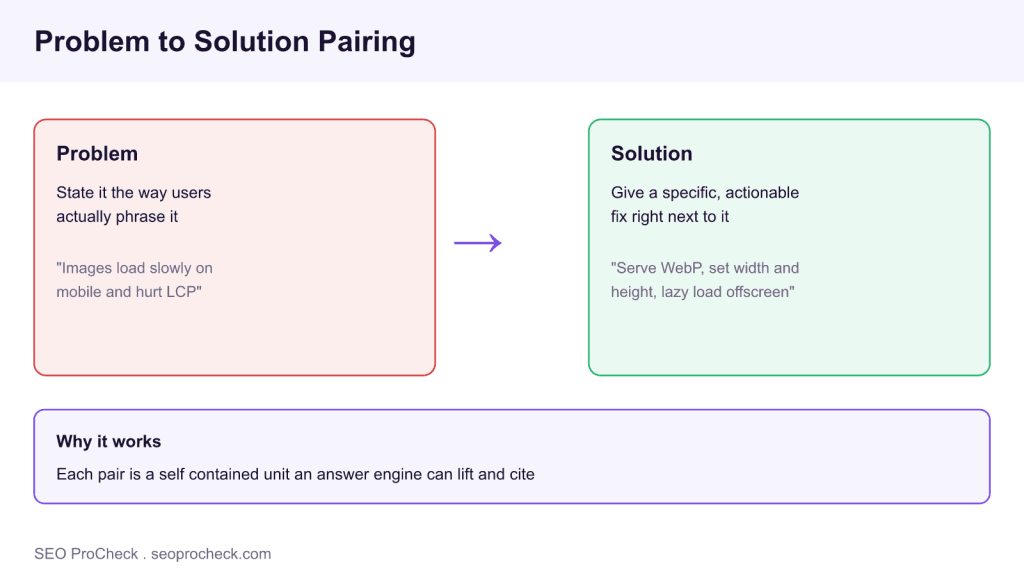
Problem solution content pairing means stating a specific user problem and placing its concrete solution directly beside it, rather than scattering symptoms and fixes across a page. This format matches how people search and gives AI answer engines a self contained, extractable unit they can retrieve and cite for how to fix queries.
- Name the problem in the words users type, then give the fix in the very next sentence or block.
- Keep each pair self contained so it can be quoted without surrounding context.
- Use a question or problem heading followed by a direct answer, which suits featured snippets and AI Overviews.
- Element code CO-014: a content GEO check that flags pages where problems and solutions are not clearly paired.
What problem solution pairing is
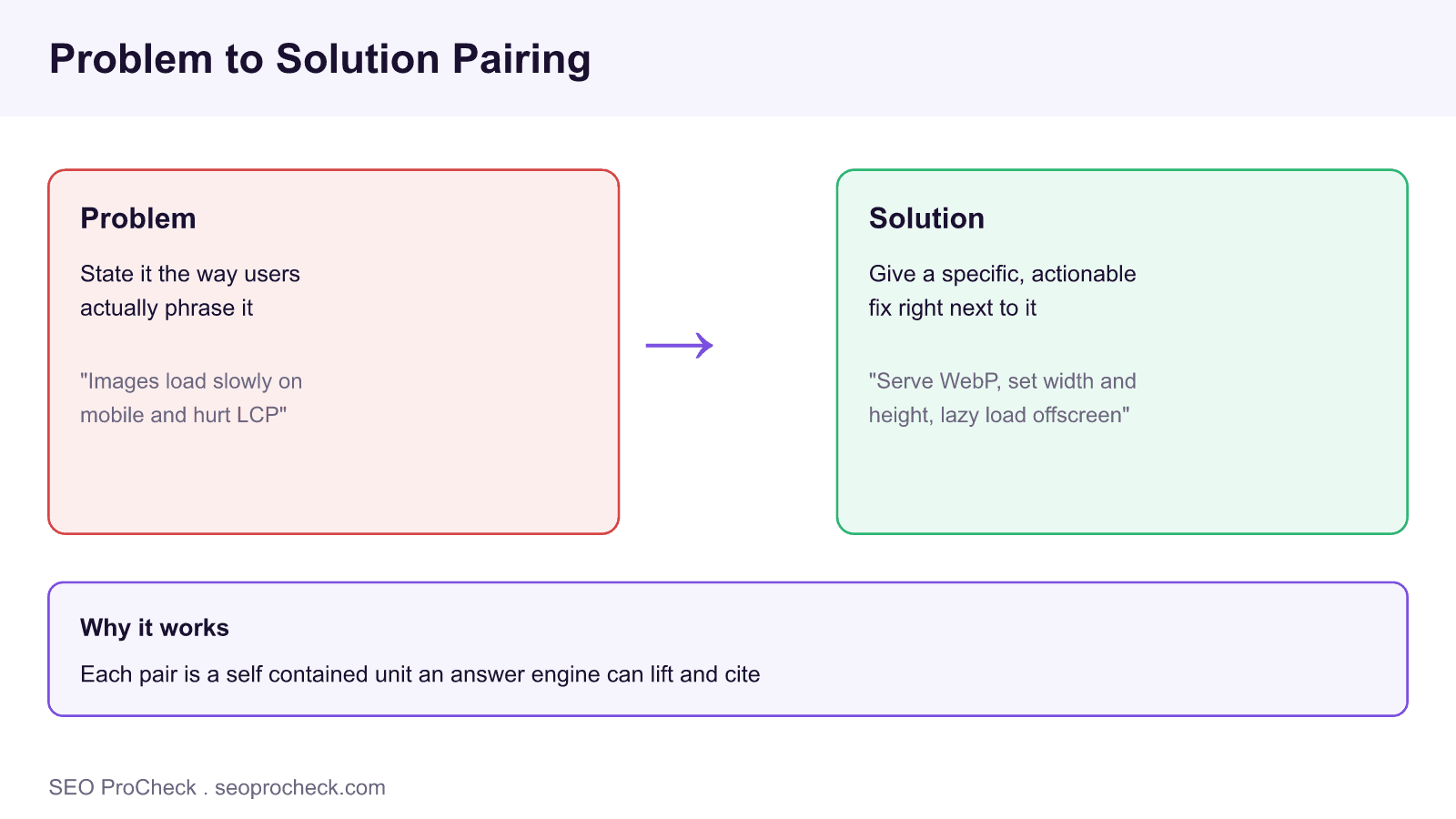
Problem solution content pairing is a structural pattern where each problem you raise is immediately answered with a specific fix, placed right next to the problem rather than paragraphs or sections away. It is the difference between a page that lists five symptoms in one section and five remedies in another, and a page where each symptom is followed at once by its remedy. The second structure mirrors how people actually search, because most informational and commercial queries are problems phrased as questions: why is this happening, how do I fix this, what should I do about that.
Inside the SEO ProCheck framework this is check CO-014 in the content GEO group. It flags pages where the content does not clearly pair problems with solutions, because that weak structure makes the page hard to retrieve for solution intent queries and hard for an answer engine to extract a clean response from.
Why this matters for your website
Two audiences reward the pattern. Human readers who arrive with a specific problem want the fix fast, and a tightly paired structure lets them scan a heading, confirm it matches their situation, and read the answer without hunting. Search and answer engines reward it because a self contained problem plus solution block is exactly what they lift for featured snippets, People Also Ask, and AI Overviews. When a model assembles an answer, it prefers passages that fully resolve a question in a small, quotable span. Scattered content forces the model to stitch fragments together, which it does less often and less confidently, so your page is less likely to be the cited source.
The generative engine optimization angle is concrete. Answer engines retrieve passages, not whole pages. A passage that reads problem then solution is a complete retrieval unit. A passage that only states a problem, with the solution three headings down, is an incomplete unit that competes poorly against a rival page that pairs them cleanly.
How to fix a page that fails this check
Work in three moves. First, state the problem in the reader's own language. Use the phrasing your audience types, drawn from People Also Ask, Search Console query data, and support tickets, and put it in a heading or a bold lead sentence. Second, give the solution immediately, in the next sentence or the adjacent block, and make it specific and actionable rather than a vague reassurance. Third, make the pairing visually obvious with a consistent template: a question style heading, a one or two sentence direct answer, then supporting detail. Repeat that unit for each problem so the whole page becomes a series of clean pairs.
A worked example. Weak: a heading that reads Performance, followed by three paragraphs mixing causes and advice. Strong: a heading that reads Why do my images load slowly on mobile, followed immediately by a direct answer that says serve modern formats such as WebP, set explicit width and height, and lazy load anything below the fold, then a short paragraph of detail. The strong version can be lifted whole into a snippet.
How to detect the issue
Detection is a content format audit rather than a technical crawl. Read the page as a searcher with one problem and ask whether the fix is adjacent or scattered. Check whether headings pose the problem or merely label a topic. Scan for orphan problems, places where you raise an issue but never pair it with a resolution, and for orphan solutions offered with no stated problem. A page that passes reads as a sequence of matched pairs, each of which could stand alone as an answer.
AI search and GEO considerations
Problem solution content is among the most citable structures for how to fix and why is this happening queries, which dominate AI answer traffic. Pair the format with a short direct answer at the top of each unit, natural language phrasing, and, where relevant, FAQ structured data so the pairs are both human readable and machine parseable. This makes each unit a candidate for extraction across Google AI Overviews, Perplexity, and chat assistants.
Weak structure versus paired structure
| Aspect | Scattered content | Paired content (passes CO-014) |
|---|---|---|
| Heading style | Topic label, for example Performance | Problem or question, for example Why do images load slowly |
| Fix location | Sections away from the problem | Immediately after the problem |
| Retrieval unit | Incomplete, needs stitching | Self contained and quotable |
| Snippet eligibility | Low | High |
| Reader effort | Must hunt for the answer | Answer is adjacent |
Frequently Asked Questions
What is problem solution content pairing?
It is a structure where each problem you raise is answered immediately with a specific fix placed right beside it. This matches how users search and gives answer engines a self contained unit to extract, rather than forcing them to stitch a problem and its solution from different sections.
Why does pairing improve AI search visibility?
Answer engines retrieve passages, not whole pages. A passage that states a problem and its solution together is a complete, quotable unit, so it is more likely to be selected for AI Overviews, featured snippets, and chat answers than scattered content.
What is check CO-014?
CO-014 is the SEO ProCheck content GEO check for problem solution pairing. It flags pages where content does not clearly pair problems with solutions, which weakens retrieval for solution intent queries.
How do I structure a problem solution pair?
Use a question or problem heading in the words users search, give a direct actionable answer in the next sentence or block, then add supporting detail. Repeat that template so the page becomes a series of clean, matched pairs.
Where do I find the problems my audience actually asks?
Mine People Also Ask, Google Search Console query data, on site search logs, and customer support tickets. Phrase your headings in that real language rather than internal topic labels.
Is this the same as adding an FAQ section?
It overlaps but is broader. An FAQ is one way to pair problems and solutions, and adding FAQ schema helps. The principle applies to your whole body content, where every issue you raise should carry its fix nearby.
Related checks
Quick Reference
Element Code: CO-014
Issue: Content does not clearly pair problems with solutions
Impact: May not be retrieved for solution queries
Fix: Structure content with clear problem-solution format
Detection: Content format analysis
What Is This Issue?
Problem-solution format matches how many users search and is easily extractable.
Why This Matters for Your Website
Problem-solution format matches search patterns.
How to Fix This Issue
- State problems: Define the issue
- Provide solutions: Clear fixes
- Structure pairing: Obvious connection
Tools for Detection
- Content analysis: Check structure
AI Search and GEO Considerations
Problem-solution content is highly citable for "how to fix" queries.
TL;DR (The Simple Version)
Structure content with clear problem statements paired with specific solutions.
Claude Vincent is a technical SEO consultant focused on crawlability, rendering, and AI-search visibility. He writes the field guides and case studies at SEO ProCheck, with a bias toward the durable, unglamorous work that decides whether search engines and AI answer engines can actually read and cite a site.
About SEO ProCheck
Technical SEO consulting and GEO strategy with 20 years of enterprise experience. Case studies, resources, and tools for search and AI visibility.
Work With Me
Technical SEO audits, GEO strategy, site migrations, and international SEO. Hourly consulting for teams who need hands-on support, not just reports.
Subscribe to our newsletter!







Recent Posts
- Can AI Crawlers Actually Read Your Site? I Measured 400 of the Biggest September 5, 2026
- The Pre-Publish Quality Gate for AI-Assisted Content August 6, 2026
- AGENTS.md vs llms.txt vs llms-full.txt: Which Agent File Does What July 18, 2026