

Does appending the brand name and location at the end of the title tag have an impact on organic traffic?
- February 9, 2023
- Metadata
AI Summary
Appending your brand name and city to the end of a title tag is a common local and directory tactic, but it costs characters and can push the useful keywords out of view. A controlled split test is the way to learn whether that suffix earns clicks for your specific pages or simply crowds out the words that win the query.
- The suffix sits at the end, so it is the first thing Google truncates on a long title.
- Brand plus location can build trust on local queries and waste space on generic ones.
- Test on a template group, never a single page, so seasonality does not fake the result.
- If the suffix gets cut off in the SERP, it delivers no click benefit at all.
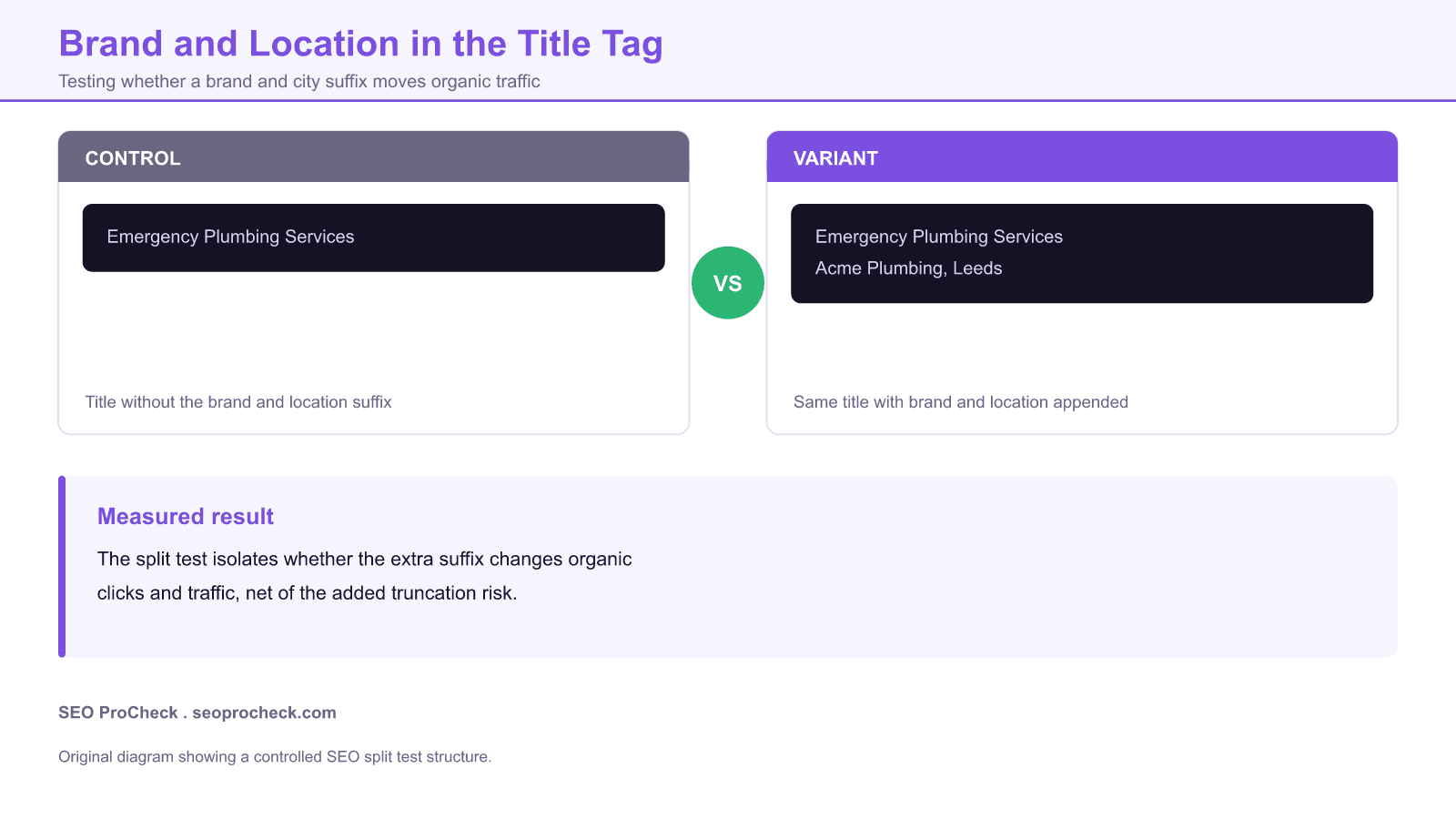
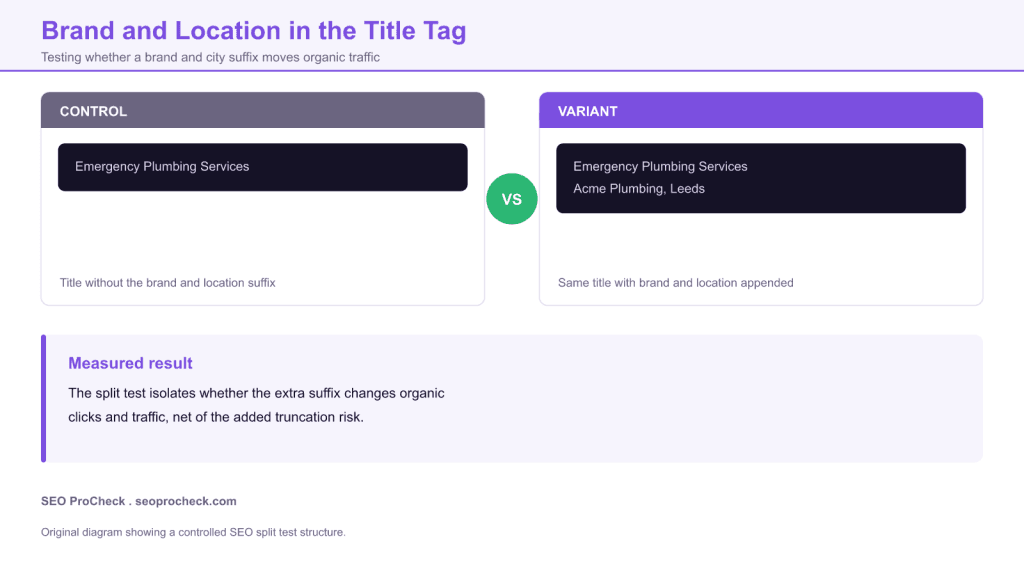
This page documents a title tag experiment that asked a narrow, testable question: does adding the brand name and location to the end of a title tag change organic traffic? Below the original summary we add a practitioner breakdown of when the suffix helps, when it hurts, and how to measure the effect on your own pages without guessing.
This SEO case study documents a successful optimization initiative, providing actionable insights for practitioners. The documented approach demonstrates how strategic SEO implementation drives measurable results.
Initial Situation
Understanding the starting point is essential context for evaluating any case study. This documentation covers the initial challenges, competitive position, and business objectives that shaped the SEO strategy.
Strategy and Approach
The strategic approach combined multiple SEO disciplines to address identified opportunities. Key decisions around prioritization and resource allocation provide a template for similar initiatives.
Implementation
Moving from strategy to execution required specific technical implementations, content development, and process changes. This case study documents the practical steps that translated strategy into action.
Results and Learnings
The outcomes demonstrate effectiveness through measurable improvements in rankings, traffic, and business metrics. Analysis of successes and challenges provides learning value for practitioners.
What the brand and location suffix test asks
Many sites end every title with a fixed pattern such as Brand Name, City or Service in City by Brand. The theory is that the extra words add trust and local relevance. The cost is that titles have a hard pixel budget of roughly 600 pixels on desktop, near 50 to 60 characters, and the suffix sits in the most expendable position. When the title runs long, the suffix is exactly what Google drops or rewrites. So the real question is not whether brand and location are nice to have, it is whether the words that survive truncation earn more clicks with the suffix than without it.
When the suffix helps and when it hurts
| Scenario | Likely effect of a brand and city suffix |
|---|---|
| Strong local brand, local intent query | Can lift clicks: users recognise the brand and the city confirms relevance. |
| Unknown brand, generic national query | Often neutral or negative: the suffix spends characters a keyword could use. |
| Already long title | Negative risk: the suffix is truncated, so it adds length without adding a visible benefit. |
| Directory or multi location site | City can disambiguate near duplicate titles across locations, which helps clarity. |
Truncation math: does the suffix even show?
Before you credit or blame a suffix, confirm it is visible. Take the rendered title, count to about 60 characters, and check whether the brand and city fall inside that window. If your core phrase is Emergency Plumbing Services in Leeds and you then append Acme Plumbing, Leeds, you have repeated the city and pushed the brand past the cut. A cleaner variant states the entity once. Use Search Console to compare impressions and clicks for the control and variant groups, because a suffix that never renders cannot move clicks, and a flat result there usually means truncation, not indifference.
How to run this test yourself
- Choose a template with many similar pages, for example every location landing page.
- Split the URLs into control and variant by hashing each URL so groups stay fixed.
- On the variant only, append the brand and location suffix through the template.
- Run the test two to six weeks and watch clicks, impressions, and average position.
- Model the two groups with a causal method such as CausalImpact before you decide.
- Keep the suffix only where it wins, and drop it where it truncates or tests flat.
This experiment is a close cousin of two others in our library: our note on shortening titles so Google rewrites them less and the broader title tag testing case study. Browse the full set under metadata case studies.
What has changed since this test
Google now rewrites a large share of titles, and a fixed brand and city suffix is a frequent trigger because it looks boilerplate across a template. If the engine keeps swapping your suffix for the H1, that is a signal to move the important words forward rather than defend the suffix. In the AI Overviews era a title that names the entity and the place plainly also helps machines attribute the page to the right business and location, so clarity beats keyword stacking. Retest any legacy suffix rule against current rewrite behaviour rather than assuming it still holds.
Case studies like this contribute to the SEO knowledge base, helping practitioners learn from documented real-world experiences.
Source: https://www.searchpilot.com/resources/case-studies/appending-brand-name-and-location-to-title-tag/
Frequently asked questions
Should I put my brand name at the end of the title tag?
Only where it earns its characters. For a strong local brand on a local query it can lift clicks, but on generic national queries it usually just displaces a keyword. Test it rather than applying a blanket rule.
Does adding a city to the title help local SEO?
It can help disambiguate near duplicate titles across locations and confirm relevance on local intent queries. It rarely helps on national queries and can waste space if the city is already in the core phrase.
Why is the suffix the first thing Google cuts?
Google truncates titles at roughly 600 pixels, near 50 to 60 characters, from the end. A brand and location suffix sits in that expendable tail, so on any long title it is the first content to disappear.
How do I know if my suffix is being truncated?
Check the rendered title in the results page or a SERP preview tool and count to about 60 characters. If the brand and city fall past that point they are being cut, so they cannot influence clicks.
Can appending brand and location hurt rankings?
It rarely hurts rankings directly, but a longer, more boilerplate title raises the chance Google rewrites it and can lower click through rate if it pushes the query words out of view.
Is a single page enough to test this?
No. A single URL has no control group, so seasonality and ranking drift contaminate the result. Split a group of similar template pages into control and variant and model the difference.
Take this with you
The assistant links open with a question about this page already written. Nothing is sent until you press enter.
Claude Vincent is a technical SEO consultant focused on crawlability, rendering, and AI-search visibility. He writes the field guides and case studies at SEO ProCheck, with a bias toward the durable, unglamorous work that decides whether search engines and AI answer engines can actually read and cite a site.
About SEO ProCheck
Technical SEO consulting and GEO strategy with 20 years of enterprise experience. Case studies, resources, and tools for search and AI visibility.
Work With Me
Technical SEO audits, GEO strategy, site migrations, and international SEO. Hourly consulting for teams who need hands-on support, not just reports.
Subscribe to our newsletter!








Recent Posts
- Most Top Sites Never Say Who They Are in Structured Data October 14, 2026
- Homepage Titles Are Mostly Too Short, Not Too Long October 8, 2026
- Who Actually Serves an llms.txt? 184 Top Sites Measured September 29, 2026