• Articles
    &Evergreen
    • Articles
      • Algorithm Updates
      • Analytics & Measurement
      • CMS and Platforms
      • Content Strategy
      • E-commerce SEO
      • General
      • Industry Guides
      • Keyword Research
      • Link Building
      • Local SEO
      • Mobile SEO
      • On-Page SEO
      • SEO Tools
    • Evergreen
      • AI and Search
        • AEO (Answer Engine Optimization)
        • AI Overviews and SGE
        • GEO (Generative Engine Optimization)
        • LLM Citation Optimization
      • Content SEO
        • Content Architecture
        • E-E-A-T Optimization
        • Internal Linking Strategy
      • Python and Automation
      • Technical SEO
        • Core Web Vitals and Performance
        • Crawlability and Indexation
        • International SEO and Hreflang
        • Log File Analysis
        • Schema and Structured Data
        • Site Architecture
        • Site Migrations
  • Case Studies
    & Researches
    • Case Studies
      • Content
      • Crawling and Indexing
      • Growth
      • International SEO
      • JavaScript SEO
      • Metadata
      • Migrations
      • Website Architecture
      • Web Performance
    • Research
      • AI Search
      • Cross-Industry
      • E-commerce
      • Enterprise
      • Local and Listings
      • Publisher
  • Free Tools
    & Resources
    • Free SEO Tools
      • Content Analysis
      • Developer Utilities
      • GEO & AI Visibility
      • Local SEO
      • Schema & Structured Data
      • Social & Meta
      • Technical SEO
    • Executive Briefings
      • What SEO Actually Is
      • Why SEO Takes Time
      • Technical vs Content SEO
      • What AI Search Changes
      • Is Your SEO Working?
      • Case Studies
      • Is It Worth It?
      • Hiring an Agency
      • SEO vs Paid
      • Resourcing SEO
    • Best Practices
      • Accessibility
      • AMP
      • Content & GEO
      • Duplicates
      • HTML Structure
      • hrefLang
      • Images
      • Indexation
      • Links
      • Mobile
      • On-Page SEO
      • Organic & Analytics
      • Performance
      • Redirections
      • Robots.txt
      • Security
      • Structured Data
      • Technical GEO
      • URLs
      • XML Sitemaps
    • FAQ
      • AI & Search FAQ
      • Technical SEO FAQ
      • Content SEO FAQ
      • Off-Page SEO FAQ
      • Local SEO FAQ
      • E-commerce SEO FAQ
      • Tools and Analytics FAQ
    • Glossary
      • Glossary | Algorithms
      • Glossary | Analytics
      • Glossary | Business
      • Glossary | Content SEO
      • Glossary | E-commerce
      • Glossary | Emerging
      • Glossary | GEO & AI SEO
      • Glossary | International SEO
      • Glossary | Link Building
      • Glossary | Local SEO
      • Glossary | Search Behavior
      • Glossary | Technical SEO
      • Glossary | Tools
  • Free Tools Hub
  • About
    Me
    • Consulting
      • Advanced SEO Audit
      • GEO & AI SEO
      • Performance & Indexation
      • Site Migrations
      • International SEO
    • Portfolio
    • Contact
    • Tools & Resources
    • Browser Extensions
  • Articles
    &Evergreen
    • Articles
      • Algorithm Updates
      • Analytics & Measurement
      • CMS and Platforms
      • Content Strategy
      • E-commerce SEO
      • General
      • Industry Guides
      • Keyword Research
      • Link Building
      • Local SEO
      • Mobile SEO
      • On-Page SEO
      • SEO Tools
    • Evergreen
      • AI and Search
        • AEO (Answer Engine Optimization)
        • AI Overviews and SGE
        • GEO (Generative Engine Optimization)
        • LLM Citation Optimization
      • Content SEO
        • Content Architecture
        • E-E-A-T Optimization
        • Internal Linking Strategy
      • Python and Automation
      • Technical SEO
        • Core Web Vitals and Performance
        • Crawlability and Indexation
        • International SEO and Hreflang
        • Log File Analysis
        • Schema and Structured Data
        • Site Architecture
        • Site Migrations
  • Case Studies
    & Researches
    • Case Studies
      • Content
      • Crawling and Indexing
      • Growth
      • International SEO
      • JavaScript SEO
      • Metadata
      • Migrations
      • Website Architecture
      • Web Performance
    • Research
      • AI Search
      • Cross-Industry
      • E-commerce
      • Enterprise
      • Local and Listings
      • Publisher
  • Free Tools
    & Resources
    • Free SEO Tools
      • Content Analysis
      • Developer Utilities
      • GEO & AI Visibility
      • Local SEO
      • Schema & Structured Data
      • Social & Meta
      • Technical SEO
    • Executive Briefings
      • What SEO Actually Is
      • Why SEO Takes Time
      • Technical vs Content SEO
      • What AI Search Changes
      • Is Your SEO Working?
      • Case Studies
      • Is It Worth It?
      • Hiring an Agency
      • SEO vs Paid
      • Resourcing SEO
    • Best Practices
      • Accessibility
      • AMP
      • Content & GEO
      • Duplicates
      • HTML Structure
      • hrefLang
      • Images
      • Indexation
      • Links
      • Mobile
      • On-Page SEO
      • Organic & Analytics
      • Performance
      • Redirections
      • Robots.txt
      • Security
      • Structured Data
      • Technical GEO
      • URLs
      • XML Sitemaps
    • FAQ
      • AI & Search FAQ
      • Technical SEO FAQ
      • Content SEO FAQ
      • Off-Page SEO FAQ
      • Local SEO FAQ
      • E-commerce SEO FAQ
      • Tools and Analytics FAQ
    • Glossary
      • Glossary | Algorithms
      • Glossary | Analytics
      • Glossary | Business
      • Glossary | Content SEO
      • Glossary | E-commerce
      • Glossary | Emerging
      • Glossary | GEO & AI SEO
      • Glossary | International SEO
      • Glossary | Link Building
      • Glossary | Local SEO
      • Glossary | Search Behavior
      • Glossary | Technical SEO
      • Glossary | Tools
  • Free Tools Hub
  • About
    Me
    • Consulting
      • Advanced SEO Audit
      • GEO & AI SEO
      • Performance & Indexation
      • Site Migrations
      • International SEO
    • Portfolio
    • Contact
    • Tools & Resources
    • Browser Extensions
consulting services
Home / Metadata / Does shortening title tags enable Google to rewrite them better?

Does shortening title tags enable Google to rewrite them better?

  • November 16, 2022
  • Metadata
No Comments
Does shortening title tags enable google to rewrite them better?

AI Summary

When a title tag runs long or repeats itself, Google is more likely to replace it with a machine generated title built from your H1 and other signals. This test asks whether trimming the title, for example removing a redundant word, keeps more of the words you actually wrote in the search result and whether that lifts organic clicks.

  • Long or repetitive titles are prime candidates for a Google rewrite.
  • Shorter titles are more likely to render as written, so you keep control of the message.
  • Removing a redundant word can preserve the query keyword that earns the click.
  • Measure rewrite rate and clicks together, since a title that shows may still test flat.
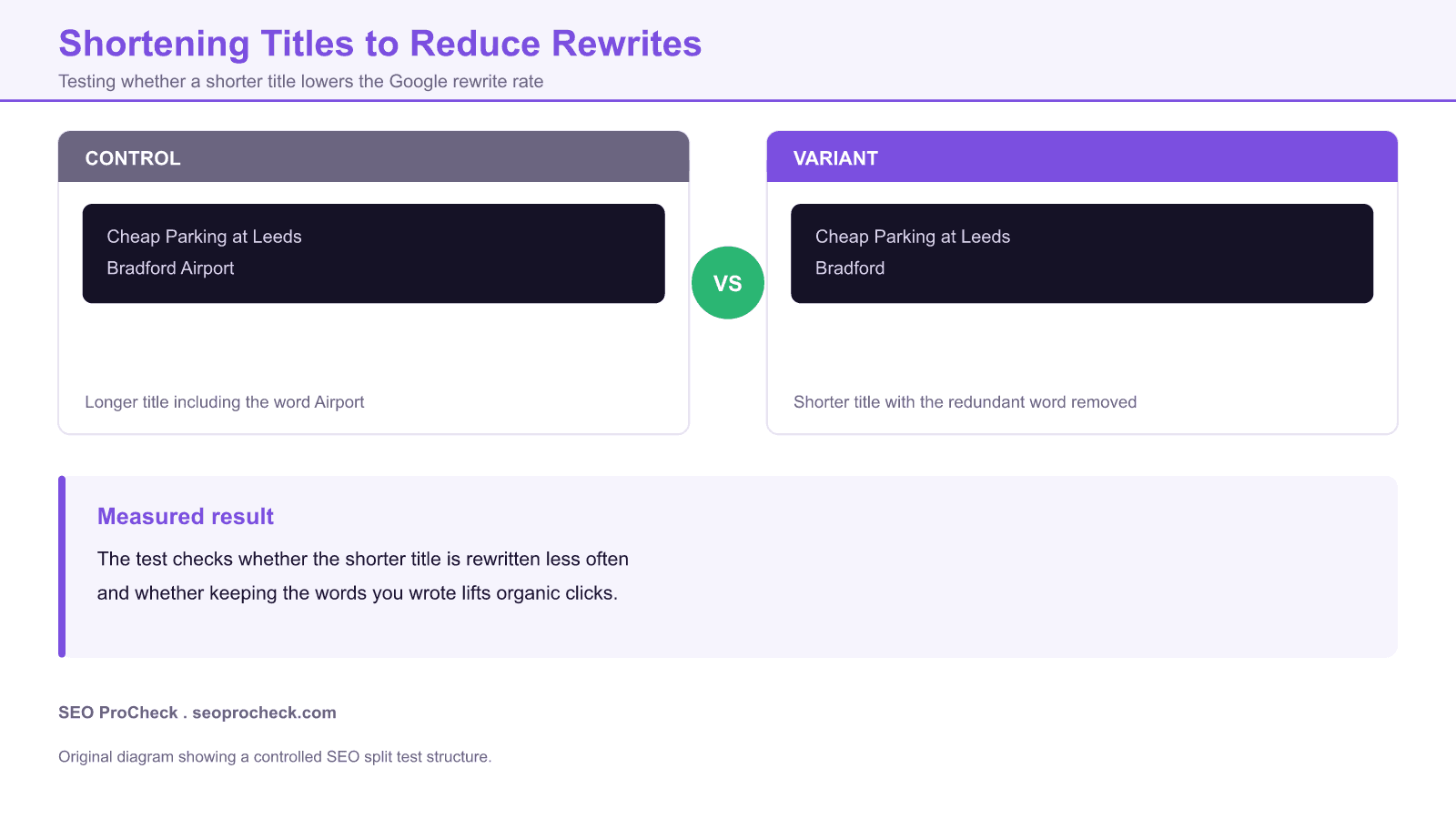
Diagram of a title tag split test comparing a longer title containing a redundant word against a shorter title, testing whether shortening reduces google rewrites.
A split test compares a longer title against a shortened version to test whether a shorter title is rewritten less often by Google.

This page records a title tag experiment focused on length: does shortening a title tag help Google keep it, and does keeping your wording improve organic performance? Below the original summary we add a practical guide to why Google rewrites titles, how to spot pages at risk, and how to measure whether a shorter title actually wins.

This SEO case study documents a successful optimization initiative, providing actionable insights for practitioners. The documented approach demonstrates how strategic SEO implementation drives measurable results.

Initial Situation

Understanding the starting point is essential context for evaluating any case study. This documentation covers the initial challenges, competitive position, and business objectives that shaped the SEO strategy.

Strategy and Approach

The strategic approach combined multiple SEO disciplines to address identified opportunities. Key decisions around prioritization and resource allocation provide a template for similar initiatives.

Implementation

Moving from strategy to execution required specific technical implementations, content development, and process changes. This case study documents the practical steps that translated strategy into action.

Results and Learnings

The outcomes demonstrate effectiveness through measurable improvements in rankings, traffic, and business metrics. Analysis of successes and challenges provides learning value for practitioners.

Why Google rewrites long titles

Since the August 2021 title generation update, Google builds the displayed title from whichever signal it judges most useful. Long titles, titles that repeat a word, and titles padded with boilerplate are among the most common triggers for a rewrite, because the engine reads them as low quality or truncated. When it rewrites, it often reaches for your H1 or the anchor text pointing at the page. The result is that the careful keyword you placed in the title may never appear in the result. Shortening the title reduces the surface area Google wants to fix, so more of your wording survives.

Title length and the rewrite risk band

Title lengthApprox pixelsRewrite risk
Under 50 charactersunder 500Low: usually rendered as written.
50 to 60 characters500 to 600Medium: near the desktop cutoff, watch for truncation.
Over 60 charactersover 600High: frequently truncated and rewritten.
Repeats a word or brandvariesHigh: repetition is a common rewrite trigger regardless of length.

How to find titles Google is overriding

You do not have to guess which pages get rewritten. Compare the title you set with the title that shows in the results page. Run a site query or use a rank tracker that captures the displayed title, then diff it against your source. Search Console does not report the displayed title directly, but a sharp gap between impressions and clicks on a page whose title reads well in your template is often a rewrite tell. Once you have a list of overridden pages, shortening and aligning the title with the H1 is the first fix to test.

Running the shortening test

  1. Identify a template where titles run long or repeat a word such as a location or category name.
  2. Split the URLs into control and variant by hashing each URL for stable groups.
  3. On the variant, trim the redundant word or shorten the pattern through the template only.
  4. Track the rewrite rate and clicks for two to six weeks after deployment.
  5. Model the click difference with a causal method before you call a winner.
  6. Roll the shorter pattern out where it both reduces rewrites and holds or grows clicks.

For related experiments, see our notes on appending brand and location to titles and the broader title tag testing case study, both in our metadata case studies.

What has changed since this test

Google's title rewriting has grown steadier and more predictable, so the practical advice has hardened: write a concise title that matches the H1, state the entity once, and lead with the query words. In the AI Overviews era the same discipline pays off, because a short, literal title is easier for a model to attribute and quote than a padded one. If a page keeps getting rewritten even after you shorten the title, treat the H1 as the real title and fix that, since Google is telling you which signal it trusts.

Case studies like this contribute to the SEO knowledge base, helping practitioners learn from documented real-world experiences.

Source: https://www.searchpilot.com/resources/case-studies/removing-airport-from-page-titles/

Frequently asked questions

Does shortening a title tag stop Google rewriting it?

Not always, but it reduces the odds. Long and repetitive titles are common rewrite triggers, so trimming them and aligning the title with the H1 keeps more of your wording in the result.

What title length triggers a Google rewrite?

Risk rises past roughly 60 characters or 600 pixels, where titles get truncated. Repetition of a word or brand can trigger a rewrite at any length.

How do I know if Google rewrote my title?

Compare the title in your source with the title shown in the results page using a site query or a rank tracker that captures the displayed title. A visible difference confirms a rewrite.

Should the title tag match the H1?

Close alignment helps. When the title and H1 disagree, Google often prefers the H1, so matching them reduces rewrites and keeps your intended message in the SERP.

Will a shorter title always get more clicks?

No. Shorter titles are more likely to render as written, but clicks depend on whether the words that remain match intent. Test the change rather than assuming shorter is better.

Can I test this on one page?

Not reliably. One URL lacks a control group, so seasonality and ranking movement distort the reading. Split a group of similar template pages and model the difference instead.

  • Claude Vincent

Claude Vincent is a technical SEO consultant focused on crawlability, rendering, and AI-search visibility. He writes the field guides and case studies at SEO ProCheck, with a bias toward the durable, unglamorous work that decides whether search engines and AI answer engines can actually read and cite a site.

  • Title Tags, Travel

About SEO ProCheck

Technical SEO consulting and GEO strategy with 20 years of enterprise experience. Case studies, resources, and tools for search and AI visibility.

Learn more about me

Work With Me

Technical SEO audits, GEO strategy, site migrations, and international SEO. Hourly consulting for teams who need hands-on support, not just reports.

Contact now

Subscribe to our newsletter!

More from our blog


Diagram of the agent-readable file stack showing AGENTS.md in the code repository read by coding agents, llms.txt and llms-full.txt at the website root read by answer engines, and robots.txt plus RSL as the access and licensing layer beneath both.

AGENTS.md vs llms.txt vs llms-full.txt: Which Agent File Does What

AGENTS.md, llms.txt and llms-full.txt look alike but serve different readers. What each…
Continue reading

Profound vs Semrush and Ahrefs: What an AI-Search Tool Actually Replaces (and What It Doesn't)

Profound vs Semrush and Ahrefs don't measure the same thing. A practitioner's…
Continue reading
SEO is the foundation everything is built on; AEO (be the answer) and GEO (get cited) are what it makes possible

SEO vs AEO vs GEO: What Each One Means and How They Actually Differ

SEO, AEO, and GEO are three different jobs: rank in search results,…
Continue reading
Google May 2026 Core Update: What We Learned After the Dust Settled

Google May 2026 Core Update: What We Learned After the Dust Settled

The May 2026 Core Update rolled out from May 21 to June…
Continue reading
Pogosticking: The Click Pattern That Quietly Decides Who Ranks

Pogosticking: The Click Pattern That Quietly Decides Who Ranks

Pogosticking is when a searcher clicks your result, bounces back to Google,…
Continue reading
Interaction to Next Paint (INP): The Complete Guide

Interaction to Next Paint (INP): The Complete Guide

Interaction to Next Paint (INP) is the Core Web Vital that replaced…
Continue reading
SSR vs CSR: Why Rendering Decides Whether AI Can Read Your Site

SSR vs CSR: Why Rendering Decides Whether AI Can Read Your Site

AI crawlers mostly don't run JavaScript, so client-side rendering hides your content…
Continue reading
Which AI Bots Are You Actually Blocking? (GPTBot, ClaudeBot, Perplexity & More)

Which AI Bots Are You Actually Blocking? (GPTBot, ClaudeBot, Perplexity & More)

Blocking 'AI bots' isn't one switch. A field guide to GPTBot, OAI-SearchBot,…
Continue reading
Prev. Post
Next Post

Recent Posts

  • AGENTS.md vs llms.txt vs llms-full.txt: Which Agent File Does What July 18, 2026
  • Profound vs Semrush and Ahrefs: What an AI-Search Tool Actually Replaces (and What It Doesn't) June 19, 2026
  • SEO vs AEO vs GEO: What Each One Means and How They Actually Differ June 15, 2026

All Website Tags

AI SEO Analytics B2B Batch Check Content Analysis Content Quality Content Strategy Core Web Vitals Crawl Budget Crawling DOM Parsing E-commerce E-E-A-T Enterprise FAQ GEO Googlebot Google Search Console High Priority Hreflang HTTP Requests Indexing Internal Linking International SEO JavaScript SEO Keyword Research Link Building Live Check Local SEO Low Priority Medium Priority Multiple APIs On-Page SEO Page Speed PageSpeed API Rich Results SaaS Schema Validation SEO Tools SERP Features Site Architecture Site Migrations Structured Data Technical SEO Title Tags

Technical SEO consulting and GEO strategy for teams who need real implementation support. 20 years of enterprise experience across major media, technology, recruitment, and ecommerce brands, and a major enterprise brand. Case studies, research, and resources for search and AI visibility.

SEO Geek since 2004. © All Rights Reserved.

Sitemap for Humans  |  Privacy Policy   |  Terms of Service