

AI Summary
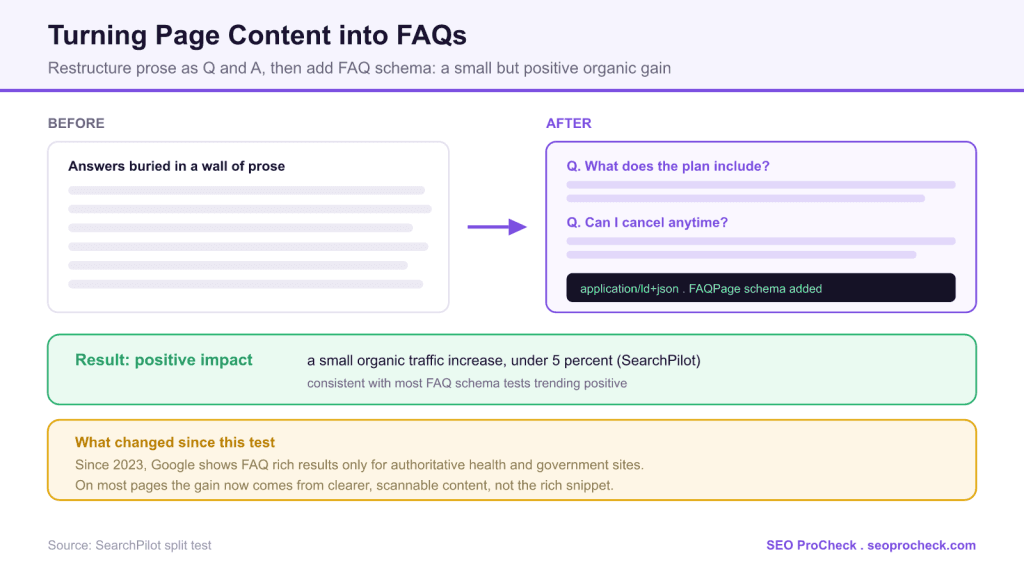
Yes, restructuring existing page content into a clear question and answer format, and adding FAQ schema, tested positive for organic traffic, though the gain was modest, under 5 percent. SearchPilot has noted that a majority of its FAQ tests came back positive, but a 2023 change to how Google shows FAQ rich results has shifted where the benefit now comes from.
- The lift came from clearer, more scannable content that matches how people phrase questions.
- Google limited FAQ rich results to authoritative health and government sites in 2023, then stopped showing them for every site on May 7, 2026.
- For most sites the win is now content clarity and answer extraction, not a visible rich snippet.
- Do not fabricate questions: reformat genuine on-page answers, and keep the schema matched to visible text.

Turning a page's existing prose into an explicit question and answer format is one of the lowest-risk content changes you can test. You are not adding claims or rewriting the substance; you are reorganizing answers that already exist so they map to the questions people actually type. This case study asked whether that reformatting, paired with FAQ schema, moves organic traffic, and the answer is a qualified yes.
Initial Situation
FAQ schema has a long track record in split testing. SearchPilot has run the test repeatedly across different industries and reported that a majority of its FAQ schema tests produced a positive impact, with recent tests continuing that trend. The page in this study carried useful information buried inside conventional paragraphs, the sort of content where the answer a searcher wants is present but hard to spot at a glance.
Strategy and Approach
The change was to take the content already on the page and recast it as discrete questions with concise answers, then mark it up with FAQPage structured data. It was validated with a full-funnel SEO A/B test that splits comparable pages into control and variant groups, so the effect of the format change is isolated rather than confounded by seasonality or unrelated ranking movement.
Implementation
Reformatting is the real work; the schema just describes what is visible. Break the prose into the actual questions users ask, answer each in two to four sentences, and keep the visible copy and the markup identical. A minimal FAQ block plus its schema looks like this:
{
  "@context": "https://schema.org",
  "@type": "FAQPage",
  "mainEntity": [{
    "@type": "Question",
    "name": "Is standard shipping free?",
    "acceptedAnswer": {"@type": "Answer",
      "text": "Yes, standard shipping is free on orders over $40."}
  }]
}
The one rule Google enforces: the answer in the schema must match the answer shown on the page. Marking up content that a user cannot see is a structured data violation and can trigger a manual action.
What the FAQ format actually buys you
The value is not one thing. Some benefits survived the 2023 rich-results change and some did not.
| Benefit | How it helps | Status in 2026 |
|---|---|---|
| Scannable answers | Users find the answer faster, lowering pogo-sticking | Still fully in effect |
| Question matching | Headings mirror long-tail question queries | Still fully in effect |
| Answer extraction | Clean Q and A is easy for AI Overviews and assistants to lift | More valuable now |
| FAQ rich result | Expandable Q and A shown under your listing | Gone for most sites since 2023, retired for all sites on May 7, 2026 |
| People Also Ask | Well-formed answers can surface in related questions | Still possible, not guaranteed |
Results and Learnings
SearchPilot reported that the change had a positive impact on organic traffic, but a modest one, an increase under 5 percent. That fits the broader pattern: FAQ changes tend to help, but the size of the win varies and is usually incremental rather than transformative. The reformatting works because it aligns the page with how people phrase queries and makes the answer easy to find, for humans and for machines. It is the same structural logic behind winning other SERP features, as in our note on using iterative tests to win rich table snippets: clean structure is what engines reward.
What has changed since this test
This is the part that changes how you should read the result today. In 2023, Google restricted FAQ rich results to well-known, authoritative government and health websites. On May 7, 2026 Google retired them for every site, so the expandable FAQ that used to appear under your listing is gone, and with it the extra SERP real estate and click-through that once came from the feature. So if your only reason for adding FAQs was the rich snippet, that reason has expired. The reasons that remain are still real: clearer content that matches question queries, answers that AI Overviews and assistants can extract cleanly, and a better on-page experience. Add FAQs for clarity and extraction, not for a rich result you will not get.
Common mistakes
- Inventing questions nobody asks. Padding a page with filler FAQs to trigger schema adds clutter, not value, and can look manipulative.
- Schema that does not match the page. Marking up answers a user cannot see violates Google's guidelines and risks a manual action.
- Expecting the old FAQ rich result. No site gets it since May 7, 2026; plan around content and extraction benefits instead.
- Duplicating the same FAQ block sitewide. Identical FAQs stamped on every page dilute relevance and help no one.
FAQ
It can. SearchPilot reported a positive but modest result, an organic increase under 5 percent, from reformatting content as questions and answers with FAQ schema. The gain comes from clearer content that matches how people search, not from ranking magic.
No. Google limited FAQ rich results to well-known, authoritative government and health websites in 2023, and on May 7, 2026 it stopped showing them for every site. No page gets the expandable FAQ under its listing anymore, so plan around content and extraction benefits.
Yes, for the right reasons. It documents your questions and answers in a machine-readable way that helps AI Overviews and assistants extract accurate answers, even though it no longer produces a visible Google rich result. The schema must match the visible text on the page.
Answer the real question directly in two to four sentences, in plain language, using the words people actually search. Reformat genuine on-page information rather than inventing questions, and keep each answer self-contained so it reads well out of context.
Only if you misuse it. Marking up content that is not visible on the page, or stuffing pages with fake questions, violates Google's structured data guidelines and can trigger a manual action. Used honestly, it is low risk.
Indirectly. A clean question and answer structure is easy for AI systems to parse and cite, so it improves your odds of being the extracted source. It is not a guarantee, but well-formed answers are consistently easier for machines to lift accurately.
Source: https://www.searchpilot.com/resources/case-studies/turn-page-content-into-faqs-and-add-schema/
Not sure FAQ schema is still earning its keep on your pages?
After the 2023 rich-results change, some FAQ markup helps and some just adds clutter. An audit shows where structured content still moves the needle.
Take this with you
The assistant links open with a question about this page already written. Nothing is sent until you press enter.
Claude Vincent is a technical SEO consultant focused on crawlability, rendering, and AI-search visibility. He writes the field guides and case studies at SEO ProCheck, with a bias toward the durable, unglamorous work that decides whether search engines and AI answer engines can actually read and cite a site.
About SEO ProCheck
Technical SEO consulting and GEO strategy with 20 years of enterprise experience. Case studies, resources, and tools for search and AI visibility.
Work With Me
Technical SEO audits, GEO strategy, site migrations, and international SEO. Hourly consulting for teams who need hands-on support, not just reports.
Subscribe to our newsletter!








Recent Posts
- Most Top Sites Never Say Who They Are in Structured Data October 14, 2026
- Homepage Titles Are Mostly Too Short, Not Too Long October 8, 2026
- Who Actually Serves an llms.txt? 184 Top Sites Measured September 29, 2026