

AI Summary
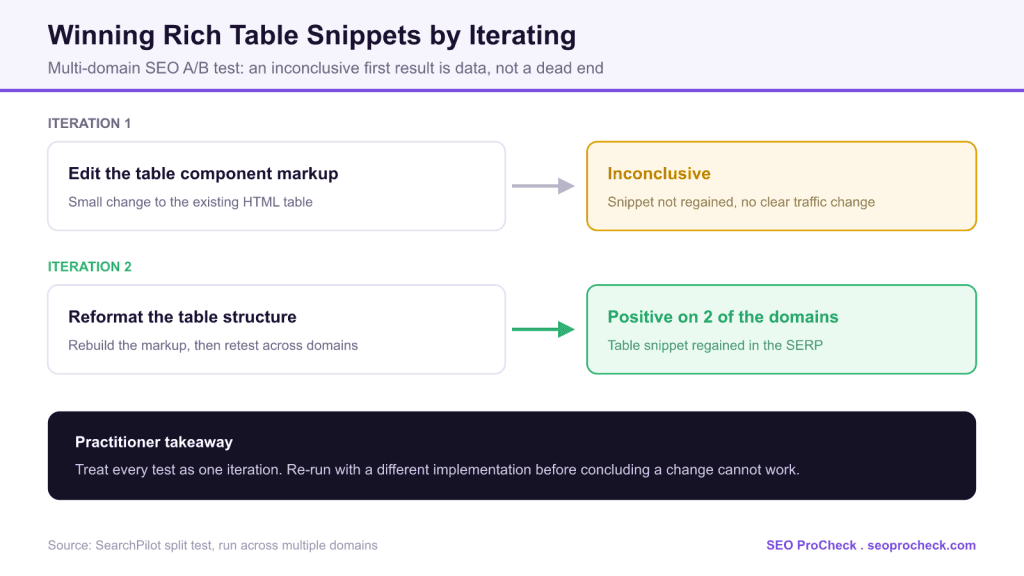
Iterative SEO testing means treating one inconclusive result as a data point, not a verdict. A customer trying to reclaim a rich table snippet it had previously owned ran two iterations: the first, a light edit to the table markup, was inconclusive and did not win the snippet back, and the second, a full reformat of the table structure, was positive on two of the domains tested and regained the snippet in the SERP.
- The first attempt failing does not mean the idea is wrong: the implementation may be.
- Low-traffic pages have limited statistical power, so a real effect can hide below the detection threshold.
- Rich table snippets reward clean, semantic HTML tables with clear headers and concise cells.
- Run the same hypothesis with a different implementation before you abandon it.
Most SEO changes are treated as one-shot bets: ship it, read the result, move on. Iterative testing flips that. You form a hypothesis, run a controlled test, read the outcome, and if it is inconclusive you change the implementation and test again rather than concluding the idea cannot work. This case study is a clean example of that discipline applied to a specific goal: winning back a rich table snippet in Google search results.
Initial Situation
A rich table snippet is the SERP feature where Google lifts a structured HTML table from a page and renders it directly in the results, often as a comparison or specification grid. The customer in this SearchPilot study had previously earned that snippet and then lost it, which is common when a table is restyled, moved into a JavaScript component, or reformatted in a way Google no longer parses cleanly. The test was run across multiple domains, which matters: it let the team see whether one fix generalized or was site specific.
Strategy and Approach
The plan was explicitly iterative. If an implementation won back the snippet, it would be rolled out across the other markets; if a result was negative, it would be dropped. Each iteration was validated with a full-funnel SEO A/B test, splitting comparable pages into control and variant groups so the effect of the markup change could be isolated from seasonality and ranking noise. The value of the split test here is not just the traffic number: it is the ability to say, at a stated confidence level, whether a change did nothing or whether the test simply could not detect a small effect.
Implementation
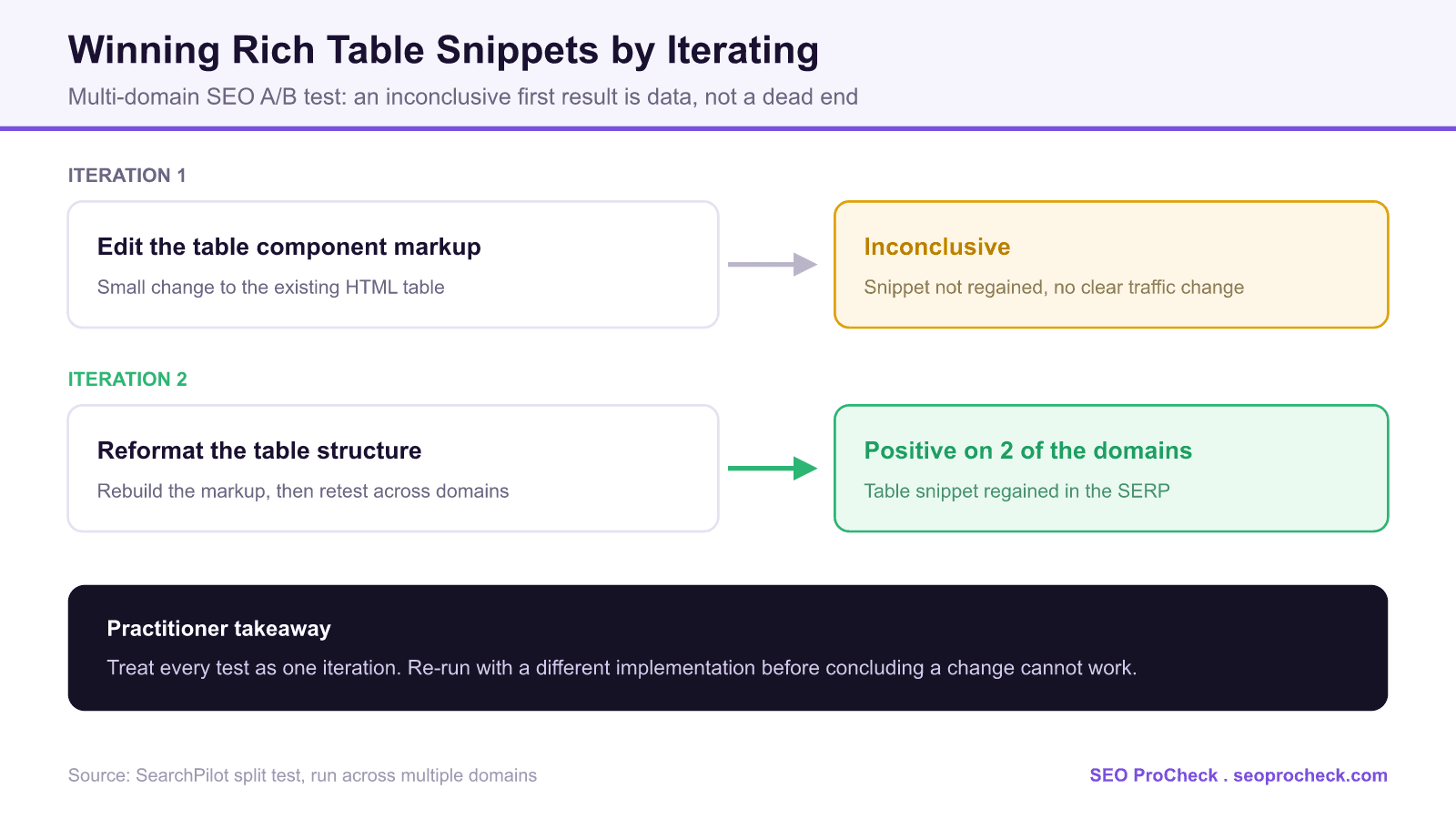
The first iteration was a light touch: editing the existing table component markup. That did not win the snippet back and was inconclusive for organic traffic. The second iteration went further and reformatted the table structure itself, rebuilding the markup rather than tweaking it. Reclaiming a table snippet generally means giving Google a genuinely clean, semantic table:
<table>
  <thead><tr><th>Plan</th><th>Price</th><th>Storage</th></tr></thead>
  <tbody>
    <tr><td>Starter</td><td>$9</td><td>50 GB</td></tr>
    <tr><td>Pro</td><td>$19</td><td>500 GB</td></tr>
  </tbody>
</table>
Real headers in a thead, one concept per column, concise cells, and no layout tables or div-based fake grids. If the data is painted in by JavaScript after load, render it server-side so it is present in the initial HTML the crawler sees.
What earns a rich table snippet
Google chooses tables it can parse confidently. The checklist below reflects what reliably helps versus what keeps a table out of the feature.
| Table element | Do this | Avoid this |
|---|---|---|
| Structure | Semantic table with thead and tbody | Div or CSS grid dressed up as a table |
| Headers | One clear th per column | Merged or missing header cells |
| Cells | Short, single-value cells | Paragraphs and mixed data in one cell |
| Rendering | Server-rendered in the initial HTML | Table injected by JavaScript after load |
| Context | A descriptive heading and intro above the table | A bare table with no surrounding context |
Results and Learnings
The first iteration was inconclusive for organic traffic and failed to regain the snippet. The second iteration, the full reformat, was positive on two of the domains tested and won the table snippet back. SearchPilot also flagged an important statistical nuance: the first test ran on a lower traffic domain, and at the 95 percent confidence level their tools would not have been able to detect a small uplift even if one existed. In other words, inconclusive is not the same as no effect. On low-traffic pages you often lack the sample size to prove a modest win, which is exactly why iterating and testing on higher-traffic templates matters. Structured data thinking connects here too: our companion note on turning page content into FAQs and adding schema shows the same theme of formatting content so engines can lift it into a SERP feature.
How to run iterative tests without fooling yourself
- Write the hypothesis down first. "Reformatting the table to clean semantic markup will regain the table snippet and lift organic traffic." A written hypothesis stops you from moving the goalposts after the fact.
- Change one thing per iteration. If you rebuild markup, adjust headers, and change styling at once, a win tells you nothing about which lever worked.
- Respect statistical power. On low-traffic pages, an inconclusive read may mean the test was underpowered, not that the change was inert. Consider testing on a higher-traffic template.
- Roll out only proven wins. Deploy across other domains or markets only after a clear positive, and keep a holdback so you can confirm the effect persists.
What has changed since this test
Rich results have grown more volatile as Google reshuffles SERP features and layers in AI Overviews, but the underlying principle is unchanged: clean, machine-readable structure is what lets an engine lift your content into a feature, whether that is a classic table snippet or a citation inside an AI answer. If anything, iterative testing matters more now because SERP features appear and disappear faster, so a single before and after reading is even less trustworthy than it used to be. Treat feature ownership as something you defend with repeated tests, not a one-time win.
Common mistakes
- Calling one inconclusive test a dead end. The idea and the implementation are different things; change the implementation and retest.
- Testing on pages too small to measure. Underpowered tests produce inconclusive reads that get misread as failures.
- Rolling out before a clear win. Deploying an unproven change across every market multiplies risk instead of learning.
- Faking tables with divs. A visual grid that is not a real HTML table will rarely earn the table snippet.
FAQ
It is a SERP feature where Google renders a structured HTML table from your page directly in the results, usually for comparison or specification data. Earning it requires a clean, semantic table that Google can parse with confidence.
The light markup edit did not give Google a materially cleaner table, and the test ran on a lower traffic domain where, at the 95 percent confidence level, the tools could not have detected a small uplift even if one existed. Inconclusive here means undetectable, not necessarily zero.
Iterative testing treats each test as one attempt at a hypothesis. If a result is inconclusive, you change the implementation and test again rather than abandoning the idea. It is how you separate a bad idea from a bad execution.
Use a real table element with a thead and tbody, one clear header per column, and short single-value cells. Render it in the initial HTML rather than injecting it with JavaScript, and give it a descriptive heading and short intro above the table.
Yes. Clean, structured tables are exactly the kind of content engines lift into SERP features and cite in AI answers. The format that wins a table snippet also makes your data easier for AI systems to extract accurately.
Enough traffic to reach statistical significance in a reasonable window, which usually means testing on a template with many similar URLs rather than a single low-traffic page. If a page is too small to measure, test the pattern on a busier template instead.
Source: https://www.searchpilot.com/resources/case-studies/rich-table-snippets/
Lost a rich result you used to own?
Table snippets, FAQ features, and other SERP enhancements come down to clean, parseable markup. An audit pinpoints what changed and how to win it back.
Take this with you
The assistant links open with a question about this page already written. Nothing is sent until you press enter.
Claude Vincent is a technical SEO consultant focused on crawlability, rendering, and AI-search visibility. He writes the field guides and case studies at SEO ProCheck, with a bias toward the durable, unglamorous work that decides whether search engines and AI answer engines can actually read and cite a site.
About SEO ProCheck
Technical SEO consulting and GEO strategy with 20 years of enterprise experience. Case studies, resources, and tools for search and AI visibility.
Work With Me
Technical SEO audits, GEO strategy, site migrations, and international SEO. Hourly consulting for teams who need hands-on support, not just reports.
Subscribe to our newsletter!








Recent Posts
- Most Top Sites Never Say Who They Are in Structured Data October 14, 2026
- Homepage Titles Are Mostly Too Short, Not Too Long October 8, 2026
- Who Actually Serves an llms.txt? 184 Top Sites Measured September 29, 2026