
• Articles
    &Evergreen
    • Articles
      • Algorithm Updates
      • Analytics & Measurement
      • CMS and Platforms
      • Content Strategy
      • E-commerce SEO
      • General
      • Industry Guides
      • Keyword Research
      • Link Building
      • Local SEO
      • Mobile SEO
      • On-Page SEO
      • SEO Tools
    • Evergreen
      • AI and Search
        • AEO (Answer Engine Optimization)
        • AI Overviews and SGE
        • GEO (Generative Engine Optimization)
        • LLM Citation Optimization
      • Content SEO
        • Content Architecture
        • E-E-A-T Optimization
        • Internal Linking Strategy
      • Python and Automation
      • Technical SEO
        • Core Web Vitals and Performance
        • Crawlability and Indexation
        • International SEO and Hreflang
        • Log File Analysis
        • Schema and Structured Data
        • Site Architecture
        • Site Migrations
  • Case Studies
    & Researches
    • Case Studies
      • Content
      • Crawling and Indexing
      • Growth
      • International SEO
      • JavaScript SEO
      • Metadata
      • Migrations
      • Website Architecture
      • Web Performance
    • Research
      • AI Search
      • Cross-Industry
      • E-commerce
      • Enterprise
      • Local and Listings
      • Publisher
  • Free Tools
    & Resources
    • Free SEO Tools
      • Content Analysis
      • Developer Utilities
      • GEO & AI Visibility
      • Local SEO
      • Schema & Structured Data
      • Social & Meta
      • Technical SEO
    • Executive Briefings
      • What SEO Actually Is
      • Why SEO Takes Time
      • Technical vs Content SEO
      • What AI Search Changes
      • Is Your SEO Working?
      • Case Studies
      • Is It Worth It?
      • Hiring an Agency
      • SEO vs Paid
      • Resourcing SEO
    • Best Practices
      • Accessibility
      • AMP
      • Content & GEO
      • Duplicates
      • HTML Structure
      • hrefLang
      • Images
      • Indexation
      • Links
      • Mobile
      • On-Page SEO
      • Organic & Analytics
      • Performance
      • Redirections
      • Robots.txt
      • Security
      • Structured Data
      • Technical GEO
      • URLs
      • XML Sitemaps
    • FAQ
      • AI & Search FAQ
      • Technical SEO FAQ
      • Content SEO FAQ
      • Off-Page SEO FAQ
      • Local SEO FAQ
      • E-commerce SEO FAQ
      • Tools and Analytics FAQ
    • Glossary
      • Glossary | Algorithms
      • Glossary | Analytics
      • Glossary | Business
      • Glossary | Content SEO
      • Glossary | E-commerce
      • Glossary | Emerging
      • Glossary | GEO & AI SEO
      • Glossary | International SEO
      • Glossary | Link Building
      • Glossary | Local SEO
      • Glossary | Search Behavior
      • Glossary | Technical SEO
      • Glossary | Tools
  • Free Tools Hub
  • About
    Me
    • Consulting
      • Advanced SEO Audit
      • GEO & AI SEO
      • Performance & Indexation
      • Site Migrations
      • International SEO
    • Portfolio
    • Contact
    • Tools & Resources
    • Browser Extensions
  • Articles
    &Evergreen
    • Articles
      • Algorithm Updates
      • Analytics & Measurement
      • CMS and Platforms
      • Content Strategy
      • E-commerce SEO
      • General
      • Industry Guides
      • Keyword Research
      • Link Building
      • Local SEO
      • Mobile SEO
      • On-Page SEO
      • SEO Tools
    • Evergreen
      • AI and Search
        • AEO (Answer Engine Optimization)
        • AI Overviews and SGE
        • GEO (Generative Engine Optimization)
        • LLM Citation Optimization
      • Content SEO
        • Content Architecture
        • E-E-A-T Optimization
        • Internal Linking Strategy
      • Python and Automation
      • Technical SEO
        • Core Web Vitals and Performance
        • Crawlability and Indexation
        • International SEO and Hreflang
        • Log File Analysis
        • Schema and Structured Data
        • Site Architecture
        • Site Migrations
  • Case Studies
    & Researches
    • Case Studies
      • Content
      • Crawling and Indexing
      • Growth
      • International SEO
      • JavaScript SEO
      • Metadata
      • Migrations
      • Website Architecture
      • Web Performance
    • Research
      • AI Search
      • Cross-Industry
      • E-commerce
      • Enterprise
      • Local and Listings
      • Publisher
  • Free Tools
    & Resources
    • Free SEO Tools
      • Content Analysis
      • Developer Utilities
      • GEO & AI Visibility
      • Local SEO
      • Schema & Structured Data
      • Social & Meta
      • Technical SEO
    • Executive Briefings
      • What SEO Actually Is
      • Why SEO Takes Time
      • Technical vs Content SEO
      • What AI Search Changes
      • Is Your SEO Working?
      • Case Studies
      • Is It Worth It?
      • Hiring an Agency
      • SEO vs Paid
      • Resourcing SEO
    • Best Practices
      • Accessibility
      • AMP
      • Content & GEO
      • Duplicates
      • HTML Structure
      • hrefLang
      • Images
      • Indexation
      • Links
      • Mobile
      • On-Page SEO
      • Organic & Analytics
      • Performance
      • Redirections
      • Robots.txt
      • Security
      • Structured Data
      • Technical GEO
      • URLs
      • XML Sitemaps
    • FAQ
      • AI & Search FAQ
      • Technical SEO FAQ
      • Content SEO FAQ
      • Off-Page SEO FAQ
      • Local SEO FAQ
      • E-commerce SEO FAQ
      • Tools and Analytics FAQ
    • Glossary
      • Glossary | Algorithms
      • Glossary | Analytics
      • Glossary | Business
      • Glossary | Content SEO
      • Glossary | E-commerce
      • Glossary | Emerging
      • Glossary | GEO & AI SEO
      • Glossary | International SEO
      • Glossary | Link Building
      • Glossary | Local SEO
      • Glossary | Search Behavior
      • Glossary | Technical SEO
      • Glossary | Tools
  • Free Tools Hub
  • About
    Me
    • Consulting
      • Advanced SEO Audit
      • GEO & AI SEO
      • Performance & Indexation
      • Site Migrations
      • International SEO
    • Portfolio
    • Contact
    • Tools & Resources
    • Browser Extensions
consulting services
Home / Metadata / Does Turning On Page Content into FAQs Benefit SEO?

Does Turning On Page Content into FAQs Benefit SEO?

  • December 9, 2021
  • Metadata
No Comments
Does turning on page content into faqs benefit seo?

AI Summary

Yes, restructuring existing page content into a clear question and answer format, and adding FAQ schema, tested positive for organic traffic, though the gain was modest, under 5 percent. SearchPilot has noted that a majority of its FAQ tests came back positive, but a 2023 change to how Google shows FAQ rich results has shifted where the benefit now comes from.

  • The lift came from clearer, more scannable content that matches how people phrase questions.
  • Since 2023, Google shows FAQ rich results only for authoritative health and government sites.
  • For most sites the win is now content clarity and answer extraction, not a visible rich snippet.
  • Do not fabricate questions: reformat genuine on-page answers, and keep the schema matched to visible text.
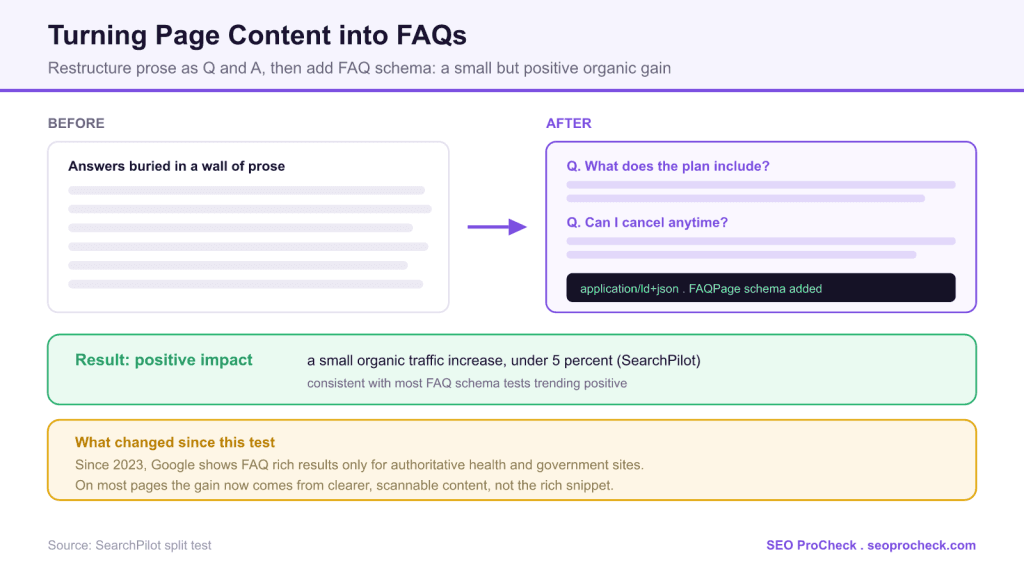
Diagram of turning prose page content into a faq format with faqpage schema, producing a positive but under 5 percent organic traffic increase, plus a note that since 2023 google shows faq rich results only for authoritative health and government sites.
Restructuring prose into a FAQ with FAQ schema produced a positive, under 5 percent organic increase in a SearchPilot split test.

Turning a page's existing prose into an explicit question and answer format is one of the lowest-risk content changes you can test. You are not adding claims or rewriting the substance; you are reorganizing answers that already exist so they map to the questions people actually type. This case study asked whether that reformatting, paired with FAQ schema, moves organic traffic, and the answer is a qualified yes.

Initial Situation

FAQ schema has a long track record in split testing. SearchPilot has run the test repeatedly across different industries and reported that a majority of its FAQ schema tests produced a positive impact, with recent tests continuing that trend. The page in this study carried useful information buried inside conventional paragraphs, the sort of content where the answer a searcher wants is present but hard to spot at a glance.

Strategy and Approach

The change was to take the content already on the page and recast it as discrete questions with concise answers, then mark it up with FAQPage structured data. It was validated with a full-funnel SEO A/B test that splits comparable pages into control and variant groups, so the effect of the format change is isolated rather than confounded by seasonality or unrelated ranking movement.

Implementation

Reformatting is the real work; the schema just describes what is visible. Break the prose into the actual questions users ask, answer each in two to four sentences, and keep the visible copy and the markup identical. A minimal FAQ block plus its schema looks like this:

{
  "@context": "https://schema.org",
  "@type": "FAQPage",
  "mainEntity": [{
    "@type": "Question",
    "name": "Is standard shipping free?",
    "acceptedAnswer": {"@type": "Answer",
      "text": "Yes, standard shipping is free on orders over $40."}
  }]
}

The one rule Google enforces: the answer in the schema must match the answer shown on the page. Marking up content that a user cannot see is a structured data violation and can trigger a manual action.

What the FAQ format actually buys you

The value is not one thing. Some benefits survived the 2023 rich-results change and some did not.

BenefitHow it helpsStatus in 2026
Scannable answersUsers find the answer faster, lowering pogo-stickingStill fully in effect
Question matchingHeadings mirror long-tail question queriesStill fully in effect
Answer extractionClean Q and A is easy for AI Overviews and assistants to liftMore valuable now
FAQ rich resultExpandable Q and A shown under your listingGone for most sites since 2023
People Also AskWell-formed answers can surface in related questionsStill possible, not guaranteed

Results and Learnings

SearchPilot reported that the change had a positive impact on organic traffic, but a modest one, an increase under 5 percent. That fits the broader pattern: FAQ changes tend to help, but the size of the win varies and is usually incremental rather than transformative. The reformatting works because it aligns the page with how people phrase queries and makes the answer easy to find, for humans and for machines. It is the same structural logic behind winning other SERP features, as in our note on using iterative tests to win rich table snippets: clean structure is what engines reward.

What has changed since this test

This is the part that changes how you should read the result today. In 2023, Google restricted FAQ rich results to well-known, authoritative government and health websites. For virtually every commercial site, the expandable FAQ that used to appear under your listing is gone, and with it the extra SERP real estate and click-through that once came from the feature. So if your only reason for adding FAQs was the rich snippet, that reason has expired. The reasons that remain are still real: clearer content that matches question queries, answers that AI Overviews and assistants can extract cleanly, and a better on-page experience. Add FAQs for clarity and extraction, not for a rich result you will not get.

Common mistakes

  • Inventing questions nobody asks. Padding a page with filler FAQs to trigger schema adds clutter, not value, and can look manipulative.
  • Schema that does not match the page. Marking up answers a user cannot see violates Google's guidelines and risks a manual action.
  • Expecting the old FAQ rich result. Most sites no longer get it; plan around content and extraction benefits instead.
  • Duplicating the same FAQ block sitewide. Identical FAQs stamped on every page dilute relevance and help no one.

FAQ

Does turning page content into FAQs benefit SEO?

It can. SearchPilot reported a positive but modest result, an organic increase under 5 percent, from reformatting content as questions and answers with FAQ schema. The gain comes from clearer content that matches how people search, not from ranking magic.

Do FAQ rich results still appear in Google?

For most sites, no. Since 2023 Google shows FAQ rich results only for well-known, authoritative government and health websites. Commercial pages generally no longer get the expandable FAQ under their listing, so plan around content and extraction benefits.

Is FAQ schema still worth adding in 2026?

Yes, for the right reasons. It documents your questions and answers in a machine-readable way that helps AI Overviews and assistants extract accurate answers, even though it rarely produces a visible rich result anymore. The schema must match the visible text on the page.

How should I write the answers?

Answer the real question directly in two to four sentences, in plain language, using the words people actually search. Reformat genuine on-page information rather than inventing questions, and keep each answer self-contained so it reads well out of context.

Can FAQ schema hurt my site?

Only if you misuse it. Marking up content that is not visible on the page, or stuffing pages with fake questions, violates Google's structured data guidelines and can trigger a manual action. Used honestly, it is low risk.

Will FAQs help me show up in AI Overviews?

Indirectly. A clean question and answer structure is easy for AI systems to parse and cite, so it improves your odds of being the extracted source. It is not a guarantee, but well-formed answers are consistently easier for machines to lift accurately.

Source: https://www.searchpilot.com/resources/case-studies/turn-page-content-into-faqs-and-add-schema/

Not sure FAQ schema is still earning its keep on your pages?

After the 2023 rich-results change, some FAQ markup helps and some just adds clutter. An audit shows where structured content still moves the needle.

Request an Advanced SEO Audit

  • Claude Vincent

Claude Vincent is a technical SEO consultant focused on crawlability, rendering, and AI-search visibility. He writes the field guides and case studies at SEO ProCheck, with a bias toward the durable, unglamorous work that decides whether search engines and AI answer engines can actually read and cite a site.

  • Content Updates, FAQ Schema, Local SEO, Structured Data

About SEO ProCheck

Technical SEO consulting and GEO strategy with 20 years of enterprise experience. Case studies, resources, and tools for search and AI visibility.

Learn more about me

Work With Me

Technical SEO audits, GEO strategy, site migrations, and international SEO. Hourly consulting for teams who need hands-on support, not just reports.

Contact now

Subscribe to our newsletter!

More from our blog


Diagram of the agent-readable file stack showing AGENTS.md in the code repository read by coding agents, llms.txt and llms-full.txt at the website root read by answer engines, and robots.txt plus RSL as the access and licensing layer beneath both.

AGENTS.md vs llms.txt vs llms-full.txt: Which Agent File Does What

AGENTS.md, llms.txt and llms-full.txt look alike but serve different readers. What each…
Continue reading

Profound vs Semrush and Ahrefs: What an AI-Search Tool Actually Replaces (and What It Doesn't)

Profound vs Semrush and Ahrefs don't measure the same thing. A practitioner's…
Continue reading
SEO is the foundation everything is built on; AEO (be the answer) and GEO (get cited) are what it makes possible

SEO vs AEO vs GEO: What Each One Means and How They Actually Differ

SEO, AEO, and GEO are three different jobs: rank in search results,…
Continue reading
Google May 2026 Core Update: What We Learned After the Dust Settled

Google May 2026 Core Update: What We Learned After the Dust Settled

The May 2026 Core Update rolled out from May 21 to June…
Continue reading
Pogosticking: The Click Pattern That Quietly Decides Who Ranks

Pogosticking: The Click Pattern That Quietly Decides Who Ranks

Pogosticking is when a searcher clicks your result, bounces back to Google,…
Continue reading
Interaction to Next Paint (INP): The Complete Guide

Interaction to Next Paint (INP): The Complete Guide

Interaction to Next Paint (INP) is the Core Web Vital that replaced…
Continue reading
SSR vs CSR: Why Rendering Decides Whether AI Can Read Your Site

SSR vs CSR: Why Rendering Decides Whether AI Can Read Your Site

AI crawlers mostly don't run JavaScript, so client-side rendering hides your content…
Continue reading
Which AI Bots Are You Actually Blocking? (GPTBot, ClaudeBot, Perplexity & More)

Which AI Bots Are You Actually Blocking? (GPTBot, ClaudeBot, Perplexity & More)

Blocking 'AI bots' isn't one switch. A field guide to GPTBot, OAI-SearchBot,…
Continue reading
Prev. Post
Next Post

Recent Posts

  • AGENTS.md vs llms.txt vs llms-full.txt: Which Agent File Does What July 18, 2026
  • Profound vs Semrush and Ahrefs: What an AI-Search Tool Actually Replaces (and What It Doesn't) June 19, 2026
  • SEO vs AEO vs GEO: What Each One Means and How They Actually Differ June 15, 2026

All Website Tags

AI SEO Analytics B2B Batch Check Content Analysis Content Quality Content Strategy Core Web Vitals Crawl Budget Crawling DOM Parsing E-commerce E-E-A-T Enterprise FAQ GEO Googlebot Google Search Console High Priority Hreflang HTTP Requests Indexing Internal Linking International SEO JavaScript SEO Keyword Research Link Building Live Check Local SEO Low Priority Medium Priority Multiple APIs On-Page SEO Page Speed PageSpeed API Rich Results SaaS Schema Validation SEO Tools SERP Features Site Architecture Site Migrations Structured Data Technical SEO Title Tags

Technical SEO consulting and GEO strategy for teams who need real implementation support. 20 years of enterprise experience across major media, technology, recruitment, and ecommerce brands, and a major enterprise brand. Case studies, research, and resources for search and AI visibility.

SEO Geek since 2004. © All Rights Reserved.

Sitemap for Humans  |  Privacy Policy   |  Terms of Service







