

How Site Pagination and Click Depth Affect SEO - An Experiment
- January 9, 2018
- Website Architecture
AI Summary
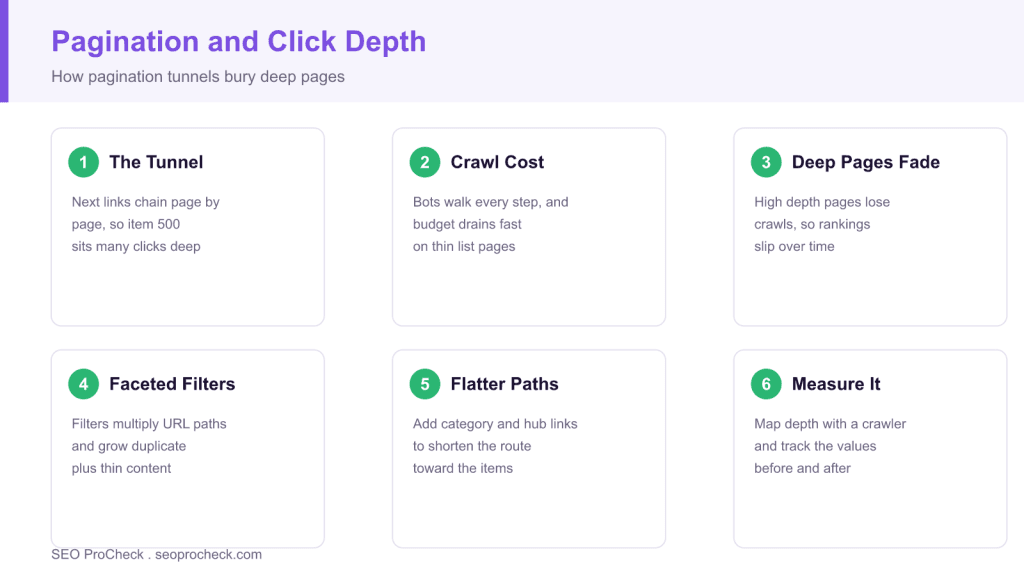
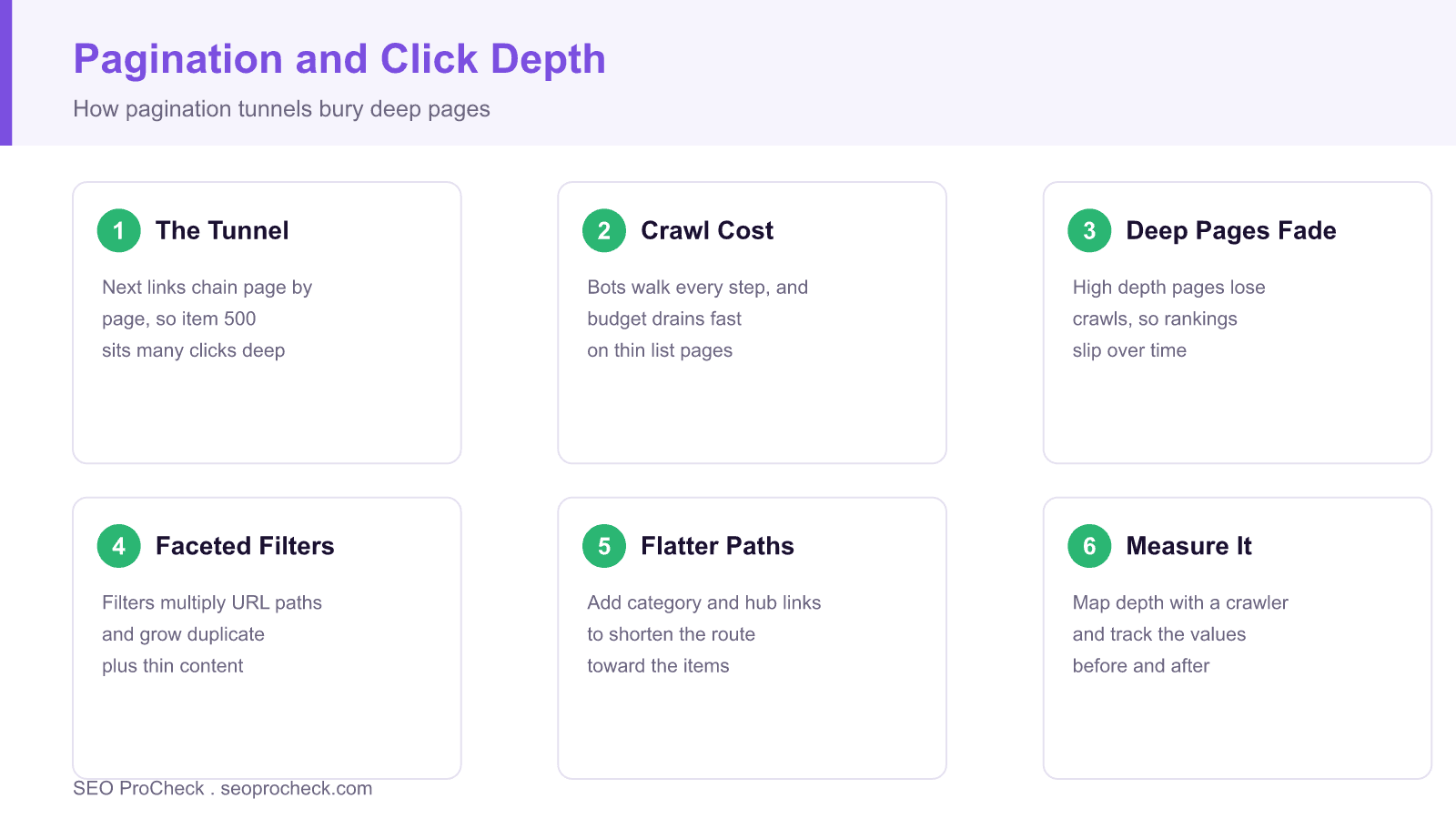
Pagination tunnels form when the only path to deep list items is a long chain of next links, which pushes those items to a high click depth. The experiment behind this study shows that deep, pagination bound pages get crawled less and can slip in visibility, so flatter linking usually helps.
- A pagination tunnel makes item 500 sit many clicks deep behind next links.
- Bots must walk each step, so crawl budget drains on thin list pages.
- High depth pages lose crawl frequency and can fade from results.
- Category links and hubs shorten the route to buried items.
This SEO case study documents a successful optimization initiative, providing actionable insights for practitioners. The documented approach demonstrates how strategic SEO implementation drives measurable results.
Initial Situation
Understanding the starting point is essential context for evaluating any case study. This documentation covers the initial challenges, competitive position, and business objectives that shaped the SEO strategy.
Strategy and Approach
The strategic approach combined multiple SEO disciplines to address identified opportunities. Key decisions around prioritization and resource allocation provide a template for similar initiatives.
Implementation
Moving from strategy to execution required specific technical implementations, content development, and process changes. This case study documents the practical steps that translated strategy into action.
Results and Learnings
The outcomes demonstrate effectiveness through measurable improvements in rankings, traffic, and business metrics. Analysis of successes and challenges provides learning value for practitioners.
Case studies like this contribute to the SEO knowledge base, helping practitioners learn from documented real-world experiences.
Source: https://www.portent.com/blog/seo/pagination-tunnels-experiment-click-depth.htm
Practitioner Commentary
Pagination looks harmless because it is so familiar. A category with hundreds of items breaks into pages, each linking to the next, and users click through happily. The problem is what that structure does to depth. If the only way to reach page fifty is to pass through the previous forty nine, then the items on page fifty sit fifty clicks from the category entrance. That is the tunnel, and search crawlers experience it the same way a patient visitor would.
Two things follow. First, crawl budget gets spent walking the sequence rather than reaching valuable content, which is wasteful on large catalogs. Second, the deepest items inherit almost no internal authority and are crawled rarely, so they refresh slowly and can quietly drop out of the index. This is the same depth problem described in the discussion of page depth as a ranking factor, seen from the angle of list templates.
The fix is to give crawlers shorter routes. Sub category pages, filtered landing pages built for real demand, and contextual links from editorial content all reduce the number of hops to reach popular items. A well designed hub can turn a fifty click journey into a two click one. Larger page sizes and view all pages, where performance allows, also compress the tunnel. The point is not to remove pagination but to stop it being the only path.
Measurement makes this concrete. Crawl the site, record the depth of your item pages, and note which sit far down the sequence. After you add hub and category links, crawl again and compare. When the deep tail moves closer to the homepage, you have shortened the tunnel. For the wider set of structural levers that pair with this work, see our notes on lesser known SEO tips.
What Has Changed Since This Was Published
Google confirmed some years ago that it no longer uses rel equals next and rel equals prev as an indexing signal, so those tags are not a substitute for good linking. That change makes the structural argument stronger, not weaker, because the burden of exposing deep items now rests entirely on your internal links. Infinite scroll and JavaScript driven listings have also spread, which can hide items from crawlers unless paginated URLs remain reachable. The practical advice is the same: give important items a short, crawlable path that does not depend on walking the whole sequence.
Tunnel Depth Versus a Flatter Path
| Scenario | Path to deep item | Crawl outcome |
|---|---|---|
| Pure next link chain | Many sequential clicks | Deep items crawled rarely |
| Sub category links | A few clicks | Better reach and refresh |
| Curated hub pages | One or two clicks | Priority items crawled often |
| Larger page size | Fewer pages overall | Shorter tunnel, less waste |
Frequently Asked Questions
What is a pagination tunnel?
It is a structure where the only route to deep list items is a long chain of next links. Because each page links only to the following one, items far down the sequence sit at a very high click depth.
Does pagination hurt SEO by itself?
Pagination is fine when it is not the only path to content. It becomes a problem when deep items have no shorter route, since those items then get crawled rarely and can lose visibility.
Should I use rel next and rel prev?
Google no longer uses those tags for indexing, so they will not rescue a deep structure. They can still aid other browsers and tools, but your internal links do the real work.
Is infinite scroll better or worse?
Infinite scroll can hide content from crawlers if there are no crawlable paginated URLs behind it. Provide real, linkable pages or hub links so bots can reach every item.
How do I find buried items?
Crawl your site and export click depth for item pages, then sort to find the deepest ones. Those are the items most likely to be under crawled and under performing.
What is the single best fix?
Add curated hub or sub category pages that link directly to popular items. That converts a long tunnel into a short path and usually improves crawl frequency.
Take this with you
The assistant links open with a question about this page already written. Nothing is sent until you press enter.
Claude Vincent is a technical SEO consultant focused on crawlability, rendering, and AI-search visibility. He writes the field guides and case studies at SEO ProCheck, with a bias toward the durable, unglamorous work that decides whether search engines and AI answer engines can actually read and cite a site.
About SEO ProCheck
Technical SEO consulting and GEO strategy with 20 years of enterprise experience. Case studies, resources, and tools for search and AI visibility.
Work With Me
Technical SEO audits, GEO strategy, site migrations, and international SEO. Hourly consulting for teams who need hands-on support, not just reports.
Subscribe to our newsletter!








Recent Posts
- Most Top Sites Never Say Who They Are in Structured Data October 14, 2026
- Homepage Titles Are Mostly Too Short, Not Too Long October 8, 2026
- Who Actually Serves an llms.txt? 184 Top Sites Measured September 29, 2026