


AI Summary
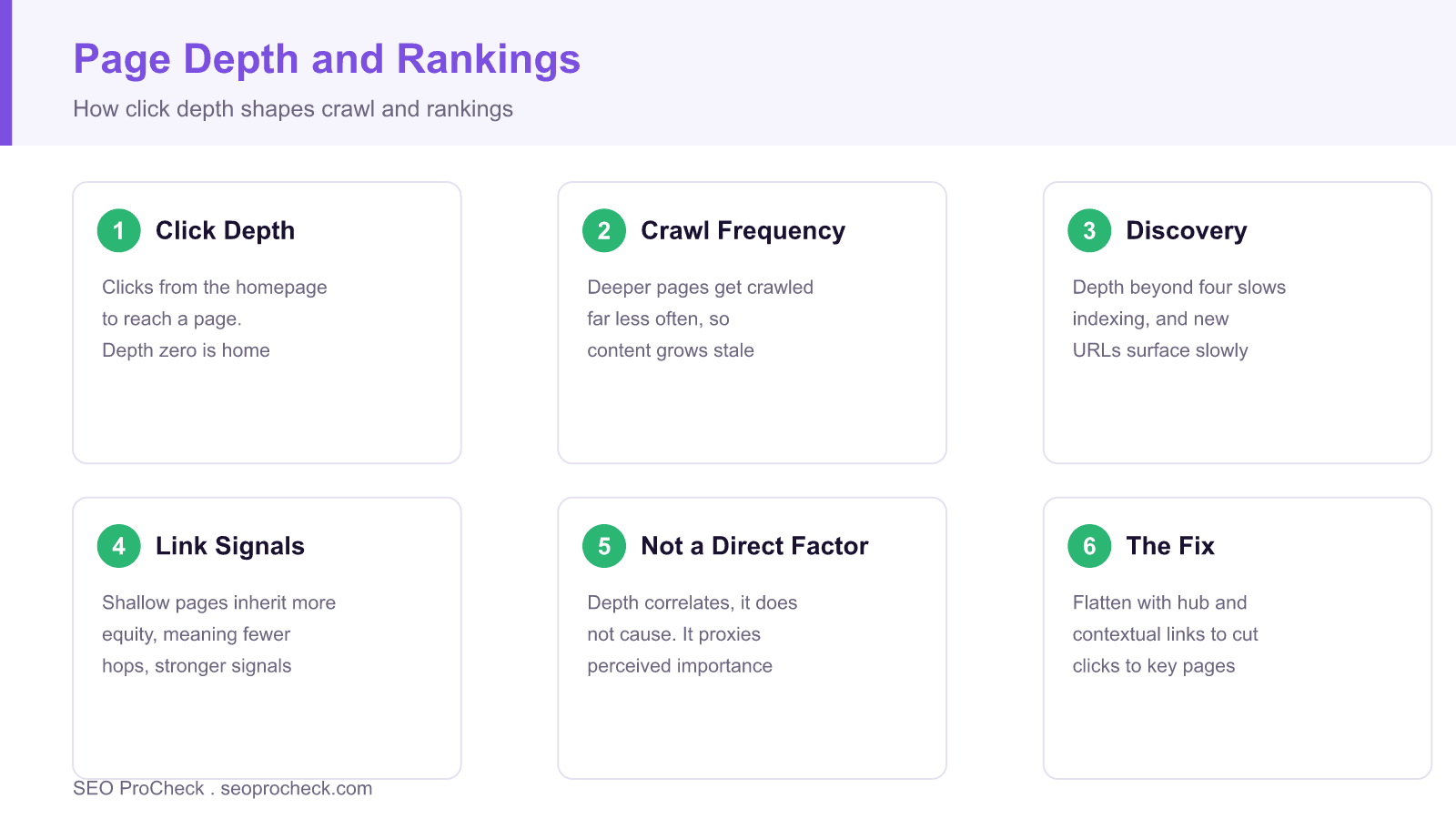
Page depth, also called click depth, is the number of clicks from the homepage to a given page, and it correlates with rankings without being a direct ranking factor. It matters because deeper pages are crawled less often and inherit weaker internal link signals, so flattening your architecture usually helps.
- Click depth is measured in clicks from the homepage, where the homepage is depth zero.
- Deeper pages are crawled less frequently, which slows indexing and refresh.
- Depth is a proxy for perceived importance rather than a standalone ranking signal.
- Hub pages and contextual links flatten depth and concentrate authority.
This SEO case study documents a successful optimization initiative, providing actionable insights for practitioners. The documented approach demonstrates how strategic SEO implementation drives measurable results.
Initial Situation
Understanding the starting point is essential context for evaluating any case study. This documentation covers the initial challenges, competitive position, and business objectives that shaped the SEO strategy.
Strategy and Approach
The strategic approach combined multiple SEO disciplines to address identified opportunities. Key decisions around prioritization and resource allocation provide a template for similar initiatives.
Implementation
Moving from strategy to execution required specific technical implementations, content development, and process changes. This case study documents the practical steps that translated strategy into action.
Results and Learnings
The outcomes demonstrate effectiveness through measurable improvements in rankings, traffic, and business metrics. Analysis of successes and challenges provides learning value for practitioners.
Case studies like this contribute to the SEO knowledge base, helping practitioners learn from documented real-world experiences.
Source: https://www.botify.com/blog/page-click-depth-ranking-factor
Practitioner Commentary
The honest answer to the headline question is that page depth is not a direct ranking factor, yet it behaves like one in practice. Google has repeatedly framed click depth as a signal of how important you consider a page. If a URL sits many clicks from your homepage, you are telling crawlers it is a low priority, and they treat it accordingly.
The mechanism runs through crawling. Bots discover pages by following links, and each hop costs budget. Pages that sit shallow in the tree get crawled often, so their content stays fresh in the index and any updates surface quickly. Pages buried five or six clicks down get visited rarely, which means new products, updated prices, or fresh articles can wait weeks before they are reflected in results. When people report that a page will not rank, deep placement is a frequent and overlooked cause.
Internal link equity reinforces the same pattern. Authority flows through links, and every additional hop dilutes it. A page reachable in two clicks from a strong homepage inherits more of that strength than an identical page reachable in six clicks. This is why the fix is rarely more content and often better structure. For the practical side of how deep pagination creates this problem, see the pagination and click depth experiment, and for the broader set of structural levers, see our notes on lesser known SEO tips.
To act on this, crawl your site and export the depth of every URL. Sort by depth and look at what sits beyond four clicks. If revenue pages or important articles appear there, add hub pages, category links, or contextual in body links that pull them closer to the homepage. You are not gaming a metric, you are correcting a structure that was quietly signaling neglect.
What Has Changed Since This Was Published
The core guidance has held up well. Google representatives have continued to describe click depth as more important than URL structure, which keeps the emphasis on how many clicks a page takes to reach rather than how the path looks. Faceted navigation and large JavaScript driven catalogs have made depth harder to see without a proper crawl, so the measurement step matters more now. The takeaway is unchanged: treat depth as a proxy for importance and flatten the paths to the pages you care about.
How Depth Affects Behavior
| Click depth | Typical crawl frequency | Practical risk |
|---|---|---|
| Zero to one | Very high | Minimal, refreshed quickly |
| Two to three | Healthy | Usually fine for key pages |
| Four to five | Reduced | Slower indexing and refresh |
| Six or more | Low | Risk of stale or orphan pages |
Frequently Asked Questions
Is page depth a confirmed Google ranking factor?
No, Google has not listed click depth as a direct ranking factor. It describes depth as a signal of importance, and depth strongly influences crawling and internal links, which do affect how pages perform.
What counts as too deep?
There is no fixed limit, but pages beyond four clicks from the homepage tend to get crawled less and refresh slowly. Treat that as a warning zone for any page you want to rank.
How do I measure click depth?
Run a full site crawl with a tool that reports crawl depth from your chosen start URL. Export the depth value for every page and sort to find the deepest important URLs.
Does URL folder structure equal click depth?
No, they are different. A URL can have many folders yet still be one click from the homepage, and click depth counts the links a user or bot must follow rather than the slashes in the path.
What is the fastest way to reduce depth?
Add the buried pages to relevant hub or category pages and place contextual links from strong existing content. Both pull the target closer without redesigning the whole site.
Will flattening depth guarantee better rankings?
Not on its own, since relevance and quality still decide results. Reducing depth improves crawling and internal signals, which removes a common obstacle to ranking.
Take this with you
The assistant links open with a question about this page already written. Nothing is sent until you press enter.
Claude Vincent is a technical SEO consultant focused on crawlability, rendering, and AI-search visibility. He writes the field guides and case studies at SEO ProCheck, with a bias toward the durable, unglamorous work that decides whether search engines and AI answer engines can actually read and cite a site.
About SEO ProCheck
Technical SEO consulting and GEO strategy with 20 years of enterprise experience. Case studies, resources, and tools for search and AI visibility.
Work With Me
Technical SEO audits, GEO strategy, site migrations, and international SEO. Hourly consulting for teams who need hands-on support, not just reports.
Subscribe to our newsletter!








Recent Posts
- Most Top Sites Never Say Who They Are in Structured Data October 14, 2026
- Homepage Titles Are Mostly Too Short, Not Too Long October 8, 2026
- Who Actually Serves an llms.txt? 184 Top Sites Measured September 29, 2026