

Training Data Implications for GEO
- January 20, 2025
- GEO (Generative Engine Optimization), AI and Search
AI Summary
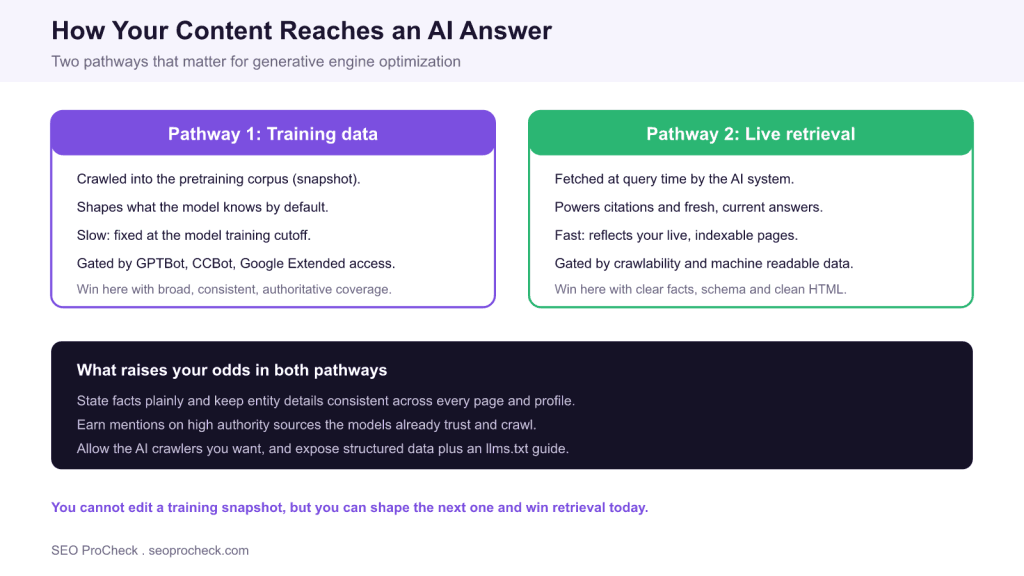
Generative engines learn about your brand in two ways: your pages can be absorbed into a model's training corpus, which is a fixed snapshot, or fetched live at query time for retrieval and citations. You cannot rewrite a snapshot that already shipped, but you can shape the next one and win retrieval today by keeping facts consistent, earning authoritative mentions, and staying crawlable to the AI bots you allow.
- Training data is a frozen snapshot: it sets what a model knows by default, up to its cutoff.
- Live retrieval reflects your current, indexable pages and drives most citations in AI answers.
- Access is controlled per crawler in robots.txt: GPTBot, Google Extended, CCBot, ClaudeBot and others.
- Consistent facts, structured data and high authority mentions raise your odds in both pathways.
What Training Data Means for GEO
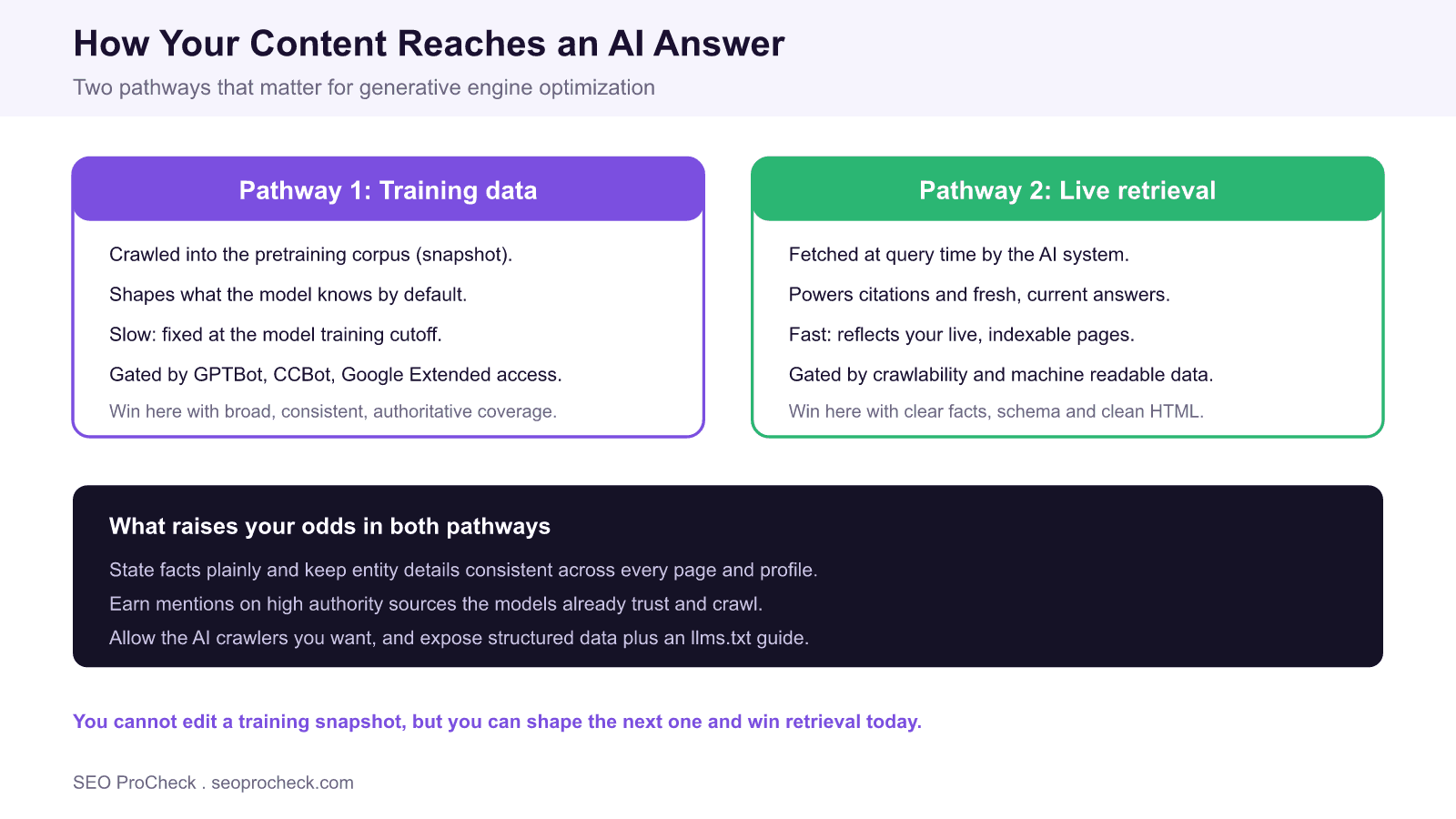
Generative engine optimization, or GEO, is the practice of making your content easy for AI systems to understand, trust and surface. To do it well you have to know the difference between two ways your pages influence an AI answer. The first is training data: crawlers collect public pages into a corpus that a large language model learns from during pretraining. The second is live retrieval, where an assistant fetches current pages at the moment a user asks a question. The two behave very differently, and confusing them leads to wasted effort. If you are new to the discipline, start with the GEO fundamentals and then return here for the training data angle.
Training data is a snapshot. Once a model is trained, whatever it absorbed about your brand is fixed until the next training run, and it is bounded by a knowledge cutoff date. You cannot edit that snapshot, correct a stale fact in it, or force a mention into it after the fact. What you can do is influence the next snapshot by making sure that, when the crawlers pass through, your information is accurate, consistent and widely repeated across sources the model builders trust.
Training Absorption Versus Live Retrieval
Live retrieval is where day to day GEO pays off fastest. When an assistant grounds an answer by fetching pages, it is reading your current, indexable HTML, so an update you publish today can appear in an answer within hours or days rather than waiting for a future model. Retrieval is also what produces the citations users click, which makes it the higher leverage target for most sites. The practical implication is that you optimise for retrieval with clean, crawlable pages and clear facts, while you optimise for training by building durable, consistent authority over time.
Both pathways depend on access. AI companies crawl with named user agents, and you decide in robots.txt which ones may read your site. Blocking a training crawler such as GPTBot, ClaudeBot or CCBot keeps your content out of future corpora but does nothing to remove what earlier snapshots already learned. Blocking a retrieval or search agent can quietly remove you from AI answers and their citations, which is usually the opposite of what a GEO programme wants. Decide access per bot on purpose, and document the choice.
Controlling AI Crawler Access
Each operator publishes the user agent string it crawls with, and each obeys robots.txt directives targeted at that string. The table below lists the common crawlers, what each one feeds, and the control you have over it. Note that Google-Extended governs Gemini and AI grounding only: it does not affect whether your pages rank in Google Search, so you can allow Search crawling while making a separate decision about AI use.
| AI crawler | Operator | What it feeds | How to control it |
|---|---|---|---|
| GPTBot | OpenAI | ChatGPT model training | Allow or disallow GPTBot in robots.txt |
| OAI-SearchBot | OpenAI | ChatGPT live search and citations | Allow or disallow OAI-SearchBot in robots.txt |
| Google-Extended | Gemini training and grounding | Toggle Google-Extended in robots.txt, Search is unaffected | |
| ClaudeBot | Anthropic | Claude model training | Allow or disallow ClaudeBot in robots.txt |
| PerplexityBot | Perplexity | Perplexity retrieval and citations | Allow or disallow PerplexityBot in robots.txt |
| CCBot | Common Crawl | Open dataset reused by many models | Allow or disallow CCBot in robots.txt |
Beyond allow and disallow, you can guide well behaved AI clients with machine readable signals. An llms.txt file at your root offers a curated map of your most useful pages, and structured data makes your facts unambiguous to a parser. Read the practical explainer on llms.txt and the wider survey of machine readable web standards before you invest in either, because adoption varies by engine.
What Makes Content Learnable and Retrievable
The same qualities help in both pathways. State facts plainly in the body text rather than hiding them in images or scripts, because a crawler indexes text it can read. Keep entity details, your name, category, location, founding facts and product claims, identical across your site, your profiles and third party listings, so the model sees one consistent version rather than conflicting ones. Earn mentions and links from sources the model builders already crawl and trust, since repetition across authoritative pages is what makes a fact stick in a corpus. Finally, keep pages fast and crawlable so retrieval agents can fetch them cleanly at query time.
A short operating checklist keeps this concrete: publish clear factual statements near the top of each page, mark up key entities and products with schema, maintain consistent NAP and brand facts everywhere, allow the retrieval crawlers you want citations from, and revisit your robots.txt whenever a new AI user agent appears. None of this requires guessing at algorithms; it is durable, low risk work that also helps classic search.
A Worked robots.txt Example
Access decisions live in a single file at your root. The snippet below allows the retrieval and search agents that produce AI citations while opting out of one training crawler as an illustration. Adapt the list to your own policy, and remember that a rule only applies to the exact user agent string it names, so keep the file current as new agents appear.
User-agent: OAI-SearchBot
Allow: /

User-agent: PerplexityBot
Allow: /

User-agent: GPTBot
Disallow: /

User-agent: *
Allow: /
Test the result in a crawler simulator or your server logs after deploying, because a stray global Disallow can silently remove you from the very AI answers you want to appear in. Recheck the file whenever you read about a new operator, and pair it with structured data so the bots you do allow can parse your facts cleanly.
What's Changed Since Early GEO Advice
Early guidance treated AI visibility as a single problem, but the split between training and retrieval is now the practical frame. Model makers ship new versions and new knowledge cutoffs on their own schedules, so the training snapshot you influence today may not surface until a future release, while retrieval reflects your live pages continuously. Crawler controls have also matured: operators now publish distinct user agents for training and for search, which lets you allow citations while opting out of corpus use if that is your policy. Treat the retrieval pathway as your fast feedback loop and the training pathway as a long term investment.
Frequently Asked Questions
What is the difference between AI training data and live retrieval?
Training data is the fixed corpus a model learns from during pretraining, bounded by a knowledge cutoff, so it changes only when the model is retrained. Live retrieval is content an assistant fetches at query time from your current pages, so updates can appear in answers quickly. GEO targets both, but retrieval usually delivers faster results and the citations users click.
Can I get my content removed from a model that already trained on it?
Not directly. Once a page is in a training snapshot, blocking the crawler afterwards prevents future corpora from including it but does not erase what the shipped model already learned. Your practical levers are correcting the public record so the next snapshot is accurate and controlling access going forward.
Does blocking GPTBot or Google-Extended hurt my Google rankings?
No. GPTBot governs OpenAI crawling and Google-Extended governs Gemini and AI grounding, and neither controls whether your pages rank in Google Search. You can allow normal Search crawling while making a separate decision about AI training and grounding through robots.txt.
How do I make my content more likely to appear in AI answers?
State facts plainly in readable text, add structured data, and keep your entity details consistent across your site and third party profiles. Earn mentions from authoritative sources the AI systems already crawl, and keep pages fast and crawlable so retrieval agents can fetch them. These steps help both the training and retrieval pathways.
What is llms.txt and do AI systems use it?
An llms.txt file is a plain text file at your site root that points AI clients to your most useful pages, similar in spirit to a curated sitemap. Support is not universal, so treat it as a low cost supplement rather than a guaranteed ranking factor. It helps well behaved clients find your best content but does not replace crawlable HTML and schema.
Should I allow every AI crawler to read my site?
Not necessarily. Decide per crawler based on whether you want citations, whether you accept training use, and any licensing considerations. A common stance is to allow retrieval and search agents so you appear in AI answers, while making a deliberate choice about training crawlers such as GPTBot, ClaudeBot and CCBot.
Claude Vincent is a technical SEO consultant focused on crawlability, rendering, and AI-search visibility. He writes the field guides and case studies at SEO ProCheck, with a bias toward the durable, unglamorous work that decides whether search engines and AI answer engines can actually read and cite a site.
About SEO ProCheck
Technical SEO consulting and GEO strategy with 20 years of enterprise experience. Case studies, resources, and tools for search and AI visibility.
Work With Me
Technical SEO audits, GEO strategy, site migrations, and international SEO. Hourly consulting for teams who need hands-on support, not just reports.
Subscribe to our newsletter!







Recent Posts
- Can AI Crawlers Actually Read Your Site? I Measured 400 of the Biggest September 5, 2026
- The Pre-Publish Quality Gate for AI-Assisted Content August 6, 2026
- AGENTS.md vs llms.txt vs llms-full.txt: Which Agent File Does What July 18, 2026