

ChatGPT SEO: Getting Cited in AI Conversations
- October 26, 2024
- LLM Citation Optimization, AI and Search
AI Summary
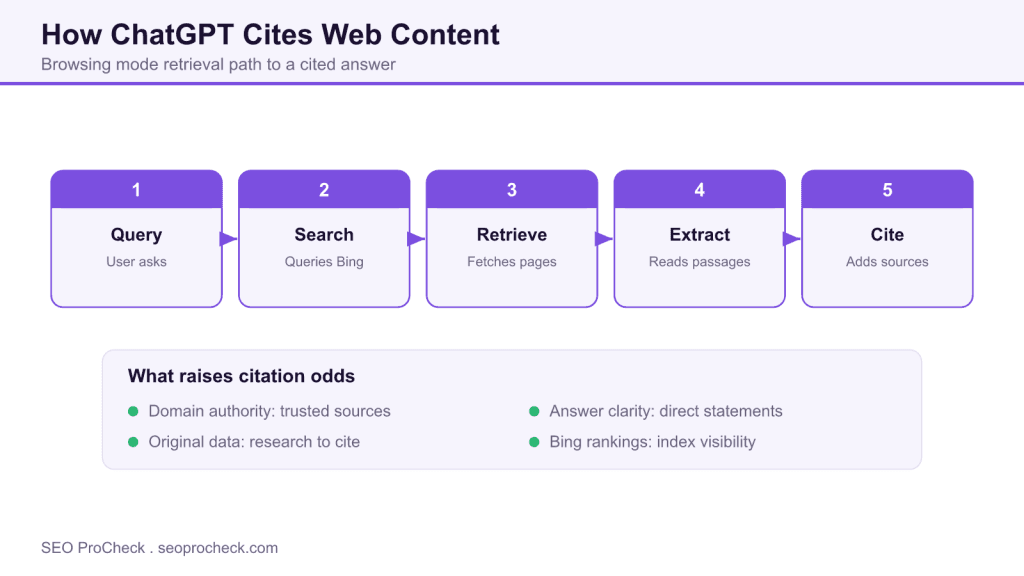
ChatGPT with browsing answers current questions by querying Bing, retrieving pages, and synthesising a cited answer, so getting cited is closer to answer engine optimisation than classic ranking. You earn citations by being visible in Bing, answering questions directly in extractable language, and publishing original data that models prefer to quote.
- Browsing mode retrieves live pages; without browsing, ChatGPT relies on training data and cites nothing.
- Bing visibility is the gating factor, because the retrieval step queries the Bing index.
- Direct, confident, self contained sentences get extracted more often than hedged or scattered prose.
- Original research and specific numbers attract citations that aggregated content cannot.

How ChatGPT Uses Web Content
ChatGPT with browsing capability (ChatGPT Plus and Enterprise) can search the web and cite sources when answering queries. Unlike its training data, which has a knowledge cutoff, web browsing enables real-time information retrieval. When users ask questions requiring current information, ChatGPT queries Bing, retrieves relevant pages, and synthesizes answers with citations. Understanding this retrieval process reveals opportunities to optimize content for ChatGPT citation, though the mechanisms differ significantly from traditional SEO.
Citation Pattern Analysis
Research into ChatGPT citation behavior reveals several patterns. High-authority domains receive disproportionate citation frequency, with Wikipedia, major publications, and established industry sources dominating. Content that directly answers questions in clear, extractable formats gets cited more often. Recent content performs well for time-sensitive queries. Original research, data, and unique findings attract citations that aggregated content doesn't. ChatGPT tends to cite multiple sources for comprehensive answers, creating opportunities for topical expertise even without dominant authority.
| Factor | Impact on Citations | Optimization Approach |
|---|---|---|
| Domain Authority | High | Build site authority through quality and links |
| Content Freshness | Medium-High for current topics | Regular updates, publication dates visible |
| Answer Clarity | High | Direct answers, clear structure |
| Original Data | High | Publish research, studies, unique findings |
| Bing Rankings | Medium | Optimize for Bing alongside Google |
Content Structure for LLM Extraction
Structure content anticipating how LLMs extract and process information. Use clear, descriptive headings that signal content to follow. Provide direct answers in opening sentences before elaboration. Include specific data points, numbers, and facts that LLMs can confidently extract and cite. Use lists and tables for comparative information. Avoid ambiguity and hedge language where possible, as LLMs prefer confident, citable statements. Include publication and update dates to establish currency. Schema markup may help LLMs understand entity relationships and content structure.
Entity and Brand Optimization
ChatGPT's understanding of entities influences how it discusses and recommends brands, products, and topics. Establish clear entity identity through consistent brand information across the web. Ensure Wikipedia presence or equivalent knowledge sources accurately describe your brand/topic. Build entity associations by being mentioned alongside relevant topics on authoritative sites. Create content that positions your entity as an authority in specific subject areas. Monitor how ChatGPT describes your brand or topics and identify gaps or inaccuracies that content can address.
Measuring ChatGPT Visibility
Direct measurement of ChatGPT citations is challenging without specialized tools. Monitor referral traffic from chat.openai.com domain in analytics, though click-through from ChatGPT citations is relatively rare. Use ChatGPT directly to test how it responds to queries in your niche, noting whether your content is cited. Track brand mentions in ChatGPT responses through manual testing or emerging monitoring tools. Some platforms now offer "LLM visibility" tracking that monitors citation patterns across multiple AI systems. Focus on building authentic authority rather than gaming specific AI behaviors, as systems evolve rapidly.
Optimising for Retrieval, Not Just Ranking
The practical shift with ChatGPT is that a citation is won at the passage level, not the page level. When the model retrieves your page, it is scanning for a compact span of text that answers the user question without requiring interpretation. That means the first sentence under each heading should state the answer plainly, with the supporting detail following rather than preceding it. Journalists call this the inverted pyramid, and it maps almost perfectly onto how a language model extracts a quotable claim.
Because the retrieval layer is Bing, the fastest lever many sites have is simply improving Bing visibility, which is often weaker than their Google presence. Verify the site in Bing Webmaster Tools, submit the sitemap, and check that the pages you want cited actually rank in Bing for the target questions. A page that is invisible in Bing cannot be retrieved by ChatGPT browsing no matter how well written it is.
Formatting Passages a Model Will Quote
Language models reward structure. Use descriptive question style headings, then answer in the first line. Convert comparative information into tables, since a well formed table gives the model clean rows to lift. Attach a specific number, date, or named entity to each key claim, because concrete facts are easier to cite with confidence than vague generalisations. The table below contrasts phrasing that tends to get extracted with phrasing that tends to get skipped.
| Weak, Skipped Phrasing | Strong, Citable Phrasing |
|---|---|
| Response times can vary quite a lot | Aim for a server response under 500 milliseconds |
| Many factors may influence citations | Bing visibility gates ChatGPT retrieval |
| Content should probably be fairly recent | Show a visible publish date and update date |
| Structured data might possibly help | Add FAQPage schema to expose question and answer pairs |
Entity Signals and Honest Measurement
Beyond individual passages, ChatGPT reasons about entities. Keep your brand facts consistent across your site, your profiles, and any reference sources, and build associations by being mentioned alongside your core topics on credible sites. Strengthening machine readable entity signals in your HTML helps models connect your name to the subjects you want to own. The same discipline pays off in Google AI Overviews, which draw on overlapping signals, so treat the two as one program rather than separate projects. Measurement remains imperfect: watch referral traffic from the chat.openai.com domain, test target prompts by hand, and track whether your pages appear as cited sources, but anchor the work in genuine authority rather than chasing any single system that will keep changing.
Frequently Asked Questions
How does ChatGPT decide which sources to cite?
In browsing mode it queries Bing, retrieves candidate pages, and cites the ones whose passages most directly and confidently answer the question. High authority domains, clear answer formatting, and recency all raise the odds a page is selected.
Do I need to do anything different from normal SEO?
The foundations overlap, but the emphasis shifts toward Bing visibility and passage level clarity. Writing direct answers, exposing dates, and publishing original data matter more for citation than they do for a blue link ranking.
Does ChatGPT without browsing cite my site?
No. Without browsing the model answers from training data and generally does not cite live sources. Real time citation requires the browsing or search feature, which retrieves current pages.
Why does Bing matter so much for ChatGPT SEO?
ChatGPT browsing retrieves pages through Bing, so a page that does not surface in the Bing index effectively cannot be retrieved. Improving Bing rankings directly expands the pool of pages ChatGPT can cite.
Can I track ChatGPT citations directly?
Only partially. You can monitor referral traffic from chat.openai.com, test prompts manually to see if your content is cited, and use emerging LLM visibility tools, but there is no complete citation report the way Search Console reports clicks.
Does schema markup help with ChatGPT citations?
It can help by making content structure and question answer pairs explicit, which supports extraction. FAQPage schema in particular mirrors the direct question and answer format that models prefer to quote.
Take this with you
The assistant links open with a question about this page already written. Nothing is sent until you press enter.
Claude Vincent is a technical SEO consultant focused on crawlability, rendering, and AI-search visibility. He writes the field guides and case studies at SEO ProCheck, with a bias toward the durable, unglamorous work that decides whether search engines and AI answer engines can actually read and cite a site.
About SEO ProCheck
Technical SEO consulting and GEO strategy with 20 years of enterprise experience. Case studies, resources, and tools for search and AI visibility.
Work With Me
Technical SEO audits, GEO strategy, site migrations, and international SEO. Hourly consulting for teams who need hands-on support, not just reports.
Subscribe to our newsletter!








Recent Posts
- Most Top Sites Never Say Who They Are in Structured Data October 14, 2026
- Homepage Titles Are Mostly Too Short, Not Too Long October 8, 2026
- Who Actually Serves an llms.txt? 184 Top Sites Measured September 29, 2026