

AI Summary
Managing online reputation for E-E-A-T means shaping and monitoring what independent sources say about your brand and authors, because that off-site evidence is what Google's raters use to judge trust. Audit your brand SERP, cultivate reviews and accurate entity data, respond to criticism professionally, and build author reputation across the web.
- Reputation is the main off-site evidence raters use to assess the trust element of E-E-A-T
- Audit your brand SERP regularly to see the reputation both users and raters encounter first
- Maintain accurate Wikidata and Organization or Person schema with sameAs to strengthen entity trust
- Respond to negative reviews professionally; visible accountability reassures onlookers
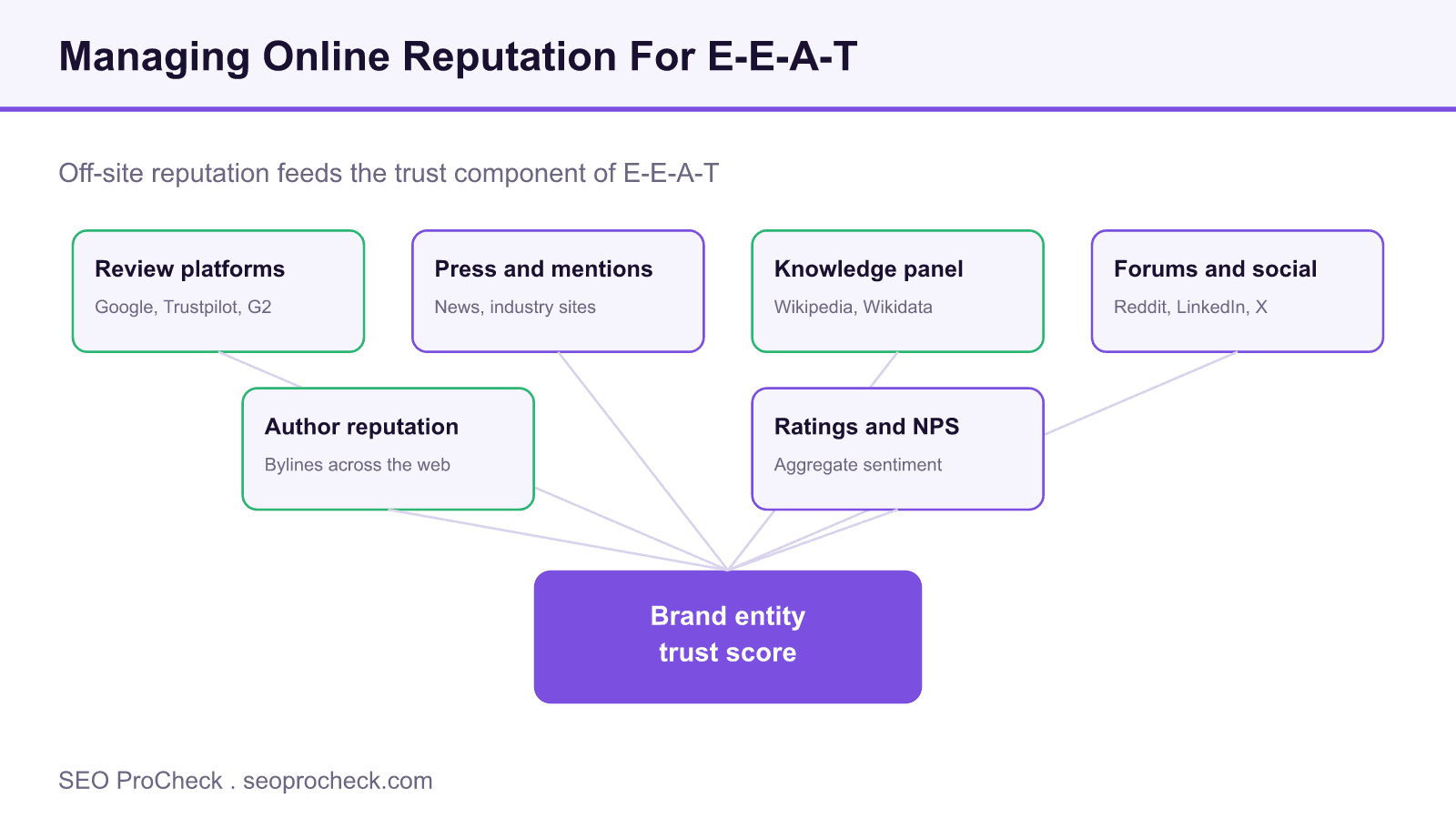
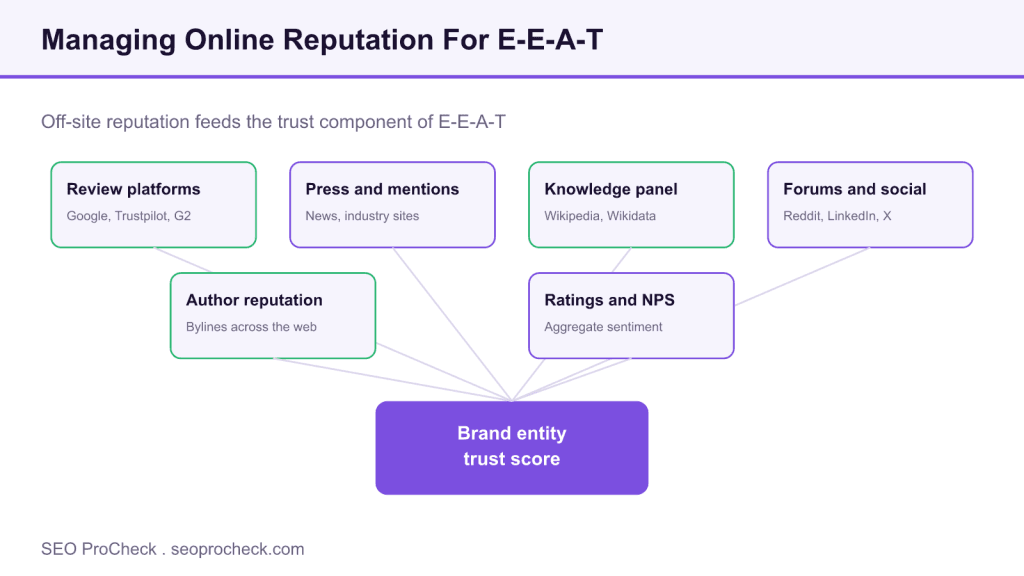
Expertise and experience can be demonstrated on your own pages, but trust is largely earned off them. Google's own quality rater guidelines instruct raters to leave the site and research its reputation using independent sources, so what the wider web says about your brand and your authors becomes a direct input to how trustworthy you appear. Managing that reputation is therefore not a public relations sideline; it is core E-E-A-T work. This guide covers the sources that matter and how to shape them.
Start by auditing your brand SERP
Search your exact brand name, then each author name, in a clean or incognito session. The first page of results is the reputation snapshot users and raters see. Catalog what appears: your own properties, third-party review profiles, news and industry mentions, social results, and crucially anything negative. This audit tells you where you stand and where the gaps or risks are. Repeat it on a schedule, because a brand SERP shifts as coverage changes.
Cultivate reviews and respond to all of them
Reviews on independent platforms such as Google, Trustpilot, and G2 are exactly the kind of outside validation raters weigh. Two habits matter most: steadily earn genuine reviews through good work and simple prompts, and respond to every review, positive and negative, promptly and professionally. A measured response to criticism often reassures onlookers more than the complaint worried them. It also signals an active, accountable organization. If your local review presence is thin, our guide on having no local reviews covers how to close that gap.
Strengthen your entity footprint
Search engines increasingly reason about brands and people as entities. Reinforce yours by maintaining accurate, consistent data on the sources Google trusts to build entities:
- Wikidata entries with correct properties and identifiers
- Wikipedia where genuine notability supports it, never fabricated
- Organization and Person schema with a complete
sameAsarray pointing to verified profiles - Consistent profiles on LinkedIn, Crunchbase, and industry directories
A well-populated knowledge panel is the visible payoff and a strong signal that you are a recognized, legitimate entity. Encode author identity with our Person schema reference.
Build author reputation, not just brand reputation
Author reputation travels with the individual across every site they write for. A contributor whose byline appears on respected industry publications, who is cited by others, and who has a coherent professional profile, lends their trust to any page they touch. Encourage your experts to publish, speak, and be quoted, and link those external signals from their bio so the track record is verifiable.
Handle negative content deliberately
You cannot delete honest criticism, and trying to game it backfires. Instead, address the substance where you can, publish genuinely strong content and profiles that legitimately rank for your name, and engage honestly in the forums where your brand is discussed. Reputation is a durable signal precisely because it is hard to fake, which is why steady, authentic effort is the only reliable strategy.
Reputation sources and how to manage them
| Reputation source | What to do | E-E-A-T effect |
|---|---|---|
| Review platforms | Earn reviews, respond to every one | Independent proof of quality |
| Press and mentions | Pursue genuine coverage and quotes | Third-party validation of authority |
| Knowledge panel data | Maintain Wikidata and sameAs | Recognized entity, stronger trust |
| Forums and social | Monitor and engage honestly | Reflects real user sentiment |
| Author bylines | Publish widely, link the record | Portable expertise and trust |
Reputation is one pillar of a larger framework. Read our complete guide to E-E-A-T and see how off-site signals feed AI answers in how AI engines choose sources. More tactics live in the E-E-A-T optimization hub.
Frequently asked questions
How does online reputation affect E-E-A-T?
Reputation is the primary evidence Google's raters use to judge the trust component of E-E-A-T. They are told to research what independent sources say about a site or creator, so consistent positive coverage, reviews, and mentions across the web reinforce trust, while unaddressed negative signals undermine it.
What is a brand SERP and why should I audit it?
A brand SERP is the results page for a search of your exact brand or author name. It is the reputation snapshot both users and raters see first, so auditing what ranks there, reviews, third-party profiles, news, and any negative results, tells you exactly what your reputation looks like to the outside world.
How do I improve a knowledge panel for E-E-A-T?
Establish and maintain accurate entries on the sources Google trusts to build entities, especially Wikidata and, where notability allows, Wikipedia, plus consistent Organization and Person schema with sameAs links. A well-populated knowledge panel signals that you are a recognized entity, which supports trust.
Should I respond to negative reviews?
Yes. Responding professionally and promptly to negative reviews shows accountability and often matters more to onlookers than the complaint itself. It also signals an active, real business, which supports the trust raters and customers are assessing.
Do social and forum mentions count?
They contribute to the overall reputation picture. Discussions on Reddit, LinkedIn, and industry forums are exactly the kind of independent, off-site opinion Google's raters are directed to consider. They are hard to control but worth monitoring and, where appropriate, engaging with honestly.
How is author reputation different from brand reputation?
Brand reputation covers how the organization is perceived, while author reputation follows the individual across every site they publish on. For E-E-A-T, a writer with a strong, verifiable track record of bylines and citations elsewhere strengthens the trust of any page they contribute to.
Take this with you
The assistant links open with a question about this page already written. Nothing is sent until you press enter.
Claude Vincent is a technical SEO consultant focused on crawlability, rendering, and AI-search visibility. He writes the field guides and case studies at SEO ProCheck, with a bias toward the durable, unglamorous work that decides whether search engines and AI answer engines can actually read and cite a site.
About SEO ProCheck
Technical SEO consulting and GEO strategy with 20 years of enterprise experience. Case studies, resources, and tools for search and AI visibility.
Work With Me
Technical SEO audits, GEO strategy, site migrations, and international SEO. Hourly consulting for teams who need hands-on support, not just reports.
Subscribe to our newsletter!








Recent Posts
- Most Top Sites Never Say Who They Are in Structured Data October 14, 2026
- Homepage Titles Are Mostly Too Short, Not Too Long October 8, 2026
- Who Actually Serves an llms.txt? 184 Top Sites Measured September 29, 2026