

AI Summary
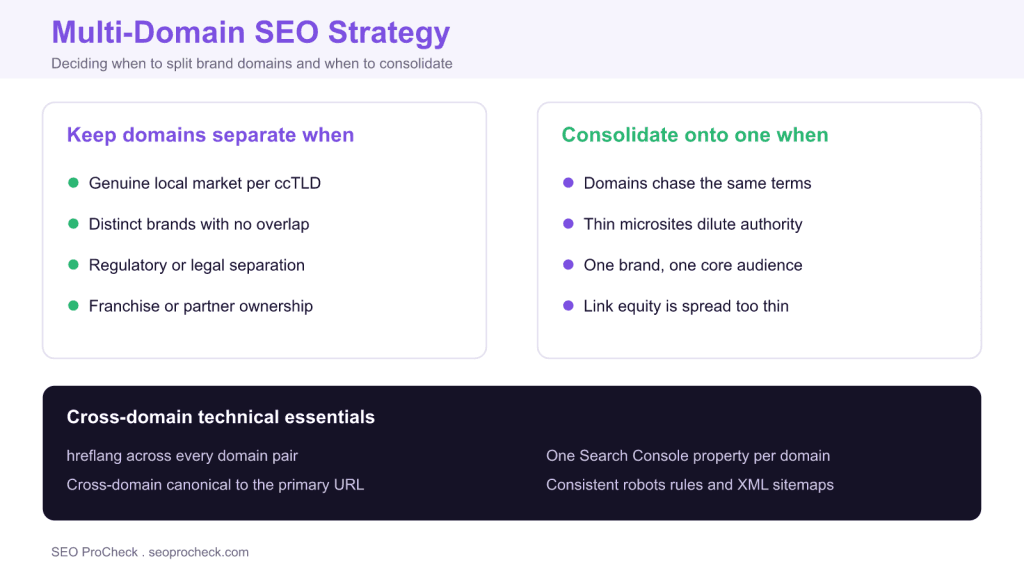
A multi-domain SEO strategy is how one organization runs several domains at once, such as country code domains, product sites, or acquired brands, so they reinforce each other instead of competing. Keep domains apart only when markets, brands, or legal boundaries are genuinely distinct, and consolidate when several domains chase the same keywords and split your authority.
- Separate domains suit true local markets, distinct brands, or legal separation.
- Consolidate when domains target the same terms and dilute link equity.
- Use cross-domain canonicals, hreflang, and a Search Console property per domain.
- Migrate with a full 301 redirect map and the Change of Address tool.
What a multi-domain SEO strategy actually governs
A multi-domain SEO strategy is the set of rules you use when your organization owns more than one domain and you want them to work together rather than cannibalize each other. Typical portfolios include country code domains for international markets, a separate domain for a flagship product, an acquired brand you have not merged, or a campaign microsite. The core question is never technical first. It is strategic: does each domain serve a genuinely different audience, or are they fragments of one brand that would rank better as a single property?
Get that call wrong and the symptoms are predictable. Two of your own URLs appear for the same query, each with mediocre authority. Link building spreads across five domains so none reaches escape velocity. Editorial teams duplicate topics because no one owns the canonical version. The fix starts with a clear map of which domain owns which market and which topic.
When to keep domains separate, and when to consolidate
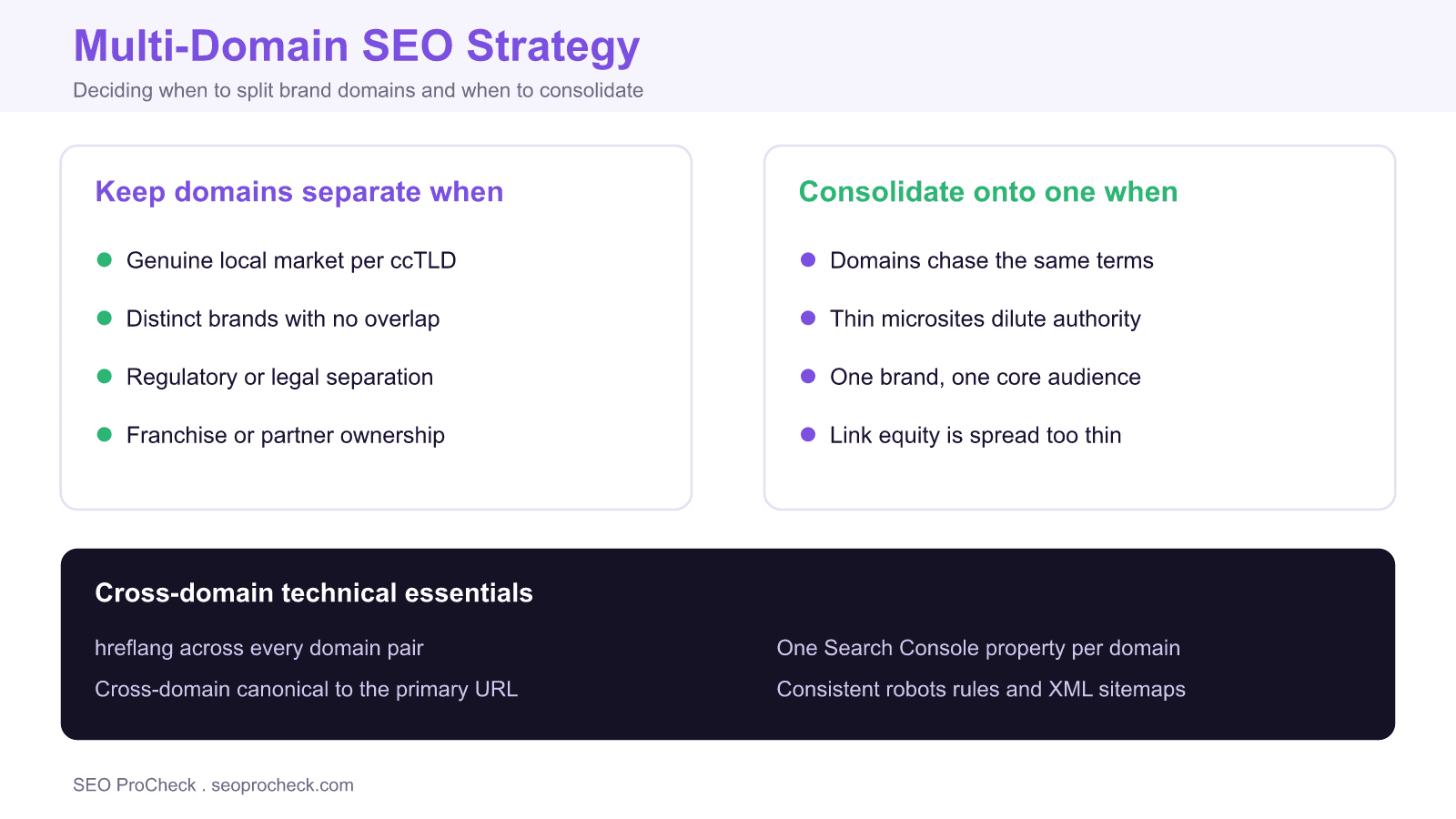
Keep domains separate when the separation is real. Genuine local operations in a market justify a country code top level domain. Distinct brands with different audiences, price points, or post acquisition identities can stay apart. Regulatory, legal, or franchise boundaries sometimes force separation regardless of SEO. In those cases the domains are not competing, so splitting authority is an acceptable cost.
Consolidate when the domains are really one brand wearing several hats. If two properties chase the same keywords in the same language for the same buyers, you are competing with yourself. Thin microsites that exist only for a campaign almost always belong as a subfolder on your primary domain, where the links and rankings survive the campaign. Consolidation pools link equity, simplifies maintenance, and gives every new piece of content a stronger starting position.
Decision matrix
| Scenario | Recommended structure | Why |
|---|---|---|
| Same product, many countries with local presence | ccTLDs or market subfolders with hreflang | Local trust signals and clean international targeting |
| Same product, one language, several exact match domains | Consolidate to one domain | Stops self-competition and pools links |
| Distinct brand kept after an acquisition | Keep separate, cross-link editorially | Different audiences and equity profiles |
| Time limited campaign microsite | Subfolder on the main domain | Retains authority after the campaign ends |
| Many franchise or store locations | One domain with location pages | Central authority with scalable local pages |
Cross-domain technical setup
Once the strategy is set, the plumbing has to match it. Add and verify a separate XML sitemap and Search Console property for every domain so you can read coverage and query data per property. Where you mirror content across your own domains, use a cross-domain canonical tag that names the master URL, so ranking signals point to one owner instead of scattering. Where you syndicate to partner sites, Google does not recommend the canonical tag for those copies; ask partners to block indexing of their copy with noindex, and to link back to your original at minimum. For international portfolios, wire hreflang across every domain pair, including a self reference on each URL, so engines swap the right domain per user without treating the set as duplicates.
Keep robots rules consistent across the portfolio. A domain that blocks its own resources or ships a stray noindex will quietly drop out while you assume it is fine. Editorial internal linking between related domains, where it genuinely helps users, also distributes authority to the pages you want to rank.
Consolidating or migrating domains safely
When you decide to merge domains, treat it as a migration, not a switch. Build a complete redirect map from every old URL to its closest live equivalent, then serve permanent 301s so link equity and rankings transfer. Avoid redirect chains and blanket redirects to the homepage, both of which bleed value. If you are moving a whole domain, use the Change of Address tool in Search Console to speed recognition, and keep the old sitemaps live for a while so engines recrawl and follow the redirects. Our redirects and status codes FAQ covers the status code details.
Measuring a multi-domain portfolio
Measurement is where multi-domain strategies live or die. Compare properties side by side: which domain wins each shared query, how authority is trending per property, and whether any pair is cannibalizing the other. Watch for two of your own results on a single query, which is the classic signal to consolidate. Review the portfolio on a schedule, because acquisitions, new markets, and campaigns constantly add domains that need a home decision. The goal is simple to state and hard to maintain: every domain should have a clear job, and no two domains should be fighting for the same click.
Frequently asked questions
Does running multiple domains help or hurt SEO?
It depends on intent. Multiple domains help when each serves a genuinely different market, brand, or audience. They hurt when several domains target the same keywords, because you split link equity and force your own pages to compete in the same results.
Should I use ccTLDs, subdomains, or subfolders for international sites?
Subfolders on one strong domain concentrate authority and are the simplest to maintain. Country code top level domains send the clearest local signal but start each market from zero authority. Choose ccTLDs only when you have real local operations and the resources to build each one.
How do I stop two of my domains from competing for the same keyword?
Decide one canonical owner for each topic and point the weaker page at the stronger with a cross-domain canonical, or consolidate the content with a 301 redirect. Track which domain ranks for the query in Search Console before you choose the survivor.
Can a canonical tag point to a different domain?
Yes. A cross-domain canonical tells search engines that the master version of a page lives on another domain you control. It is the standard way to mirror content across your own properties without creating duplicate competition; for copies syndicated to partner sites, Google recommends that the partner block indexing instead.
Do I need a separate Search Console property for every domain?
Yes. Each domain and subdomain is its own property, so add and verify all of them. That gives you per property coverage, index, and query data, which you need to compare performance and plan any consolidation.
Is a marketing microsite bad for SEO?
A standalone microsite usually is, because it builds authority that dies when the campaign ends. Publishing the same campaign as a subfolder on your main domain keeps the links, rankings, and content working for you long after launch.
Take this with you
The assistant links open with a question about this page already written. Nothing is sent until you press enter.
Claude Vincent is a technical SEO consultant focused on crawlability, rendering, and AI-search visibility. He writes the field guides and case studies at SEO ProCheck, with a bias toward the durable, unglamorous work that decides whether search engines and AI answer engines can actually read and cite a site.
About SEO ProCheck
Technical SEO consulting and GEO strategy with 20 years of enterprise experience. Case studies, resources, and tools for search and AI visibility.
Work With Me
Technical SEO audits, GEO strategy, site migrations, and international SEO. Hourly consulting for teams who need hands-on support, not just reports.
Subscribe to our newsletter!








Recent Posts
- Most Top Sites Never Say Who They Are in Structured Data October 14, 2026
- Homepage Titles Are Mostly Too Short, Not Too Long October 8, 2026
- Who Actually Serves an llms.txt? 184 Top Sites Measured September 29, 2026