

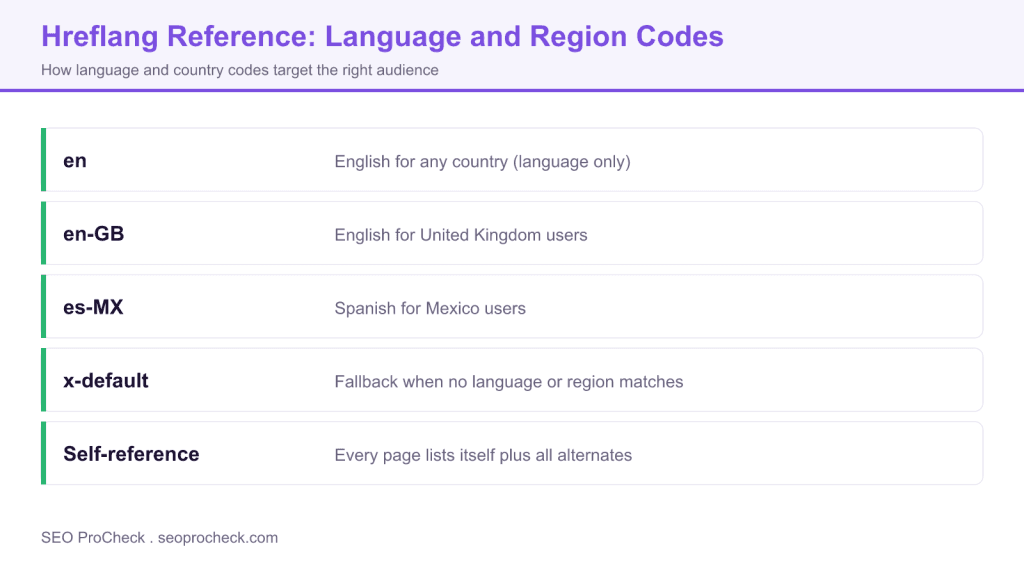
AI Summary
Hreflang is an HTML attribute that tells Google and Bing which language and regional version of a page to serve each user, which prevents the wrong version showing and stops same language duplicates from competing. Every version must reference itself and every alternate, the references must be bidirectional, and an x-default entry should catch users no version matches.
- Format is a language code such as
en, optionally with a country code such asen-GBores-MX. - Pick one delivery method per page: HTML head link tags, HTTP headers, or the XML sitemap.
- Missing return references are the most common error, and Google ignores hreflang when the confirmation is absent.
- Canonical tags must point each page at itself, never at another language version.

Complete guide to hreflang implementation and international SEO. How to target multiple countries and languages, avoid duplicate content issues, and structure global websites.
Table of Contents
- International SEO Basics
- Hreflang Implementation
- Site Structure Options
- Content Considerations
- Technical Setup
- Troubleshooting
International SEO Basics
What is international SEO?
Optimizing your website to rank in multiple countries or languages. Involves signaling to search engines which content is intended for which audience, handling duplicate content across versions, and ensuring proper indexation of regional variations. Goes beyond translation to include local search behavior.
What's the difference between language and country targeting?
Language targeting serves content in a specific language regardless of location (Spanish speakers globally). Country targeting serves content to users in specific countries (Spain vs Mexico vs Argentina). You can combine both: Spanish content specifically for Mexican users.
When do I need international SEO?
When you have content in multiple languages, target customers in multiple countries, have regional pricing/products, or see significant traffic from non-primary markets. If your analytics shows international traffic but poor conversion, international SEO can help match users with relevant content.
What is geotargeting?
Showing different content based on user location. Can be implemented via ccTLDs, server-side detection, or CDN rules. Google uses various signals (IP, language settings, search location) to determine user location for search results.
How does Google handle international content?
Google tries to show users content in their language and relevant to their location. Uses hreflang signals, URL structure, content language, and user signals. Without proper implementation, Google may show wrong version or flag duplicate content issues.
Hreflang Implementation
What is hreflang?
An HTML attribute telling search engines which language and regional version of a page to show specific users. Format: hreflang="en-US" for US English, hreflang="es" for Spanish globally. Helps prevent duplicate content issues and ensures users see the right version in search results.
What is the correct hreflang syntax?
Use ISO 639-1 language codes (en, es, de) optionally with ISO 3166-1 Alpha-2 country codes (US, GB, MX). Examples: "en" (English, any country), "en-GB" (English, UK), "es-MX" (Spanish, Mexico). Language code is required; country code is optional but recommended for country-specific content.
Where can I implement hreflang?
Three options: HTML head (), HTTP headers (for PDFs and non-HTML), or XML sitemap. Choose one method per page; don't mix. HTML head is most common and easiest to audit. Sitemap method works well for large sites.
How do I add hreflang in HTML?
In
:. List ALL language versions including the current page. Every page must reference itself and all alternates.How do I add hreflang in XML sitemap?
Add xhtml namespace and include xhtml:link elements for each URL. Each URL entry lists all alternate versions. More scalable for large sites but harder to audit. Ensure sitemap stays synchronized with actual page relationships.
What is x-default hreflang?
A fallback for users whose language/country doesn't match any specified version. Typically points to your homepage language selector, international homepage, or most common language version. Format: hreflang="x-default". Recommended for all international implementations.
Do pages need self-referencing hreflang?
Yes. Every page must include a hreflang tag pointing to itself. If page A references B and C, A must also reference A. Missing self-references cause validation errors. Google requires complete, bidirectional references between all versions.
What are bidirectional hreflang references?
If page A references page B as an alternate, page B must reference page A back. Missing return references are the most common hreflang error. Google ignores hreflang when bidirectional confirmation is missing. Audit both directions carefully.
Site Structure Options
What are ccTLDs for international SEO?
Country-code top-level domains: example.de (Germany), example.fr (France), example.co.uk (UK). Strongest geotargeting signal. Downsides: separate domain authority for each, more expensive, complex management. Best for brands with strong single-country focus per domain.
Should I use subdirectories for international sites?
Subdirectories (example.com/de/, example.com/fr/) keep all content under one domain, consolidating authority. Easier to manage than ccTLDs. Use hreflang and locale-specific URLs for country versions (Search Console geotargeting was retired in 2022). Most recommended option for businesses new to international SEO.
Should I use subdomains for international sites?
Subdomains (de.example.com, fr.example.com) partially separate content while keeping main domain. More isolated than subdirectories but don't consolidate authority as well. Can complicate technical setup. Generally less preferred than subdirectories unless specific hosting requirements exist.
Which international URL structure is best?
Subdirectories for most businesses: consolidates authority, easiest management, lower cost. ccTLDs for major brands with strong per-country presence and resources. Subdomains rarely optimal. Consider your resources, business model, and whether you need hard geographic separation.
How do I set geotargeting in Search Console?
You can't anymore. Google deprecated the International Targeting report and its country setting in 2022. For generic TLDs (.com, .net) with subdirectories/subdomains, geotarget with locale-specific URLs and hreflang instead. ccTLDs are automatically geotargeted to their country.
Content Considerations
What's the difference between translation and localization?
Translation converts text to another language. Localization adapts content for cultural context: local idioms, currency, date formats, imagery, examples, regulations, and search behavior. Proper international SEO requires localization, not just translation. Users and search engines recognize the difference.
Is translated content duplicate content?
No. Different languages are different content. However, identical English content on example.com and example.co.uk IS duplicate content. Use hreflang to specify which version targets which audience. Properly implemented hreflang helps Google show the right regional URL and consolidate signals; there is no duplicate content penalty to prevent.
Can I use machine translation for international SEO?
Not recommended as sole solution. Machine translation quality has improved but still produces errors and unnatural phrasing. Google has penalized pure machine-translated content. Use as starting point, then have native speakers review and localize. Quality matters for rankings.
What if I can only translate some pages?
Start with highest-value pages: homepage, main product/service pages, top traffic drivers. Don't create thin international sites. It's better to have 20 well-localized pages than 1,000 poorly translated ones. Expand gradually as resources allow.
How do I handle same language, different countries?
US and UK English, Spain and Mexico Spanish need separate hreflang tags (en-US vs en-GB, es-ES vs es-MX). Localize for each market: spelling differences, local terms, pricing, regulations. Even same-language markets have different search behaviors and needs.
Do I need separate keyword research per market?
Yes. Search behavior varies by country even for same language. Volume, competition, and intent differ. Spanish keywords in Spain vs Mexico have different search patterns. Use local keyword tools or filter by country. Don't assume direct translation of keywords.
Technical Setup
Should I auto-redirect based on IP/language detection?
Avoid auto-redirects for Googlebot; it typically crawls from US IPs and needs access to all versions. For users, prefer suggestion banners over forced redirects. Let users choose their version. If you must redirect users, ensure Googlebot can still access all pages.
How do canonical and hreflang work together?
Each page's canonical should point to itself, not to another language version. Canonical handles duplicates within same language; hreflang handles relationships across languages. Common mistake: canonicalizing all versions to English page, which breaks hreflang.
Do I need separate sitemaps per language?
Optional but recommended for organization. Can have one master sitemap with hreflang annotations, or separate sitemaps per language/country listed in sitemap index. Either works; separate sitemaps make auditing easier for large international sites.
Does server location affect international SEO?
Minimal direct ranking impact. Google uses other signals (hreflang, ccTLD) for geotargeting. Server location affects page speed for local users, which indirectly impacts rankings. Use CDN for global performance regardless of origin server location.
How should I handle currency and pricing?
Display local currency for each market. Use structured data with correct currency codes. Ensure prices are accurate for local markets, including taxes where required. Dynamic currency conversion without local pricing can harm user experience and conversions.
Troubleshooting
How do I find hreflang errors?
Search Console no longer reports hreflang errors, since Google retired the International Targeting report in 2022. Use Screaming Frog or Sitebulb to crawl and validate all hreflang relationships, and URL Inspection to check individual pages. Common errors: missing return tags, incorrect language codes, URLs returning errors, missing self-references.
Why is the wrong language version ranking?
Common causes: missing or incorrect hreflang, missing return tags, canonical pointing to wrong version, stronger signals for wrong version (more backlinks to English than local version), Google detecting language mismatch on page content.
Why aren't my international pages being indexed?
Check: robots.txt blocking, noindex tags, hreflang errors preventing discovery, thin content on international pages, duplicate content issues, crawl budget exhausted before reaching international sections. Verify pages are in sitemap and internally linked.
How do I validate hreflang implementation?
Use hreflang testing tools (Merkle, TechnicalSEO.com), Screaming Frog's hreflang validation, or Sitebulb. Check: all versions reference each other, self-references present, language codes correct, URLs accessible (200 status), canonicals don't conflict.
Should I have separate Search Console properties per region?
Yes, for subdirectories and subdomains targeting specific countries. Add each section as property and monitor performance separately (country targeting is no longer a Search Console setting). Helps identify regional issues and compare performance across markets. For ccTLDs, each domain is automatically separate.
When should I consolidate international sites?
Consider consolidation when: managing multiple ccTLDs is unsustainable, domain authority is fragmented, content is duplicated across domains, or you're not truly localizing per market. Migration requires careful redirect mapping and hreflang planning to preserve rankings.
Quick reference table
Choosing a site structure decides how geotargeting signals and authority flow across your markets. The comparison below pairs with the practices in our XML sitemaps FAQ and the wider technical SEO FAQ.
| URL structure | Example | Geotargeting signal | Domain authority | Best for |
|---|---|---|---|---|
| ccTLD | example.de | Strongest, automatic | Split across each domain | Major brands with one country per domain |
| Subdirectory | example.com/de/ | Locale URL plus hreflang | Consolidated on one domain | Most businesses new to international SEO |
| Subdomain | de.example.com | Locale URL plus hreflang | Partly split | Specific hosting or infrastructure needs |
Frequently Asked Questions
Yes, whenever the same URL structure serves more than one language or region. Hreflang tells search engines which version fits each user and prevents your translated pages from being read as duplicates. Without it, Google may show the wrong language in results.
Canonical handles duplicates inside a single language, while hreflang maps relationships across languages and regions. Each localized page should canonical to itself, then list every alternate with hreflang. A common mistake is canonicalizing all versions to the English page, which breaks hreflang entirely. For deeper indexing control, see our meta robots and X-Robots-Tag reference.
The x-default value marks the fallback page for users whose language or region matches none of your specified versions. It usually points to an international homepage or a language selector. Google recommends including it in every hreflang set.
Subdirectories suit most businesses because they consolidate authority on one domain and are cheaper to run. ccTLDs send the strongest country signal but split authority and cost more, so they fit large brands with a strong presence per country. Subdomains are rarely the optimal choice.
Not as your only step. Modern machine translation is a useful starting point, but pure machine output still reads unnaturally and has been devalued by Google. Have native speakers localize currency, idioms, and examples before publishing.
Avoid forced redirects, especially for Googlebot, which usually crawls from United States IP addresses and must reach every version. Offer a suggestion banner instead and let users choose. Blocking access to alternates can leave whole language versions unindexed.
Take this with you
The assistant links open with a question about this page already written. Nothing is sent until you press enter.
Claude Vincent is a technical SEO consultant focused on crawlability, rendering, and AI-search visibility. He writes the field guides and case studies at SEO ProCheck, with a bias toward the durable, unglamorous work that decides whether search engines and AI answer engines can actually read and cite a site.
About SEO ProCheck
Technical SEO consulting and GEO strategy with 20 years of enterprise experience. Case studies, resources, and tools for search and AI visibility.
Work With Me
Technical SEO audits, GEO strategy, site migrations, and international SEO. Hourly consulting for teams who need hands-on support, not just reports.
Subscribe to our newsletter!








Recent Posts
- Most Top Sites Never Say Who They Are in Structured Data October 14, 2026
- Homepage Titles Are Mostly Too Short, Not Too Long October 8, 2026
- Who Actually Serves an llms.txt? 184 Top Sites Measured September 29, 2026