

Hreflang Implementation Without the Errors: Return Tags, x-default, and Why Most Setups Silently Break
- July 18, 2024
- International SEO
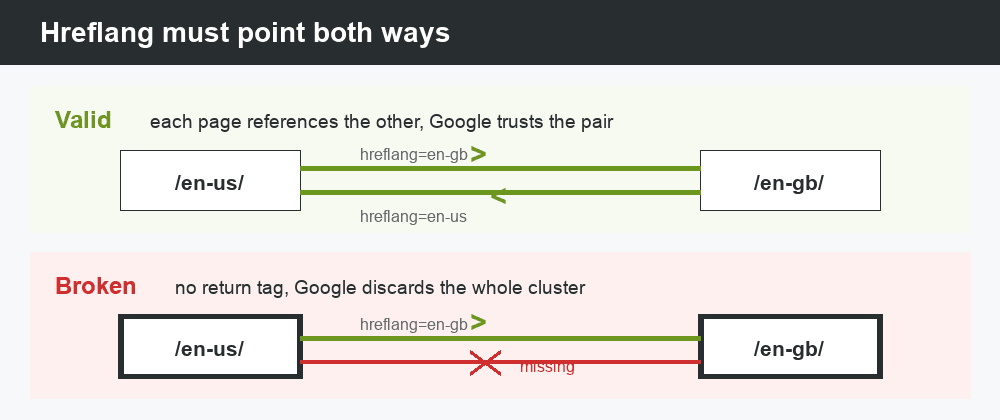
One wrong return tag silently invalidates an entire hreflang cluster: Google reports no error, your localized pages just stop swapping in. Validate in this order: return tags, self-references, x-default, canonicals, then language codes.
Hreflang is the most error-prone signal in international SEO, and the reason is structural: it is the only annotation where a tag on one URL is invalid unless a matching tag exists on a different URL you may not control. Get one return tag wrong and Google discards the entire cluster silently, no error in most reports, just localized URLs that never swap in the SERP. This is a diagnostic walkthrough of why that happens and how to validate a setup before it costs you rankings.
How common are these breaks? Patrick Stox's Ahrefs study of 374,756 domains found that 67 percent of sites using hreflang have at least one implementation issue. If you are choosing where to put your annotations in the first place, start with where to declare hreflang, then sanity-check your setup against these seven real-world hreflang scenarios.
How Google actually consumes hreflang (and why "silent" is the right word)
Hreflang is a clustering signal, not a directive. I repeat: it is a fucking SIGNAL, not a DIRECTIVE, and if you start to fuck it up by inventing new rules instead of following best practices, you are going to have a bad time. Google reads every annotation on a page, then looks for confirmation on the target URLs. If the confirmation is missing or contradictory, it doesn't penalize you, it simply drops the unconfirmed pairs and falls back to its own language and canonical guesses. There is no hard failure state. That is exactly why broken setups persist for months: the page still indexes, still ranks somewhere, just not where you intended.
Three classes of conflict cause Google to ignore hreflang, and they are almost always the culprit when a technically "present" implementation does nothing:
- Missing return tags, the most common failure by a wide margin.
- Invalid language or region codes, silently dropped at parse time.
- Canonical conflicts, hreflang pointing one way, canonical pointing another.
Return tags: the bidirectional rule that breaks most clusters
Hreflang must be reciprocal. If page A (en-us) references page B (en-gb), then page B must reference page A. Miss the return reference and Google treats the A→B claim as unverified and discards it. In a cluster of ten locales, every page must reference all ten, including a self-referential tag pointing to itself.
Self-referencing is non-negotiable and routinely forgotten. Each URL in the set lists the full set, itself included:
<link rel="alternate" hreflang="en-us" href="https://example.com/us/" />
<link rel="alternate" hreflang="en-gb" href="https://example.com/uk/" />
<link rel="alternate" hreflang="x-default" href="https://example.com/" />
The same exact block appears on /us/, /uk/, and /. If the block differs page to page, say a template injects only the "other" locales and omits self, you have a non-reciprocal set and Google will distrust it. The most insidious version of this bug is a protocol or trailing-slash mismatch: page A references https://example.com/uk but the actual page is https://example.com/uk/ (or HTTP vs HTTPS, or www vs non-www). The return tag technically exists, but because the URLs don't match byte-for-byte after redirect resolution, Google sees no return reference. Always annotate the final, canonical, post-redirect URL.
Language and region codes: where setups die at parse time
The value of hreflang is an ISO 639-1 language code, optionally followed by an ISO 3166-1 Alpha-2 region code. The order, casing convention, and the codes themselves all matter, and a single invalid value causes that one annotation to be ignored entirely.
- Language first, region second. It is
en-gb, nevergb-en. Reversing them produces an invalid code. - Region is a country, not a language. There is no
en-uk, the ISO country code for the United Kingdom isGB. Similarly there is noen-eu; the EU is not a country. These are two of the most frequent real-world errors. - Don't invent language-for-region. Targeting Latin America with
es-419is valid (UN M49 region code), but most CMS validators choke on it, confirm support before relying on it. - Case is forgiving but be consistent.
en-USanden-usare both accepted; pick one convention to keep audits clean. - Region-only is invalid. You cannot write
hreflang="us". A region must be paired with a language.
When a code is malformed, Google drops just that pair, which can quietly orphan a single market while the rest of the cluster works, making the problem hard to spot from a spot-check.
x-default: what it is for and how people misuse it
The x-default value designates the fallback page for users whose language or region you haven't explicitly targeted, the global selector, a language-picker landing page, or your primary market. It is not required, but on multi-locale sites it materially improves which page shows for unmatched audiences.
Two recurring mistakes: first, treating x-default as a substitute for a real locale tag, it supplements the set, it doesn't replace en-us. Second, pointing x-default at a page that 302-redirects based on IP geolocation; Googlebot crawls predominantly from the US, so an IP-redirecting default can collapse your whole fallback logic. Point x-default at a stable, crawlable URL.
Canonical conflicts: the silent killer
This is the conflict that wastes the most debugging time. rel="canonical" and hreflang answer different questions, canonical says "this is the master version of this content," hreflang says "here are the localized equivalents." They must agree.
The fatal pattern: each localized page sets its canonical to the en-us page (a common mistake when teams think of locales as "duplicate content"). Now hreflang says /uk/ is the UK version, but canonical says /uk/ isn't even the real page, /us/ is. Google resolves the contradiction by trusting canonical and discarding hreflang. Every localized page must self-canonicalize. The canonical on /uk/ is /uk/, full stop. Cross-canonicalization across locales is almost always a bug.
How to validate at scale
Spot-checking three pages tells you nothing about a 40,000-URL multi-locale site. Validate systematically:
- Crawl with hreflang extraction. Use a crawler that reports hreflang as a relationship graph (Screaming Frog, Sitebulb, Lumar). The key reports are "non-reciprocal" / "missing return links" and "non-200 hreflang URLs", those two surface the majority of real defects.
- Check the response status of every annotated URL. Any hreflang target returning 3xx, 4xx, or 5xx is dead weight. Redirected targets are the classic trailing-slash bug in disguise.
- Validate codes against the ISO lists programmatically. Extract all unique hreflang values and diff them against valid ISO 639-1 and 3166-1 Alpha-2 sets. This catches
en-uk,en-eu, and reversed codes instantly. - Cross-reference canonical vs hreflang per URL. Flag any page whose self-referential hreflang URL differs from its declared canonical, that is your canonical-conflict report.
- Confirm one delivery method, not two. Pick HTML
<link>tags, HTTP headers, or XML sitemap annotations. Mixing them, or worse, contradicting them, creates ambiguity. For large sites, sitemap-based hreflang is the most maintainable because the entire cluster lives in one file you can validate as a unit. - Use GSC's URL Inspection as ground truth. The legacy International Targeting report is deprecated, but URL Inspection shows whether Google has actually associated the alternates. If it hasn't after a few crawl cycles, your annotations aren't being trusted.
Common mistakes
- Omitting the self-referencing tag. Each page must list itself. Templates that inject only "other" locales break reciprocity.
- Annotating pre-redirect URLs. Reference final canonical URLs only, match protocol, host, and trailing slash exactly.
- Cross-canonicalizing locales. Localized pages self-canonicalize; pointing canonical at the US version voids hreflang.
- Using
en-ukoren-eu. The correct country code isGB, and the EU has no ISO country code. - Putting region before language. It's
language-REGION, e.g.fr-ca, notca-fr. - An
x-defaultthat IP-redirects. Googlebot crawls from the US and will follow the redirect, defeating the fallback. - Mixing delivery methods. One source of truth, sitemap, header, or link tags, prevents contradictory signals.
- Relative URLs. hreflang requires absolute, fully qualified URLs including the protocol.
The one-line diagnosis
If GSC is ignoring your hreflang, work the chain in this order: do the target URLs return 200, do they reference back with byte-identical URLs, are all the codes valid ISO, and does every page self-canonicalize? Ninety percent of "silently broken" setups fail one of those four checks, and because none of them throws a visible error, the only way to find the break is to validate the entire cluster as a graph, not page by page.
Want this handled properly on your site?
It is exactly the kind of work an advanced technical SEO audit covers. See how an advanced SEO audit works →
🌍 The International SEO series
- Hreflang and International SEO: The Complete Implementation Guide
- Where to Declare Hreflang: HTML, XML Sitemap, or HTTP Header
- Hreflang Best Practices: 7 Real-World Scenarios
- Localization vs Internationalization vs Translation vs Transcreation
- Hreflang and International SEO FAQ
- Hreflang issue fix-guides (audit library)
Running a multi-language site?
SEO ProCheck audits international setups, hreflang included, end to end.
Take this with you
The assistant links open with a question about this page already written. Nothing is sent until you press enter.
Claude Vincent is a technical SEO consultant focused on crawlability, rendering, and AI-search visibility. He writes the field guides and case studies at SEO ProCheck, with a bias toward the durable, unglamorous work that decides whether search engines and AI answer engines can actually read and cite a site.
About SEO ProCheck
Technical SEO consulting and GEO strategy with 20 years of enterprise experience. Case studies, resources, and tools for search and AI visibility.
Work With Me
Technical SEO audits, GEO strategy, site migrations, and international SEO. Hourly consulting for teams who need hands-on support, not just reports.
Subscribe to our newsletter!








Recent Posts
- Most Top Sites Never Say Who They Are in Structured Data October 14, 2026
- Homepage Titles Are Mostly Too Short, Not Too Long October 8, 2026
- Who Actually Serves an llms.txt? 184 Top Sites Measured September 29, 2026