

AI Summary
Query Deserves Freshness (QDF) is Google's idea that some searches should temporarily favor recent content because the topic is trending, newsy, or time-sensitive. Freshness is earned by the query, not the page, so re-dating an evergreen article does nothing while a genuinely newsy query can lift a piece published hours ago above older, stronger pages.
- Freshness is query-dependent: newsy queries reward recency, evergreen queries reward depth.
- The boost is temporary and fades as interest cools.
- Make freshness substantive with new data and examples, not a changed date.
- Classify the query first, then decide whether speed to publish is even the lever.

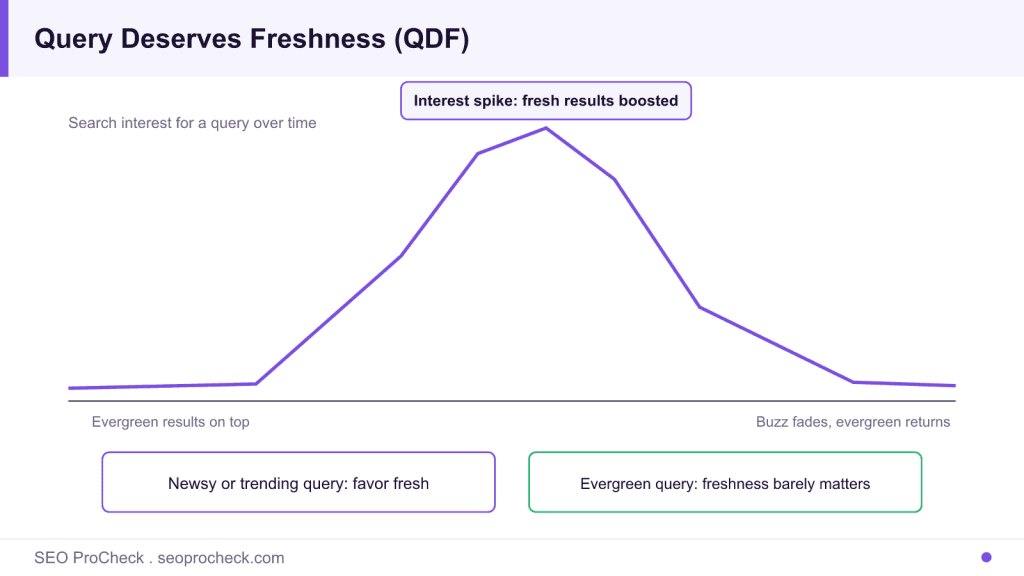
QDF, "Query Deserves Freshness", is Google's idea that some searches should favor recent content because the topic is trending, newsy, or time-sensitive. Coined years ago by Google's Amit Singhal, it means Google detects a spike in interest for a query and temporarily boosts fresh results over older, otherwise-authoritative pages.
The stakes are about matching your content cadence to the query. For a topic that "deserves freshness," a page from 2019 loses to a solid one published this morning, no matter how strong the old page's links are. For an evergreen topic, freshness barely matters and constant re-dating is wasted effort. Knowing which is which tells you where to spend your update time.
A real example of QDF
Search a footballer's name the day a transfer rumor breaks and the results reshuffle toward articles published in the last few hours, news pieces, live updates, hot takes, instead of the evergreen Wikipedia-style biography that normally sits on top. That temporary reshuffle toward recency is QDF doing its job: Google noticed the interest spike and decided this query, right now, deserves fresh answers. A week later, when the buzz dies down, the results settle back toward the stable, authoritative pages. Same query, different freshness weighting, driven entirely by real-time demand.
The key word in the name is "deserves." Freshness isn't a blanket bonus every page can claim by publishing recently, it's earned by the query, not the page. Google is effectively asking, for each search, "would a searcher here rather have something new or something proven?" For "latest iPhone reviews" the answer leans new; for "how does a combustion engine work" it leans proven. That's why dumping a 2026 into your title on an evergreen topic does nothing: the query never triggered the freshness demand in the first place, so there's no boost waiting to be claimed. You can only ride QDF on queries that actually want recency.
Which query types deserve freshness, and what to do about it
Not every query wants fresh content. Here's how to read the intent and match your content strategy to it.
| Query type | Freshness demand | Content implication |
|---|---|---|
| Breaking news ("earthquake," "election results") | Very high, results shift by the hour | Publish fast; timestamps and live updates matter |
| Recurring events ("Super Bowl," "WWDC") | High around the event window | Refresh your page for the current year before the spike |
| Trending topics (viral, seasonal spikes) | Elevated while interest is hot | Move quickly with timely angles, then maintain |
| Evolving info ("best laptop 2026," pricing) | Moderate, recency signals current relevance | Update annually; year-in-title and refreshed data help |
| Evergreen how-to ("how to tie a tie") | Low, the answer doesn't change | Don't chase freshness; depth and accuracy win |
| Definitional / historical ("what is photosynthesis") | Minimal | Stability and authority beat recency; leave it alone |
How to use QDF to your advantage
- Classify the query's freshness demand. Before optimizing, decide whether the topic is newsy, evolving, or evergreen. That single call drives everything else.
- Move fast on genuinely fresh queries. For trending or breaking topics, speed to publish beats polish. QDF rewards being early while interest is peaking.
- Refresh recurring pages before the spike. For annual events and "2026"-style queries, update the page ahead of the surge so you're already fresh when demand hits.
- Make freshness real, not cosmetic. Add new information, data, and examples, don't just change the date. Google's content freshness assessment looks at substantive change.
- Leave evergreen pages alone. For stable topics, pouring effort into re-dating is wasted. Spend that energy on depth, accuracy, and links instead.
Mistakes people make with QDF
- Faking freshness by changing the date. Bumping a timestamp with no real update is transparent and doesn't earn a lasting QDF boost.
- Chasing freshness on evergreen topics. Constantly "refreshing" a how-to that never changes wastes time QDF was never going to reward.
- Assuming freshness always beats authority. QDF is query-dependent. On stable queries, a trusted older page still outranks a hastily published new one.
- Expecting a permanent lift. The freshness boost is temporary, it fades as the query cools. Build lasting value, not a one-day spike.
- Ignoring intent. Not every "2026" query is newsy. Read the actual search intent before assuming freshness is the lever.
How to tell if a query actually deserves freshness
Before you pour effort into being first, run three quick checks that tell you whether the query wants recency at all. First, read the live SERP: if the top results carry visible publish dates from the last few days, or Google shows a Top stories carousel, the query is in a freshness window right now. If page one is dominated by pages that are years old and still ranking, freshness is not the lever and depth is. Second, look at Google Trends for the term: a sharp recent spike is the same demand signal QDF responds to, while a flat line means there is nothing to ride. Third, ask what a searcher would actually prefer for that phrase, latest reviews and prices lean fresh, while definitions and how-to steps lean proven.
When a query does deserve freshness, speed beats polish: publish a solid piece while interest peaks and refine it afterward. When it does not, spend that time on accuracy, examples, and internal links, because a cosmetic date change earns nothing and can erode trust if the body never changed. For recurring events, update the page in advance so you are already fresh when the annual surge arrives.
Frequently asked questions
What does QDF stand for?
Query Deserves Freshness. It's the concept that Google boosts recent content for queries where users clearly want up-to-date results, like breaking news or trending topics.
Is QDF still a thing?
The exact original mechanism is old and Google doesn't detail its current systems, but the principle absolutely persists: search results demonstrably favor freshness for time-sensitive queries. The label matters less than the behavior, which you can observe directly.
Does updating my page date trigger QDF?
No. Freshness isn't a date field you flip. Google looks for genuine changes to the content, and QDF only applies when the query itself demands recency in the first place.
Which queries trigger QDF?
Queries with a spike in interest or an obvious time-sensitive intent, breaking news, live events, trending topics, and "current best/price" searches. Evergreen and definitional queries mostly don't.
How is QDF different from a general ranking factor?
Freshness is one input among many ranking signals, but QDF is specifically about when that input gets weighted heavily. It's a conditional boost tied to query demand, not a constant ranking factor that applies everywhere.
Related reading: pair this with content freshness, and see how freshness fits among the broader ranking signals.
Take this with you
The assistant links open with a question about this page already written. Nothing is sent until you press enter.
Claude Vincent is a technical SEO consultant focused on crawlability, rendering, and AI-search visibility. He writes the field guides and case studies at SEO ProCheck, with a bias toward the durable, unglamorous work that decides whether search engines and AI answer engines can actually read and cite a site.
About SEO ProCheck
Technical SEO consulting and GEO strategy with 20 years of enterprise experience. Case studies, resources, and tools for search and AI visibility.
Work With Me
Technical SEO audits, GEO strategy, site migrations, and international SEO. Hourly consulting for teams who need hands-on support, not just reports.
Subscribe to our newsletter!








Recent Posts
- Most Top Sites Never Say Who They Are in Structured Data October 14, 2026
- Homepage Titles Are Mostly Too Short, Not Too Long October 8, 2026
- Who Actually Serves an llms.txt? 184 Top Sites Measured September 29, 2026