

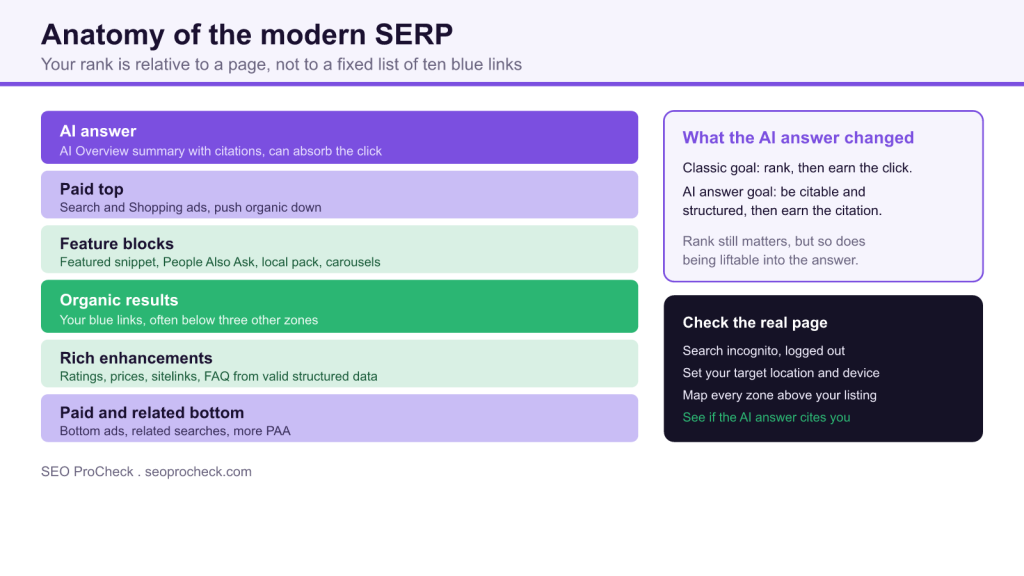
A SERP, or search engine results page, is the ranked mix of organic links, ads, and feature blocks a search engine assembles for a specific query. The ten blue links model is gone: your organic ranking now competes with paid slots, SERP features, and an AI answer that often sits on top.
- Read the results page in zones, because a number one result under an AI Overview, ads, and a snippet can still be buried.
- On answer heavy queries the goal shifts from earning the click to being a cited, structured source.
- Check rankings incognito, logged out, with your target location and device, because personalization distorts what you see.
- Valid structured data earns rich enhancements that make your listing bigger and more clickable at the same rank.
What a SERP is
A SERP, search engine results page, is the page you get back after a query: the ranked mix of organic links, ads, and special result blocks a search engine assembles for that specific search. It matters because the SERP is the battlefield where visibility is decided; two keywords with identical search volume can send wildly different traffic depending on how many features, ads, and AI answers sit between the user and your blue link.
The old mental model, "ten blue links", is dead. A modern SERP is a dynamically assembled page where your organic ranking is one element competing for attention against paid slots, SERP features, and increasingly an AI-generated answer sitting on top of everything.
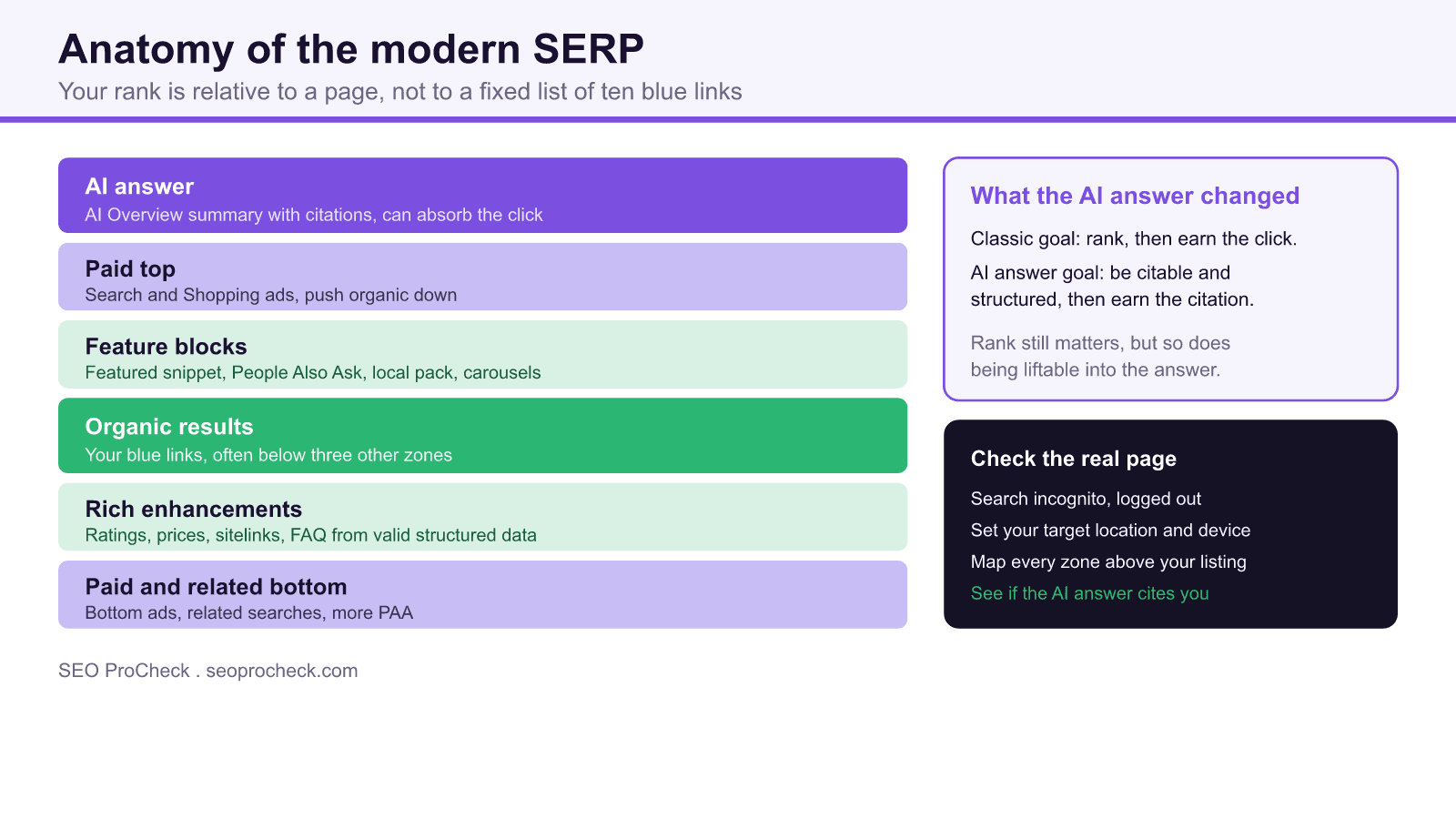
Anatomy of the modern SERP
Think of the results page in zones, top to bottom. Where you land in this stack, and what's stacked above you, determines whether ranking #1 organically actually earns the click.
| Zone | What appears | Who it rewards | Impact on your click |
|---|---|---|---|
| AI answer | AI Overviews / generated summaries with citations | Trusted, well-structured, citable sources | Can absorb the click entirely or drive it to cited pages |
| Paid top | Search & Shopping ads | Advertisers with budget + Quality Score | Pushes organic below the fold |
| Feature blocks | Featured snippet, People Also Ask, knowledge panel, local pack, image/video carousels | Structured, direct, entity-clear content | Position zero can win or bleed clicks |
| Organic results | The ranked "blue links" with titles, URLs, descriptions | Relevance, authority, intent match | Your core real estate, often below three other zones |
| Rich enhancements | Star ratings, prices, sitelinks, FAQ, breadcrumbs | Valid structured data | Bigger, more clickable listing at the same rank |
| Paid/related bottom | Bottom ads, related searches, more PAA | Advertisers; broad-intent queries | Last chance for the click |
The practical read: your rank is relative to a page, not to a fixed list. A #1 organic result under an AI Overview, a featured snippet, and four ads is buried; a #3 result on a feature-light query can be the first thing a user sees.
What the AI answer changed
The biggest shift is the answer layer. When an AI Overview generates a summary at the top, many informational queries get resolved without a click, the "zero-click" pattern, while some clicks redirect to the sources the answer cites. That flips the goal on a chunk of your keywords: you're no longer only fighting for rank, you're fighting to be one of the cited sources.
Here's the difference in plain terms:
Classic SERP intent:   rank in the top organic positions -> earn the click
AI-answer SERP intent: be citable and structured  -> earn the citation
                       (rank still matters, but so does being liftable)
This doesn't kill organic SEO, transactional and navigational queries still route to pages, and AI answers cite ranked, trusted sources. But it does mean structure, clarity, and entity signals now do double duty: they help you rank and help you get quoted. See featured snippets vs AI Overviews for how the two answer formats differ.
How to check the real SERP for your keywords
- Search the exact query in an incognito window. Log out, go incognito, and search. Personalization and login state distort what you see; a clean session is closer to the neutral SERP.
- Set location and device deliberately. The SERP changes by location and between mobile and desktop. Check both, using your target market's location, a local-pack query looks nothing alike across cities.
- Map the features above you. Note every zone before the first organic result: AI Overview, ads, featured snippet, PAA, carousels. That stack, not your rank number, tells you how visible you really are.
- Check whether an AI Overview cites you or your competitors. If one appears, see whose pages it links. Being cited is the new position zero on those queries.
- Cross-reference Search Console. Compare live SERP impressions against actual clicks. A high-impression, low-click query usually means the answer is being satisfied above your listing.
Common mistakes with SERPs
- Judging position from your own logged-in search. Personalization inflates your apparent rank. Fix: check incognito, logged out, with the correct target location.
- Chasing rank #1 while ignoring the features above it. Top organic under a stacked SERP can still starve for clicks. Fix: assess the whole page, and target the feature (snippet, PAA, citation) that's actually catching the eye.
- Assuming every keyword has the same SERP shape. Feature-heavy informational queries behave nothing like clean transactional ones. Fix: audit intent and SERP layout per keyword before setting expectations.
- Ignoring rich-result eligibility. A plain listing loses clicks to enhanced neighbors at the same rank. Fix: add valid structured data to earn rich results like ratings, prices, and sitelinks.
- Treating zero-click queries as failures. Some queries were always going to be answered on the page. Fix: prioritize keywords with genuine click intent, and pursue citations on the answer-heavy ones.
Frequently asked questions
What does SERP stand for?
Search Engine Results Page, the page a search engine returns for a query, containing the ranked mix of organic links, ads, and feature blocks assembled specifically for that search.
Why do two people see different SERPs for the same query?
Location, device, language, login state, and search history all shape the page. That's why you check rankings incognito, logged out, and pinned to your target location, otherwise you're measuring your own personalization, not the real result.
Is ranking #1 still worth it with AI Overviews on the page?
Yes, but with a caveat. On answer-heavy queries an AI Overview can absorb clicks, and being one of its cited sources matters as much as raw rank. On transactional and navigational queries, top organic positions still drive the majority of clicks.
What's the difference between a SERP feature and an organic result?
An organic result is a standard ranked listing, title, URL, description. A SERP feature is a special block (featured snippet, local pack, knowledge panel, image carousel, AI Overview) that sits alongside or above organic results and often draws the eye first.
How do I see which SERP features my keywords trigger?
Search each query in a clean incognito session with your target location and log the features present, or use a rank tracker that records SERP features per keyword. Then reconcile with Search Console impressions and clicks to see which features are actually costing or earning you traffic.
Take this with you
The assistant links open with a question about this page already written. Nothing is sent until you press enter.
Claude Vincent is a technical SEO consultant focused on crawlability, rendering, and AI-search visibility. He writes the field guides and case studies at SEO ProCheck, with a bias toward the durable, unglamorous work that decides whether search engines and AI answer engines can actually read and cite a site.
About SEO ProCheck
Technical SEO consulting and GEO strategy with 20 years of enterprise experience. Case studies, resources, and tools for search and AI visibility.
Work With Me
Technical SEO audits, GEO strategy, site migrations, and international SEO. Hourly consulting for teams who need hands-on support, not just reports.
Subscribe to our newsletter!








Recent Posts
- Most Top Sites Never Say Who They Are in Structured Data October 14, 2026
- Homepage Titles Are Mostly Too Short, Not Too Long October 8, 2026
- Who Actually Serves an llms.txt? 184 Top Sites Measured September 29, 2026