

AI Summary
Keyword stuffing is loading a page with keywords or numbers to manipulate rankings, and it is named explicitly in Google's spam policies. The usual outcome is not a dramatic penalty but quiet suppression: quality systems score the page as low value and it underperforms indefinitely.
- The defining trait is text that exists for a crawler, not a reader, from repetition to hidden text to city lists.
- Blatant cases like hidden text can draw a manual action, but silent algorithmic scoring is the common result.
- Audit anchor text and templates, not just body copy, because stuffing hides in footers and boilerplate at scale.
- The fix is adding substance, not deleting words, since the repetition was filling a content vacuum.
Keyword stuffing is loading a page with keywords or numbers in an attempt to manipulate rankings, repeating terms unnaturally, listing city after city, or hiding text where only crawlers look. Unlike most SEO sins, this one is named explicitly in Google's spam policies, which means the downside isn't "suboptimal", it's demotion or removal from results.
What stuffing looks like in 2026
The cartoon version, white text on a white background, mostly died out because it's trivially detectable. What survives is subtler and often unintentional: template-generated location pages that swap a city name into otherwise identical copy, meta keywords thinking applied to body text, and e-commerce category descriptions written by someone who was clearly paid per keyword occurrence. The defining trait hasn't changed since 2003: text that exists for a crawler, not a reader. Modern language models are, inconveniently for spammers, extremely good readers.
Stuffing patterns and what they cost you now
| Pattern | Example | Modern consequence |
|---|---|---|
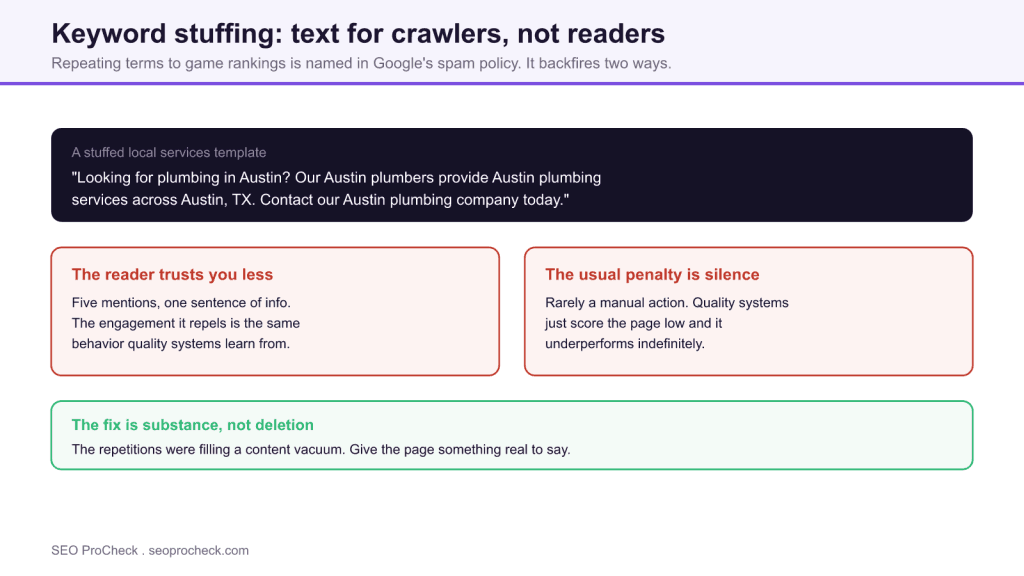
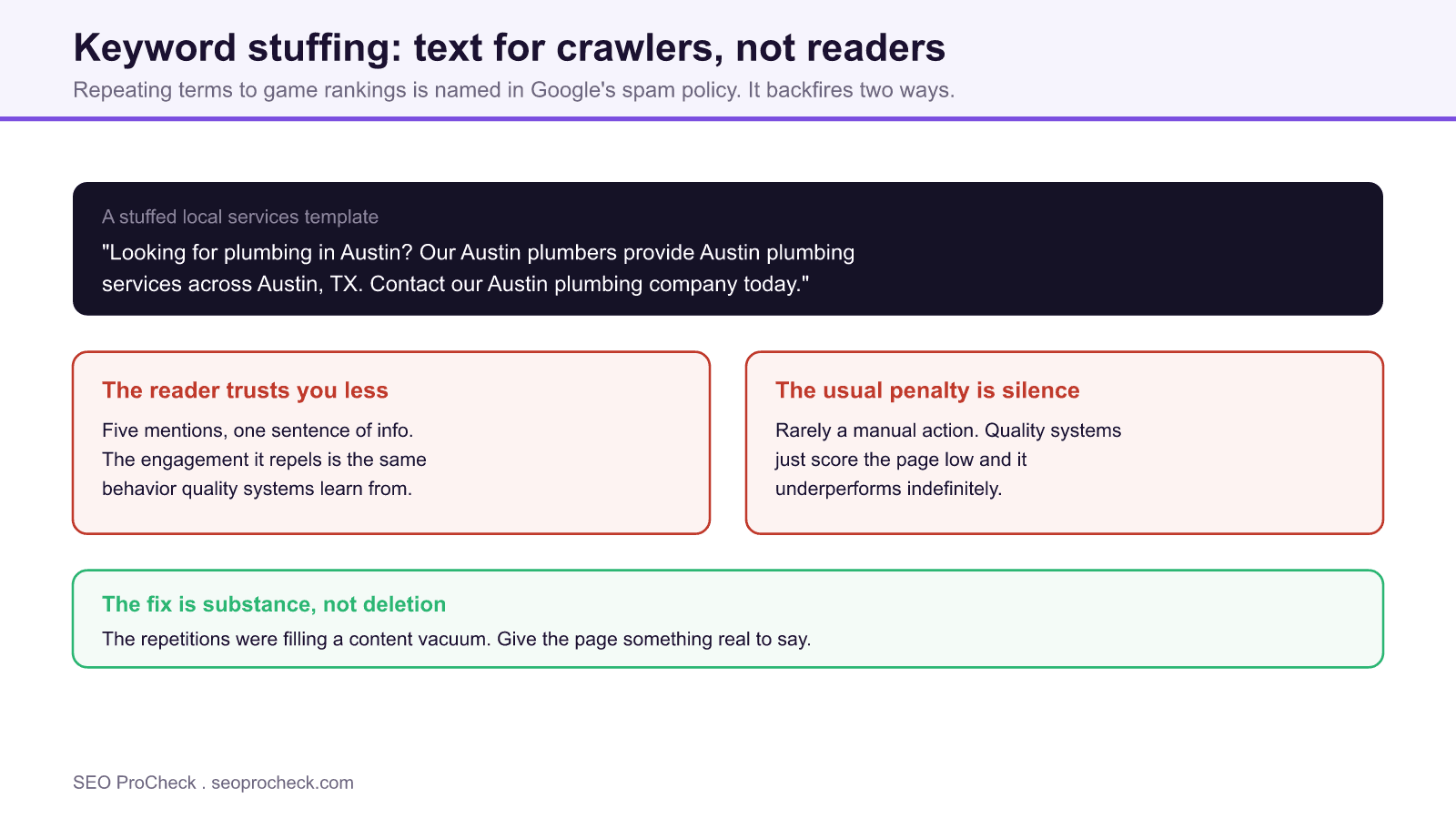
| Compulsive repetition | "Our custom cabinets are the best custom cabinets. Buy custom cabinets today from the custom cabinet experts." | Rarely a manual action alone; quality systems simply score the page as low value and it underperforms indefinitely, the punishment is invisibility, so most owners never learn why |
| City/phone-number lists | Footer or paragraph listing 40 towns "served," identical copy per location page | Explicitly cited in Google's spam policy examples; doorway-page treatment, and pages cannibalize each other into irrelevance |
| Hidden text & stuffed attributes | Background-matched text, CSS-shifted blocks, keyword paragraphs in alt text | Old-school deception signals; among the likeliest to draw a manual action because intent to deceive is unambiguous |
| Variant grinding | "cheap flights, flights cheap, cheapest flight deals, cheap flight deal" as body copy or anchors | Treated as the same pattern as repetition; also poisons internal anchor-text signals sitewide |
| Tag stuffing | Title tags and H1s packed with 4 comma-separated keywords | Google rewrites the title, CTR drops, and the page forfeits the one placement where clear language actually helps |
Note the first row carefully, because it describes the majority of real-world cases: no penalty notification, no dramatic drop, just a page that never performs, forever, while its owner blames the algorithm. The distinction from keyword density matters here: density is a neutral, mostly useless measurement; stuffing is the behavior at the far end of it, and the behavior is what's policed.
A real example of the failure mode
A local services template: "Looking for plumbing in Austin? Our Austin plumbers provide Austin plumbing services across Austin, TX. Contact our Austin plumbing company today." One sentence of information, five mentions of the target. A human reads it and trusts the business less, which is the detail that makes stuffing self-defeating even before algorithms enter the picture. The engagement it repels is the same behavior quality systems learn from. Local sites are the top offender category, usually because someone conflated this with legitimate local keyword targeting, which is about matching real local search language, not chanting the city name.
How to check it on your own site
- Crawl with Screaming Frog and export titles, H1s, and meta descriptions. Sort by length and scan for comma-separated keyword lists and repeated head terms, tag stuffing is the fastest to find and fix.
- Use custom search in the crawl to count occurrences of your main commercial terms per page. You're not chasing a percentage, you're finding the outlier pages where the count is triple everything else's.
- Inspect templates, not just posts: footers, sidebars, category descriptions, and boilerplate blocks are where stuffing hides at scale. View source on one page of each template type.
- Check for hidden text by pressing Ctrl+A on key pages (revealing background-matched text) and searching the rendered source for off-screen CSS positioning on keyword-bearing blocks.
- Review Search Console to Security & Manual Actions. Almost always empty, see the table for why algorithmic suppression is the common case, but a "pure spam" or "thin content" notice changes your priorities entirely. A pattern-based scan like this site's keyword stuffing detection check covers the same ground automatically.
Common audit mistakes
- Flagging every repetition as stuffing. A pipe-fitting spec sheet legitimately says "pipe" fifty times. Fix: judge intent and readability, does each occurrence carry information, or is it incantation?
- Fixing body copy and ignoring anchors. Sites clean their paragraphs, then keep 200 internal links reading "best CRM software." Fix: audit anchor text distribution in the same pass.
- Deleting keywords instead of adding substance. Stripping repetitions from a hollow page leaves a hollow page. Fix: the real cure is giving the page something to say, the repetitions were filling a content vacuum.
- Missing generated content. AI-drafted product descriptions can stuff at industrial scale if the prompt demanded keyword inclusion. Fix: spot-check generated inventory with the same outlier method.
- Expecting instant recovery. After cleanup, algorithmic reassessment takes recrawls and often a core update cycle. Fix: set expectations in weeks-to-months and track per-URL in GSC.
FAQ
How many times can I use a keyword before it's stuffing?
There's no number, and asking for one is density-era thinking. The test is whether a reader would notice the repetition as unnatural. If yes, you're there, regardless of count.
Will keyword stuffing get my site penalized?
It can draw a manual action in blatant cases (hidden text especially), but the common outcome is quieter: quality systems score the content down and the pages simply never rank to potential.
Is alt-text keyword stuffing still a thing?
Yes, and it's doubly dumb, it degrades accessibility for screen-reader users while adding a documented spam signal. Alt text should describe the image, keyword or not.
My competitor stuffs keywords and still ranks. Why?
They likely rank despite it, on the strength of links, brand, or weak competition, not because of it. Copying a stronger site's worst habit imports the liability without the assets that offset it.
Can I just fix it by lowering keyword density?
Diluting a ratio doesn't address why the page reads like spam. Rewrite for a reader and the ratio takes care of itself, the difference between the metric and the offense is exactly what the keyword density entry covers.
Take this with you
The assistant links open with a question about this page already written. Nothing is sent until you press enter.
Claude Vincent is a technical SEO consultant focused on crawlability, rendering, and AI-search visibility. He writes the field guides and case studies at SEO ProCheck, with a bias toward the durable, unglamorous work that decides whether search engines and AI answer engines can actually read and cite a site.
About SEO ProCheck
Technical SEO consulting and GEO strategy with 20 years of enterprise experience. Case studies, resources, and tools for search and AI visibility.
Work With Me
Technical SEO audits, GEO strategy, site migrations, and international SEO. Hourly consulting for teams who need hands-on support, not just reports.
Subscribe to our newsletter!








Recent Posts
- Most Top Sites Never Say Who They Are in Structured Data October 14, 2026
- Homepage Titles Are Mostly Too Short, Not Too Long October 8, 2026
- Who Actually Serves an llms.txt? 184 Top Sites Measured September 29, 2026