


AI Summary
Yelp is a review and local discovery platform that matters to local SEO well beyond its own app: it is a high authority citation, its pages rank in Google for many "best X near me" queries, and its data has historically fed Apple Maps, Siri, and other surfaces. The catch is Yelp filters a large share of reviews and explicitly tells businesses not to ask customers for them.
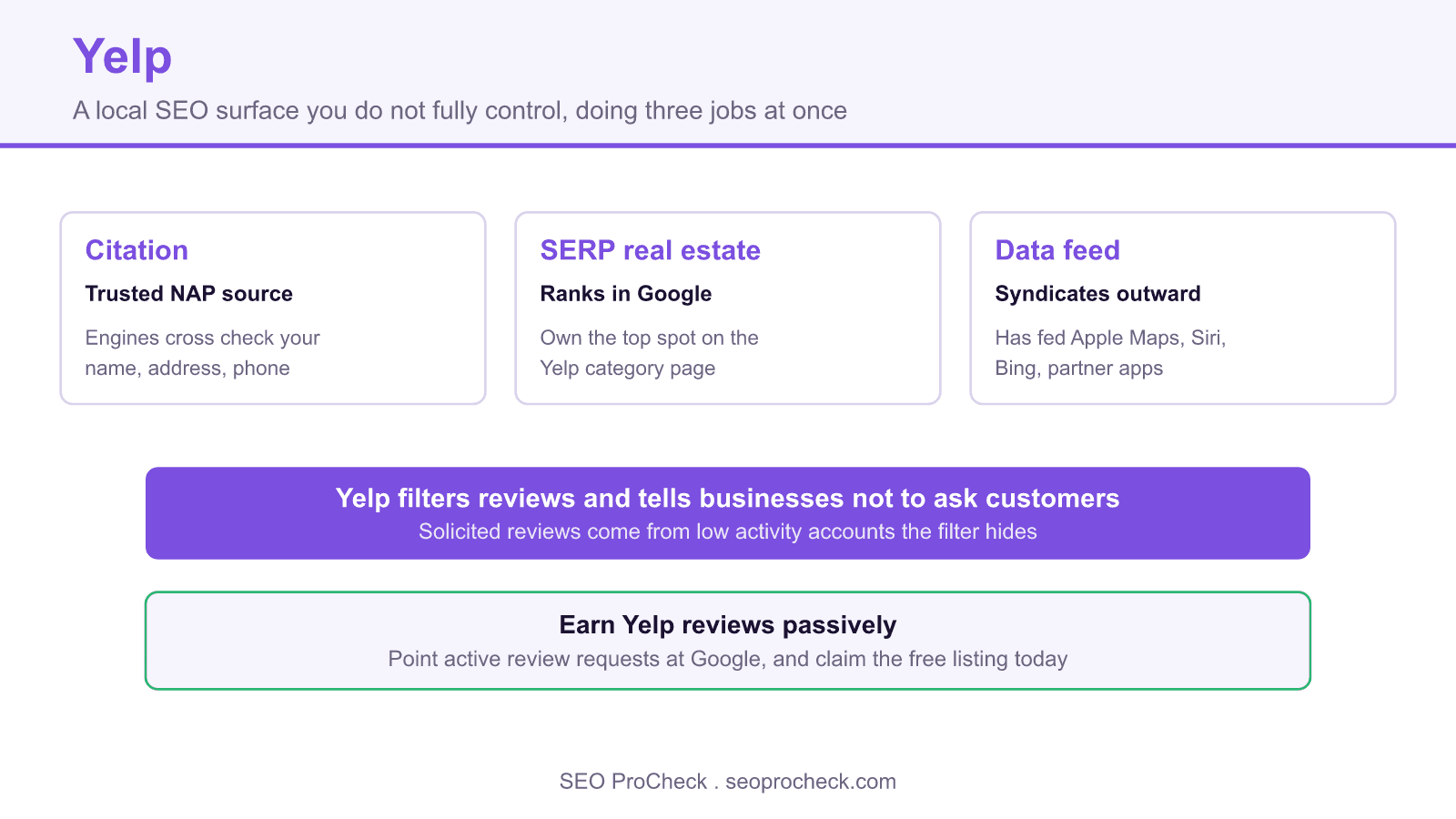
- Yelp does three jobs: a trusted NAP citation, SERP real estate in Google, and a data feed to partner platforms.
- The recommendation filter hides reviews from new or low activity accounts, and solicited reviews are exactly what it eats.
- Run separate review strategies: earn Yelp reviews passively, and point active requests at Google.
- Claim the listing, match NAP to your Google Business Profile to the character, and fix stale syndicated data at the source.
Yelp is a review and local-discovery platform that matters to local SEO well beyond its own app: it's a high-authority citation, its pages rank organically in Google for a huge share of "best X near me" queries, and its data has historically flowed into other ecosystems, including Apple's, where Yelp ratings and reviews long powered place cards served to Siri and Apple Maps users. Ignore it and you're leaving surfaces you don't control to whatever three-year-old reviews happen to sit there.
What Yelp actually does for a local business
Three distinct jobs, often confused:
Citation. A claimed Yelp listing is one of the most trusted NAP sources on the web. Search engines cross-reference your name, address, and phone against sites like Yelp to decide whether your business data is credible, the mechanics are covered under NAP consistency.
SERP real estate. Search "best plumber [city]" and a Yelp category page is very often sitting in Google's top five. You can't outrank Yelp for those queries in most markets, but you can be the top-rated business on that Yelp page, which is the next best thing. That's a ranking battle fought entirely inside Yelp: review quantity, rating, and category accuracy.
Data feed. Yelp syndicates. Apple used Yelp as a core data and reviews provider for Apple Maps for roughly a decade (Apple has since shifted toward its own place data and other sources, but legacy Yelp data still echoes around), and Yelp content has fed voice assistants and dozens of smaller apps and directories. A wrong phone number on Yelp doesn't stay on Yelp.
The filtered-review reality
Here's the part that makes business owners want to put a fist through a wall: Yelp's "recommendation software" hides a chunk of your reviews, often the majority. Filtered reviews sit behind a grey "not currently recommended" link and don't count toward your star rating. The filter is aggressive toward reviews from new accounts, accounts with no friends or photos, one-off reviewers, and anything arriving in a suspicious burst.
The kicker: Yelp explicitly tells businesses not to ask customers for reviews at all. Not "don't incentivize", don't ask. Solicited reviews tend to come from exactly the low-activity accounts the filter eats, so asking often produces nothing but filtered reviews and, at worst, a "consumer alert" banner if Yelp detects compensated reviewing. This is the opposite of Google's rules, where asking (without incentives) is fine. Run one review strategy across both platforms and you'll comply with neither.
Yelp signals and where they travel
| Yelp signal | What it affects on Yelp | Where it feeds beyond Yelp |
|---|---|---|
| NAP data (claimed listing) | Listing accuracy, category placement | Citation graph for Google/Bing; syndicated to partner apps and directories |
| Recommended reviews & star rating | Rank in Yelp search and category pages | Historically Apple Maps place cards and Siri answers; review snippets in Bing; third-party apps via Yelp Fusion API |
| Filtered ("not recommended") reviews | Nothing, invisible to rating and rank | Nowhere; they're dead weight |
| Categories & attributes | Which Yelp searches you appear in | Category context for aggregators consuming Yelp data |
| Photos | Listing engagement, conversion within Yelp | Surface in synced place cards on partner platforms |
| Review responses | Trust signal to readers; no rank effect | Visible wherever the review syndicates |
| Yelp page itself | Not applicable | Ranks directly in Google organic for brand and "best X in city" queries |
How to check your Yelp position
- Claim and audit the listing. Search yourself at biz.yelp.com, claim if unclaimed, then verify NAP, categories, hours, and website URL against your Google Business Profile, they should match to the character.
- Count the filtered reviews. On your public Yelp page, scroll to the bottom and click "not currently recommended." Note the ratio. A 3.5 rating built on 12 visible reviews with 30 filtered ones reads very differently.
- Check the Google SERP. Search your top three money queries and note where Yelp pages rank. If a Yelp category page sits above your site, open it and record your position and rating on that page, that's a ranking you can move.
- Search yourself on Yelp. Use the Yelp app with your service and city. If you're buried under competitors with worse ratings, your categories are probably wrong or your listing is thin.
- Trace the syndication. Check your listing in Apple Maps and Bing for stale Yelp-sourced data (old hours, dead phone numbers). Fix at the source, then correct downstream via Apple Business Connect and Bing Places.
Common mistakes and fixes
- Blasting customers with Yelp review requests. The filter eats them and Yelp may penalize you. Fix: earn Yelp reviews passively, a Yelp sticker, a link in your footer, and point active requests at Google instead.
- Leaving the listing unclaimed. Unclaimed means wrong hours you can't fix and a "Is this your business?" banner. Fix: claim it today; it's free.
- Fighting the filter with fake or traded reviews. Yelp runs sting operations and slaps public consumer-alert banners on offenders. Fix: don't. The banner does more damage than any filter.
- Ignoring negative reviews. A calm, factual owner response is read by hundreds of future customers; the silence is too. Fix: respond to every review over two stars of impact, publicly and briefly.
- Treating Yelp as only-for-restaurants. Home services, medical, legal, automotive, Yelp category pages rank in Google across all of them. Check your vertical before dismissing it.
Frequently asked questions
No mechanism exists. The filter is algorithmic and recalculates continuously; reviews sometimes surface later if the reviewer's account becomes more active. You cannot request restoration, and anyone selling that service is selling smoke.
Yelp says no, and no credible study has shown advertisers get favorable filtering. Ads buy placement, not treatment. Longstanding owner suspicion to the contrary has never been substantiated in court or data.
Not directly, Google's local algorithm counts its own reviews. Indirectly, yes: the citation supports your entity, Yelp pages carrying your business rank in Google, and review sentiment across the web contributes to prominence.
Less than it used to. Apple built out its own ratings and place data and leans on multiple providers now, but Yelp data shaped Apple Maps listings for years and remnants persist. Keeping Yelp accurate is still cheap insurance for Apple surfaces.
Yes, for thirty minutes: claim, complete, photograph, done. It's a trusted citation from day one, and the listing quietly accumulates value while you focus energy on Google.
Take this with you
The assistant links open with a question about this page already written. Nothing is sent until you press enter.
Claude Vincent is a technical SEO consultant focused on crawlability, rendering, and AI-search visibility. He writes the field guides and case studies at SEO ProCheck, with a bias toward the durable, unglamorous work that decides whether search engines and AI answer engines can actually read and cite a site.
About SEO ProCheck
Technical SEO consulting and GEO strategy with 20 years of enterprise experience. Case studies, resources, and tools for search and AI visibility.
Work With Me
Technical SEO audits, GEO strategy, site migrations, and international SEO. Hourly consulting for teams who need hands-on support, not just reports.
Subscribe to our newsletter!








Recent Posts
- Most Top Sites Never Say Who They Are in Structured Data October 14, 2026
- Homepage Titles Are Mostly Too Short, Not Too Long October 8, 2026
- Who Actually Serves an llms.txt? 184 Top Sites Measured September 29, 2026