

AI Summary
Thin affiliate content is a page built to earn commissions that adds nothing a buyer could not get straight from the merchant, recycling feed descriptions, stock photos and a buy button. Google has flagged this pattern for two decades, and enough thin pages can drag down a whole domain, so the fix is enriching pages with real first hand testing rather than deleting them.
- The tell is zero original assets: no photos you took, numbers you measured, or opinions only you could have.
- Added value beats word count; a short review with real testing outranks respun spec sheets.
- Mark affiliate links rel sponsored or nofollow and keep a visible disclosure.
- Upgrade thin templates in place because Google judges sitewide quality.

What Is Thin Affiliate Content?
Thin affiliate content is a page built to earn affiliate commissions that adds nothing a buyer couldn't get straight from the merchant, it recycles manufacturer blurbs, network product feeds, and stock photos, then wraps them around a "Buy Now" button. Google has flagged this pattern as low-value for two decades, and it is one of the easiest ways to get an affiliate site buried by a spam update or a core update.
The stakes are simple: a thin affiliate page can rank for a week, then vanish when the algorithm decides it has no reason to exist. Worse, enough of these pages can drag down the rest of a domain, because Google evaluates sitewide quality, not just the page you're worried about.
A Real Example
Say you run a site reviewing robot vacuums. You publish "Best Robot Vacuum 2026" and the whole article is: the manufacturer's spec sheet copied for each model, an Amazon product image, one paragraph of AI-spun praise per unit, and affiliate links. You never plugged one in, never measured suction, never checked how it handles a rug edge or pet hair. That's thin affiliate content.
The fix isn't more words. It's a page where you actually ran the vacuums: a photo of the dustbin after one pass on your own floor, a note that Model A got stuck on the kitchen threshold, a battery-life number you timed yourself, and a plain recommendation of which one you'd buy with your own money. Same affiliate links, completely different value.
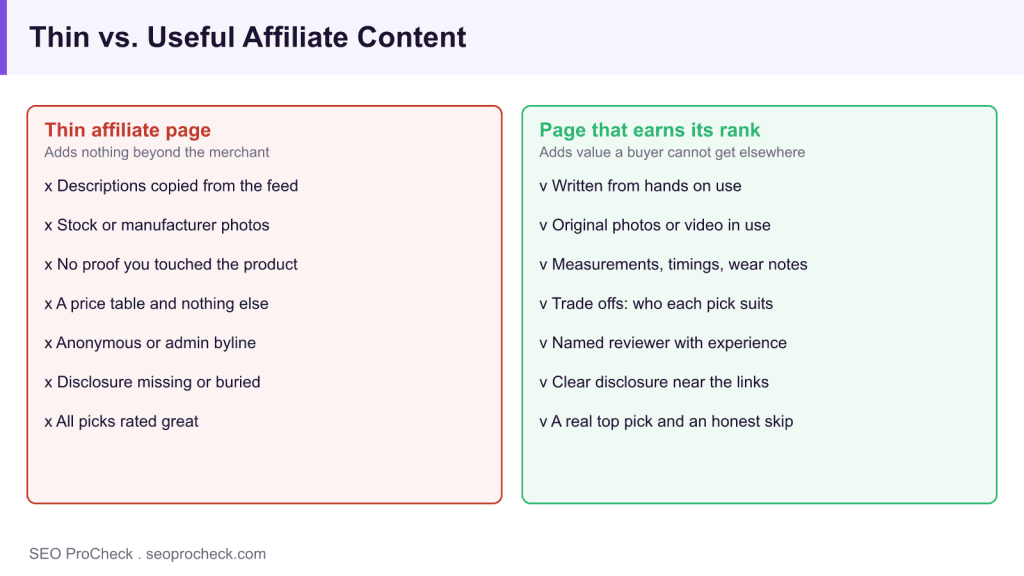
Thin vs. Genuinely Useful Affiliate Content
| Signal | Thin affiliate page | Page that earns its rank |
|---|---|---|
| Product descriptions | Copied verbatim from the merchant or network feed | Written from hands-on use, in your own words |
| Images | Stock / manufacturer press photos | Original photos or video of the product in use |
| Testing evidence | None, no proof you touched the product | Measurements, timings, wear notes, screenshots |
| Comparison | A price table and nothing else | Trade-offs explained: who each pick is right for |
| Author | Anonymous or "admin" | Named reviewer with relevant experience |
| Disclosure | Missing or buried | Clear affiliate disclosure near the links |
| Recommendation | "All great, buy any of them!" | A clear top pick and an honest "skip this one" |
How to Check Whether Your Affiliate Pages Are Thin
- Pick a product page and ask: would this help someone who has never seen the product? If the only answer is "it has the price and a link," it's thin.
- Copy a sentence from your product description and paste it into Google in quotes. If dozens of other affiliate sites show the exact same text, you're republishing a feed, not writing a review.
- Count the original assets on the page: photos you took, numbers you measured, opinions only you could have. Zero original assets is the tell.
- Check Search Console for pages that got impressions, then flatlined after a core or spam update, that decay pattern often points straight at thin affiliate templates.
- Confirm every money page carries a visible affiliate disclosure and that comparison links are marked correctly (see the common mistakes below).
- Read the page out loud. If it sounds like a spec sheet with adjectives bolted on, rewrite it around what you actually know.
Common Mistakes (and How to Fix Them)
- Publishing at scale before you've touched a single product. Fix: cut the catalogue in half and make the survivors genuinely first-hand. Ten pages you actually tested beat a hundred you didn't.
- Rewriting the manufacturer copy with an AI spinner and calling it original. Fix: spinning doesn't add value or experience, add real testing notes and your own photos instead.
- Leaving affiliate links as plain follow links. Fix: Google expects affiliate links to carry
rel="sponsored"(ornofollow); mark them and keep a clear disclosure. See Affiliate Link Disclosure. - Ranking every product as "excellent" to keep every commission alive. Fix: pick a real winner and say what you'd skip. Honest verdicts are what readers, and reviewers on the SERP, reward.
- Treating thin pages as a noindex problem. Fix: don't hide them, upgrade them. Enriching a page with real experience beats deleting a URL that already has some traction.
Frequently Asked Questions
Is all affiliate content considered thin by Google?
No. Google has said plainly that affiliate links are fine, what it penalizes is affiliate pages with no added value. A review packed with first-hand testing, original photos, and honest comparisons is a legitimate page that happens to earn a commission.
How much original content is "enough" to escape thin?
There's no word count that saves you. A 400-word review with real measurements and photos beats a 2,000-word page of respun spec sheets. The bar is added value a reader couldn't get from the merchant, not volume.
Can AI-written affiliate content be thin?
It usually is, when AI is used to paraphrase product descriptions at scale. AI can help you draft or structure, but it can't have used the product. If nobody tested anything, the page is thin no matter what wrote it.
Will thin affiliate pages hurt my whole site?
They can. Google assesses sitewide quality, so a pile of thin templates can weigh on stronger pages. Enrich or consolidate them rather than letting them sit.
Do I really need an affiliate disclosure for SEO?
The disclosure itself is an FTC and trust requirement, not a ranking factor, but missing disclosures signal a low-trust, money-first page, which is exactly the profile quality systems distrust. Add it and mark the links correctly.
Related Reading
- Affiliate SEO: Analysis of 10,000 Search Results to See Who Ranks
- People-First Content and E-E-A-T
- Thin Content Alert
Take this with you
The assistant links open with a question about this page already written. Nothing is sent until you press enter.
Claude Vincent is a technical SEO consultant focused on crawlability, rendering, and AI-search visibility. He writes the field guides and case studies at SEO ProCheck, with a bias toward the durable, unglamorous work that decides whether search engines and AI answer engines can actually read and cite a site.
About SEO ProCheck
Technical SEO consulting and GEO strategy with 20 years of enterprise experience. Case studies, resources, and tools for search and AI visibility.
Work With Me
Technical SEO audits, GEO strategy, site migrations, and international SEO. Hourly consulting for teams who need hands-on support, not just reports.
Subscribe to our newsletter!








Recent Posts
- Most Top Sites Never Say Who They Are in Structured Data October 14, 2026
- Homepage Titles Are Mostly Too Short, Not Too Long October 8, 2026
- Who Actually Serves an llms.txt? 184 Top Sites Measured September 29, 2026