

AI Summary
Topical authority is the trust a search engine places in your site on a subject because you have covered it deeply and connected the pieces with internal links. It is not a published Google metric, it is an observable pattern where comprehensive, well linked coverage helps the whole site rank on that topic.
- It comes from coverage plus internal linking, not from any single blockbuster post.
- With it, new pages on the topic rank faster and hold longer, and the site ranks for long tail queries it never targeted.
- Build it by mapping coverage, filling question gaps, connecting a pillar and cluster, and matching query intent.
- It differs from domain authority: it is subject specific and driven by structure, not backlinks.
What topical authority actually means
Topical authority is the trust a search engine places in your site on a specific subject because you have covered that subject deeply and connected the pieces together. It is not a number Google publishes or a confirmed named metric, it is a pattern that shows up when your content genuinely owns a topic instead of dabbling in it.
The stakes are simple. When a site has topical authority, new pages on the same subject rank faster and hold longer, and Google is more willing to surface them for related queries it has never seen that page rank for. When you do not have it, every page fights alone from a standing start, and thin one-off posts get buried under sites that treated the topic like a body of work.
A real example
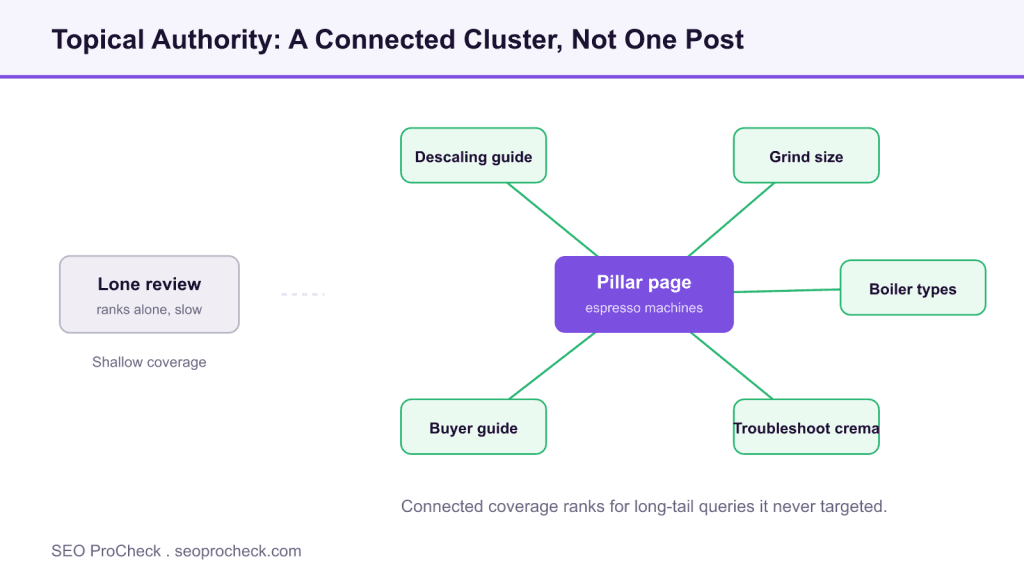
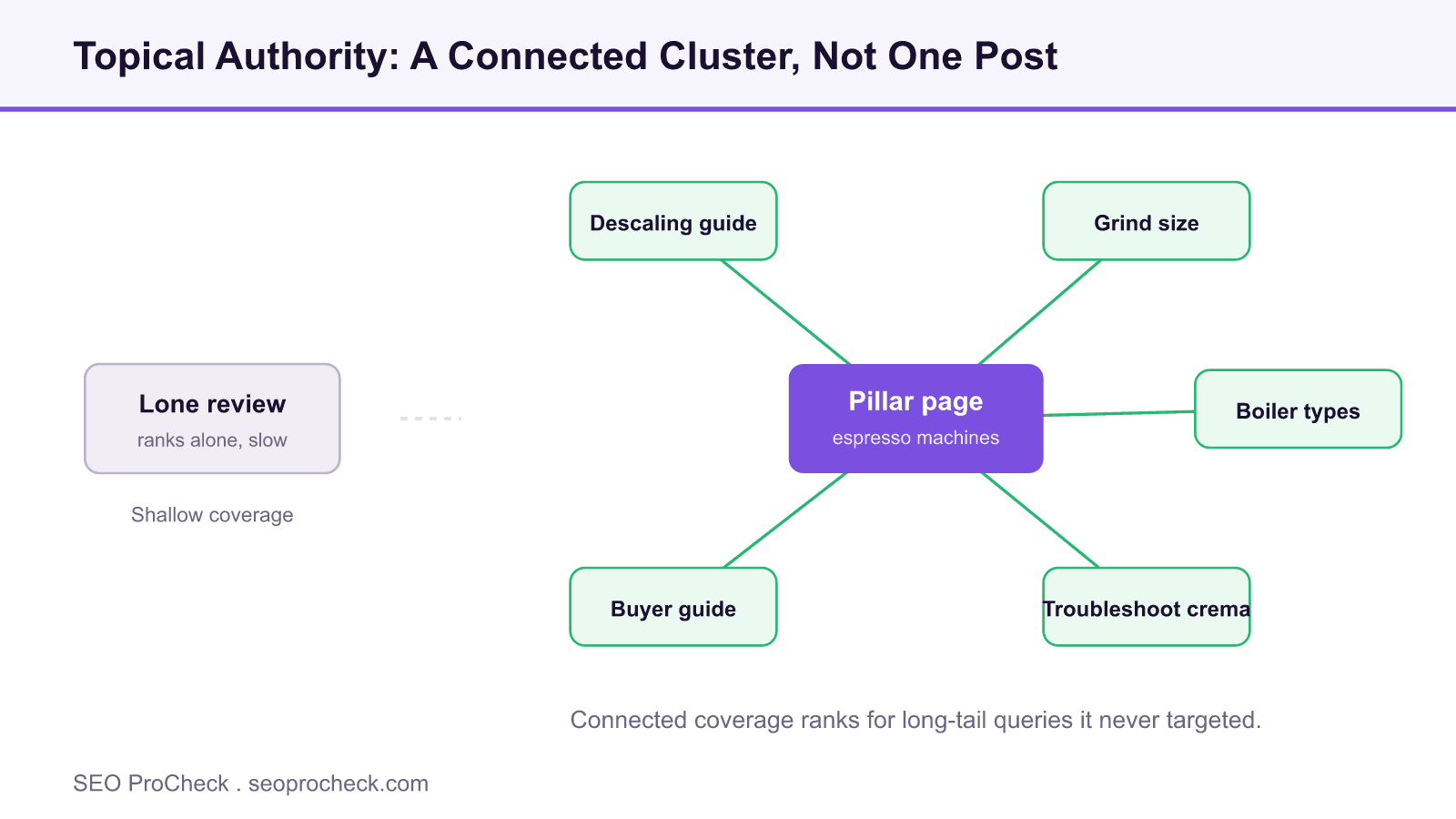
Say you run a site about espresso machines. You publish one review of a single machine and call it a day. A competitor publishes a review of that machine, plus a guide to descaling, a piece on grind size, a comparison of boiler types, a troubleshooting page for weak crema, and a buyer's guide that links to all of them. Six months later the competitor ranks for "why is my espresso sour," "single vs double boiler," and dozens of long-tail queries neither of you targeted directly, because Google now reads that site as an espresso authority. Your lone review never got that lift. That gap is topical authority in the wild, and it comes from coverage plus internal linking, not from any single blockbuster post.
Coverage depth vs. authority signals
People conflate "publishing a lot" with "building authority." They are not the same. The table below separates the surface behavior from the signal Google can actually read.
| Signal | What weak sites do | What authoritative sites do | Why it matters |
|---|---|---|---|
| Subtopic coverage | One page skims the whole topic | Every meaningful subtopic gets its own dedicated page | Google sees the full shape of the subject, not a headline |
| Internal linking | Pages float, linked only from the menu | Related pages link to each other with descriptive anchors | Link paths tell Google which pages belong to the same cluster |
| Query intent match | All pages chase the same head keyword | Pages map to distinct questions and stages | Avoids cannibalization; each page earns its own rankings |
| Update cadence | Publish once, never revisit | Refresh cornerstone pages as the topic evolves | Freshness plus depth reinforces the ownership signal |
| Author & source credibility | Anonymous, no citations | Named expertise, real sources, first-hand detail | Supports E-E-A-T on top of raw coverage |
How to check topical authority on your own site
- Map what you cover. List every page you have on the target topic and the exact query each one answers. If two pages answer the same query, you have overlap, not depth.
- Find the gaps. Write out the questions a real person asks across the whole journey, awareness, comparison, troubleshooting, buying. Mark which have no page. Those gaps are why Google does not yet trust you on the topic.
- Trace your internal links. Pick your best page and check how many other on-topic pages link to it with a relevant anchor. If the answer is "only the nav menu," your cluster is not connected.
- Check Search Console by topic, not by page. In Google Search Console, filter queries by the topic's core term. A site with authority ranks for a long tail of related queries it never optimized for directly. If you only rank for the exact phrases in your titles, you are still shallow.
- Watch how fast new pages rank. Publish a new page in the cluster and note how many days until it earns impressions. As authority builds, that lag shrinks. That speed-up is the clearest proof the signal is real.
Common mistakes and how to fix them
- Chasing volume over coverage. Fifty thin posts on scattered topics build nothing. Fix: pick one topic and cover it end to end before you move on.
- Publishing orphan pages. A great page nobody links to internally is invisible to the cluster. Fix: every new page gets links from and to its siblings the day it goes live.
- Keyword cannibalization. Five pages all targeting "best espresso machine" split your own authority. Fix: consolidate or re-angle each page to a distinct intent.
- Ignoring the pillar. No central hub means Google has nothing to anchor the cluster to. Fix: build one comprehensive pillar page that links out to every subtopic and back.
- Treating it as one-and-done. Authority decays when the topic moves and your pages don't. Fix: schedule refreshes on your cornerstone pages.
FAQ
Is topical authority a real Google ranking factor?
Not as a confirmed, named metric with a dial you can turn. Google has never published a "topical authority score." It is a useful shorthand for the observable pattern where comprehensive, well-linked coverage of a subject helps the whole site rank better on that subject. Treat it as a strategy, not a switch.
How long does it take to build?
Longer than a single post and shorter than most people fear, typically a few months of consistent, connected coverage before you notice new pages ranking faster. There is no fixed number; it depends on competition and how complete your coverage gets.
How is topical authority different from domain authority?
Domain authority (a third-party metric, not Google's) is a whole-site strength estimate driven heavily by backlinks. Topical authority is subject-specific and driven by coverage and internal structure. A brand-new site can build topical authority on a narrow niche without a huge backlink profile.
Do I need backlinks to build it?
They help, but the core levers are on your own site: depth of coverage, clean internal linking, and matching real query intent. Links from other sites reinforce the signal; they don't replace the coverage.
How does this connect to entities?
Closely. Comprehensive topic coverage overlaps with entity SEO, the clearer and more consistent your content is about the things (entities) in your topic, the easier it is for Google to place you as an authority on it.
Related reading
Claude Vincent is a technical SEO consultant focused on crawlability, rendering, and AI-search visibility. He writes the field guides and case studies at SEO ProCheck, with a bias toward the durable, unglamorous work that decides whether search engines and AI answer engines can actually read and cite a site.
About SEO ProCheck
Technical SEO consulting and GEO strategy with 20 years of enterprise experience. Case studies, resources, and tools for search and AI visibility.
Work With Me
Technical SEO audits, GEO strategy, site migrations, and international SEO. Hourly consulting for teams who need hands-on support, not just reports.
Subscribe to our newsletter!







Recent Posts
- Can AI Crawlers Actually Read Your Site? I Measured 400 of the Biggest September 5, 2026
- The Pre-Publish Quality Gate for AI-Assisted Content August 6, 2026
- AGENTS.md vs llms.txt vs llms-full.txt: Which Agent File Does What July 18, 2026