

AI Summary
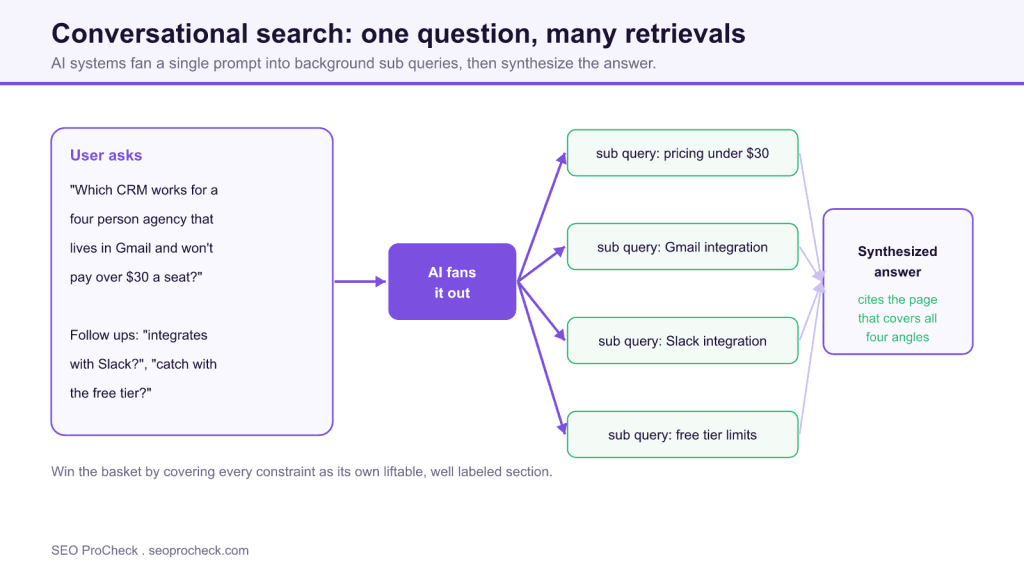
Conversational search is search conducted as a dialogue: full natural language questions, follow ups that build on earlier turns, and context carried across the session. AI systems fan a single prompt into several background sub queries and synthesize the answer, so your page competes for membership in a basket of machine generated queries, not one keyword.
- Queries arrive fully specified with constraints baked in, like price ceilings, team sizes, and skill levels.
- Content built for two word keywords loses to self contained sections that answer one question completely.
- Phrase subheadings as the questions users ask, and cover the natural follow up turns on the page or one link away.
- Measure citations and assistant referrals, because keyword volume undercounts this demand structurally.
Conversational search is search conducted as a dialogue: full natural-language questions, follow-ups that build on earlier turns, and context the system carries across the whole session. It changes what a "query" even is, your content is now matched against long, constraint-loaded questions and against the synthetic sub-queries AI systems spin out of them, and content built for two-word keywords competes badly in that game.
What changed about the query
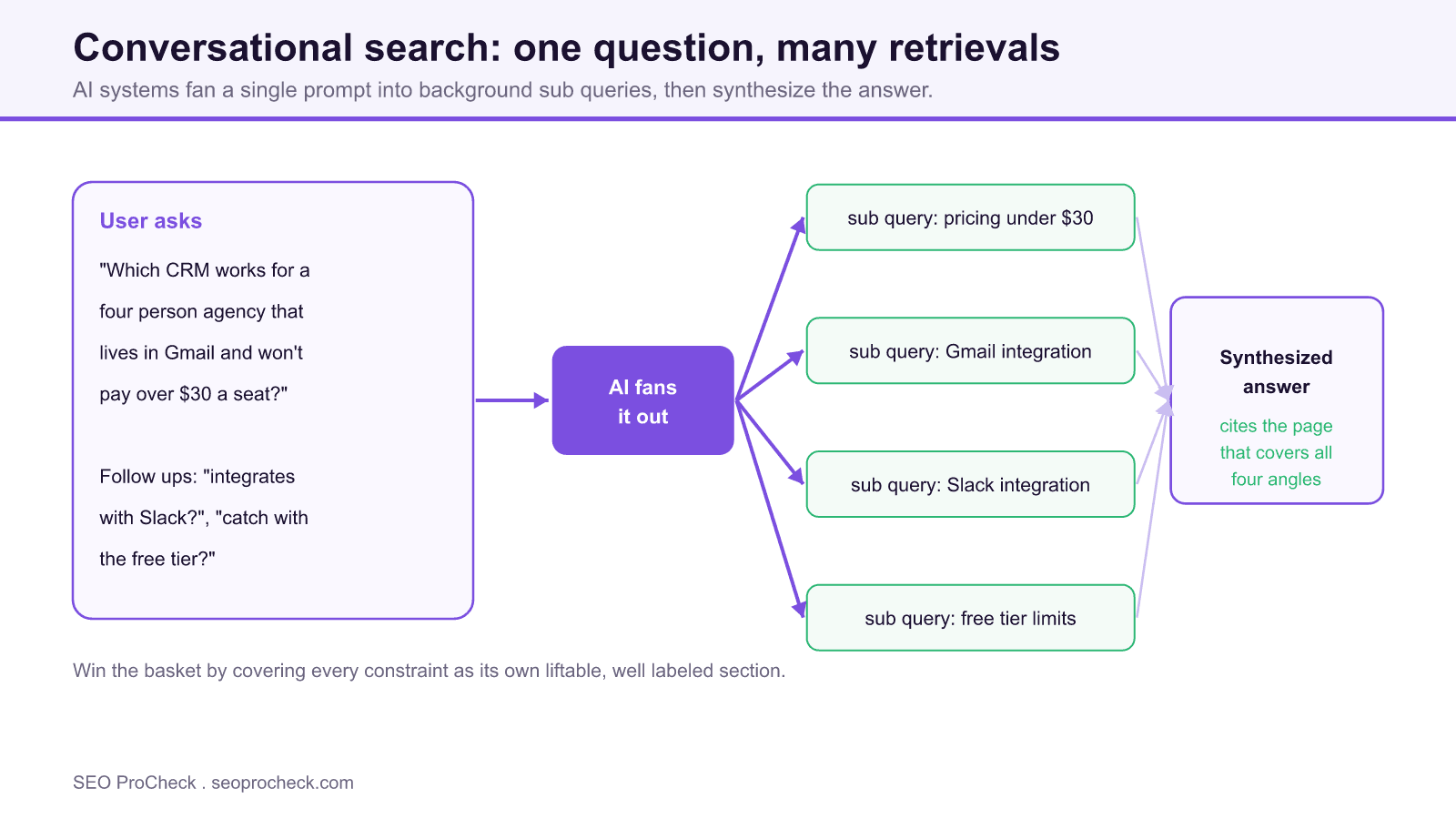
Classic search trained users to compress: "best crm small business." Conversational interfaces removed the compression. The same user now asks, "which CRM works for a four-person agency that lives in Gmail and won't pay more than $30 a seat?", then follows up with "does it integrate with Slack?" and "what's the catch with the free tier?" Three things just happened that keyword-era content never had to handle: the intent arrived fully specified, the constraints arrived inside the query, and the second and third questions inherited context from the first.
Under the hood there's a fourth change. Systems like Google's AI Mode take one conversational prompt and fan it out into multiple background searches, the pricing angle, the integration angle, the alternatives angle, then synthesize from whatever those retrievals return. Your page isn't competing for one query; it's competing for membership in a basket of machine-generated sub-queries you never see in a keyword tool. The AI Mode entry covers that mechanism in detail.
Keyword search vs. conversational search: what to adapt
| Dimension | Keyword search | Conversational search | Content adaptation |
|---|---|---|---|
| Query form | 2 to 4 word fragments | Full questions with constraints baked in ("under $30", "for beginners", "without coding") | Cover the constraint variations explicitly, price tiers, team sizes, skill levels, as addressable sections, not throwaway mentions |
| Intent | Inferred from a fragment; often ambiguous | Stated outright in the phrasing | Match content to the four intent types precisely; the search intent guide maps this |
| Session shape | One-shot query, then clicks | Multi-turn; each answer seeds the next question | Anticipate the follow-ups, pricing, comparisons, gotchas, alternatives, on the same page or one internal link away |
| What wins | Ranked pages; position decides visibility | Passages selected and cited inside a synthesized answer | Self-contained sections that answer one question completely under a heading phrased like that question |
| Measurement | Rankings, clicks, keyword volume | Citations, assistant referrals, brand presence in answers | Track question-style queries in GSC and assistant referrers in analytics; keyword volume undercounts this demand structurally |
How to check where you stand
- Pull question queries from GSC. Regex-filter for queries starting with how, what, why, which, can, does, should. Note their share of impressions and how much longer they run than your head terms, that's your conversational demand already arriving.
- Run your money topics as conversations. Ask an assistant the way a customer would, including two or three follow-ups. Record which pages get cited at each turn, and whether yours ever appears past turn one.
- Audit your headings against real questions. Take the questions from steps 1 to 2 and grep your H2s/H3s. Clever section labels ("The Bottom Line", "Diving Deeper") match nothing a user asks.
- Test passage completeness. Read each section under its heading in isolation. If it answers its question without the surrounding page, it's liftable into an answer; if not, it isn't.
- Mine People Also Ask and assistant follow-up chips for your core topics, they are a free map of the follow-up turns you should already cover.
Common mistakes and fixes
- Optimizing only head terms. The demand didn't shrink; it re-formed as long, specific questions that keyword tools report as near-zero volume. Fix: treat question clusters as first-class targets even when the volume column says nobody asks.
- Spinning up one page per question variant. Fifty thin pages for fifty phrasings is the old playbook, and fan-out retrieval punishes it. Fix: consolidated pages with distinct, well-labeled sections per sub-intent, depth wins the basket.
- Ignoring the follow-up turns. Ranking for the opening question and losing every subsequent turn hands the session to whoever covers pricing, comparisons, and objections. Fix: close the loop on the obvious next questions; the conversational query optimization guide works through this turn by turn.
- Writing headings for style instead of retrieval. Fix: phrase subheadings as the question each section answers, boring, and effective.
- Treating it as identical to voice search. They overlap but differ: voice search is an input method, often one-shot and local; conversational search is a session model with memory, on any input. Optimizing for one doesn't automatically cover the other.
FAQ
Is conversational search the same thing as voice search?
No. Voice search means speaking the query, and historically it skewed short, local, and single-turn. Conversational search is about the dialogue structure, context carried across turns, and most of it happens by typing into chat-style interfaces. A page can be well-optimized for a spoken "near me" query and useless in a five-turn product research conversation.
Do keywords still matter if queries are full sentences?
Yes, as topics rather than strings. The entities and attributes inside conversational queries, product names, features, price points, use cases, are what retrieval matches on. What died is string-matching one exact phrase; what matters now is covering the attribute space of a topic thoroughly enough to surface across many phrasings.
How do I show up in follow-up questions, not just the first answer?
Cover the natural second and third turns where your first-turn content lives. If your page wins "what is X," the follow-ups are "X vs Y," "how much does X cost," and "what are X's downsides", put substantive, citable sections for those on the page or one obvious internal link away, so the retrieval step keeps finding you as the conversation narrows.
Does conversational search kill my traffic?
It reshapes it. Simple lookup questions increasingly get answered in the interface, and that click was already dying via featured snippets. What survives the answer layer is the click for depth, comparisons, tools, data, experience, and citations that put your brand inside the answer itself. Plan for fewer, higher-intent visits and measure presence, not just sessions.
How do I optimize a page for conversational search?
Phrase your subheadings as the exact questions users ask, then answer each one completely in the section beneath it so the passage stands on its own. Cover the constraints people attach to the topic, such as price tiers, team sizes, and skill levels, as addressable sections rather than passing mentions, because those constraints are what the retrieval step matches on.
Which tools show conversational demand?
Google Search Console reveals the question style queries already reaching you when you regex filter for how, what, why, which, can, and does. People Also Ask boxes and the follow up chips in AI interfaces map the next turns, and your analytics referrer report surfaces assistant traffic that keyword volume tools structurally undercount.
Take this with you
The assistant links open with a question about this page already written. Nothing is sent until you press enter.
Claude Vincent is a technical SEO consultant focused on crawlability, rendering, and AI-search visibility. He writes the field guides and case studies at SEO ProCheck, with a bias toward the durable, unglamorous work that decides whether search engines and AI answer engines can actually read and cite a site.
About SEO ProCheck
Technical SEO consulting and GEO strategy with 20 years of enterprise experience. Case studies, resources, and tools for search and AI visibility.
Work With Me
Technical SEO audits, GEO strategy, site migrations, and international SEO. Hourly consulting for teams who need hands-on support, not just reports.
Subscribe to our newsletter!








Recent Posts
- Most Top Sites Never Say Who They Are in Structured Data October 14, 2026
- Homepage Titles Are Mostly Too Short, Not Too Long October 8, 2026
- Who Actually Serves an llms.txt? 184 Top Sites Measured September 29, 2026