

AI Summary
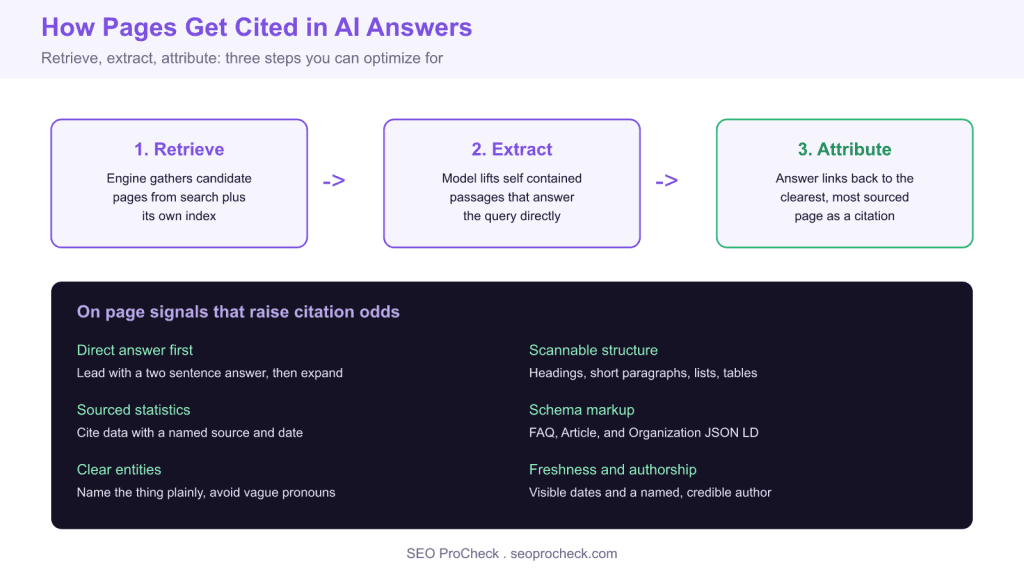
To get cited in AI answers, structure each page so a model can lift a self contained, trustworthy passage: lead with a direct two sentence answer, attach named sources and dates to any statistic, name your entities plainly, and use question headings, lists, tables, and schema. These same edits help classic search, so one well built page earns visibility in both the traditional index and the generative layer above it.
- Answer engines retrieve, extract, and attribute: optimize each page to be the passage they quote.
- Lead with a two sentence answer, then expand, so the model has a clean quotable unit.
- Attribute every statistic to a named source and date, and never fabricate numbers.
- Publish an llms.txt, allow the AI crawlers you want, and add FAQ and Article schema.
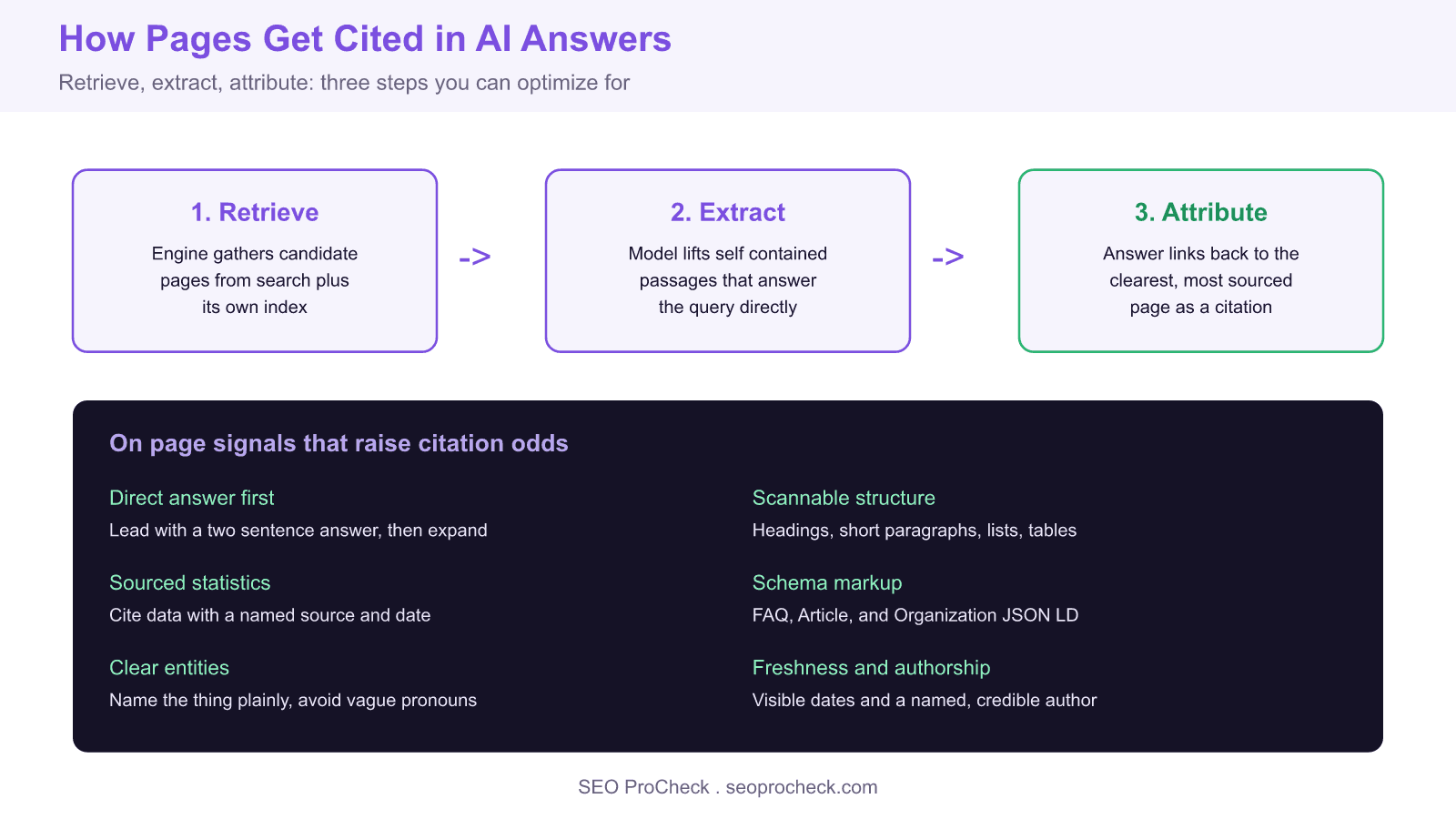
Getting cited in an AI answer is a different game from ranking a blue link, but the two reinforce each other. Answer engines such as ChatGPT search, Perplexity, Google AI Overviews, and Copilot pull candidate pages, extract the passages that most directly answer a prompt, and attribute a citation to the clearest source. The source article makes the case that visibility in generative outputs rewards content that is factual, well structured, and easy to quote. The sections below turn that into concrete edits you can make to a page today.
Write the answer before you write the article
Language models favor passages that stand on their own. If a sentence only makes sense after three paragraphs of setup, it is a poor extraction candidate. Lead every page and every major section with a direct, two sentence answer to the question a user would actually type, then expand with detail. This is the same pattern you see in the AI Summary block at the top of this page. A self contained answer near the top gives the model a clean, quotable unit and gives human readers the payoff immediately.
Make claims verifiable
Models are tuned to prefer statements they can trust. Attach a named source and a date to any statistic, and link to the primary source rather than a second hand roundup. Instead of writing that a tactic improves results, state who measured it, when, and by how much, then link the study. Verifiable, attributed facts are more likely to be lifted into an answer than vague assertions, and they protect you when a model checks a claim against other pages. Never invent numbers to sound authoritative: a fabricated statistic that contradicts the wider corpus can get your page dropped from consideration entirely.
Name your entities plainly
Extraction breaks when a passage leans on pronouns and unnamed references. Write the product, company, or concept by name in the sentence that carries the key fact, rather than relying on it or this to point back. Clear entity naming also helps knowledge based systems connect your page to the right topic. Support it with Organization and Article schema so the machine readable layer agrees with the visible text about who published the page and what it is about.
Structure for extraction
Descriptive headings phrased as the questions users ask, short paragraphs, bulleted lists, and comparison tables all give a model discrete, labeled chunks to pull from. A three column table of options with a one line takeaway per row is far easier to summarize than the same information buried in prose. Add FAQPage schema built from real questions, because a question and answer pair is already the exact shape an answer engine wants.
Publish an llms.txt and keep crawlers welcome
Emerging practice is to publish an llms.txt file at your site root that points AI systems to your most important, clean content, alongside a full text variant. Just as important, confirm that the AI crawlers you want to reach are not blocked in robots.txt. If your goal is citation, verify that user agents such as those used by the major answer engines can fetch your pages, then decide deliberately which to allow. Blocking every AI crawler and then hoping to be cited is a contradiction worth catching early.
What has changed since this was written
AI answer surfaces have moved from experiment to default. Google AI Overviews now appear on a large share of informational queries, ChatGPT and Perplexity ship live web search with citations, and the practice of publishing an llms.txt file has spread quickly across documentation and marketing sites. The underlying advice has held up: clear answers, sourced facts, named entities, and clean structure remain the levers. What is new is that these signals now feed two audiences at once, the classic search index and the generative layer sitting on top of it, so a single well structured page earns visibility in both.
Signal to edit checklist
| Signal | Concrete edit | Why it helps citation |
|---|---|---|
| Direct answer | Two sentence answer at the top of each section | Gives the model a self contained quote |
| Sourced data | Add source name, date, and link per statistic | Raises trust and verifiability |
| Entities | Name products and orgs in the key sentence | Improves extraction accuracy |
| Structure | Question headings, lists, comparison tables | Creates labeled, quotable chunks |
| Schema | FAQPage, Article, Organization JSON LD | Confirms meaning to machines |
| Access | Publish llms.txt, allow chosen AI crawlers | Lets engines fetch and index you |
Related reading
- What generative engine optimization means in practice
- What researchers found about ranking in AI search
- Fix structured data warnings to strengthen machine readability
Frequently asked questions
What does it mean to get cited in an AI output?
It means an answer engine such as Perplexity, ChatGPT search, or Google AI Overviews uses your page as a source and links to it in its generated response. Citation is the AI era equivalent of a ranked result, and it depends on your content being quotable, trustworthy, and easy to extract.
How is optimizing for LLMs different from traditional SEO?
The fundamentals overlap heavily: crawlable pages, clear structure, and authority all still matter. The difference is emphasis. LLM optimization rewards self contained answers, attributed facts, and clean passage level structure, because the engine extracts and quotes rather than simply ranking a link.
Do I need an llms.txt file to be cited?
It is not required, but it is a low cost signal. An llms.txt file at your site root points AI systems to your key content and a full text version, which can help them find and use your best pages. Just as important is making sure your robots.txt does not block the AI crawlers you want reaching your content.
Does schema markup help with AI citations?
Yes, indirectly. Schema such as FAQPage, Article, and Organization gives machines an unambiguous read of who published a page, what it covers, and which question and answer pairs it contains. That machine readable layer supports accurate extraction and attribution alongside your visible content.
Should I add statistics to improve citation odds?
Add statistics only when they are real and you can attribute them to a named source with a date. Sourced data is exactly the kind of verifiable fact answer engines prefer to quote. Never fabricate figures, because a statistic that conflicts with the wider corpus can cause a model to distrust and skip your page.
Will optimizing for AI hurt my normal search rankings?
No. The two goals are largely aligned. Clear answers, sourced facts, named entities, and clean structure improve the experience for human readers and classic search crawlers as much as for generative engines, so a single well built page tends to gain in both channels.
Claude Vincent is a technical SEO consultant focused on crawlability, rendering, and AI-search visibility. He writes the field guides and case studies at SEO ProCheck, with a bias toward the durable, unglamorous work that decides whether search engines and AI answer engines can actually read and cite a site.
About SEO ProCheck
Technical SEO consulting and GEO strategy with 20 years of enterprise experience. Case studies, resources, and tools for search and AI visibility.
Work With Me
Technical SEO audits, GEO strategy, site migrations, and international SEO. Hourly consulting for teams who need hands-on support, not just reports.
Subscribe to our newsletter!







Recent Posts
- Can AI Crawlers Actually Read Your Site? I Measured 400 of the Biggest September 5, 2026
- The Pre-Publish Quality Gate for AI-Assisted Content August 6, 2026
- AGENTS.md vs llms.txt vs llms-full.txt: Which Agent File Does What July 18, 2026