


AI Summary
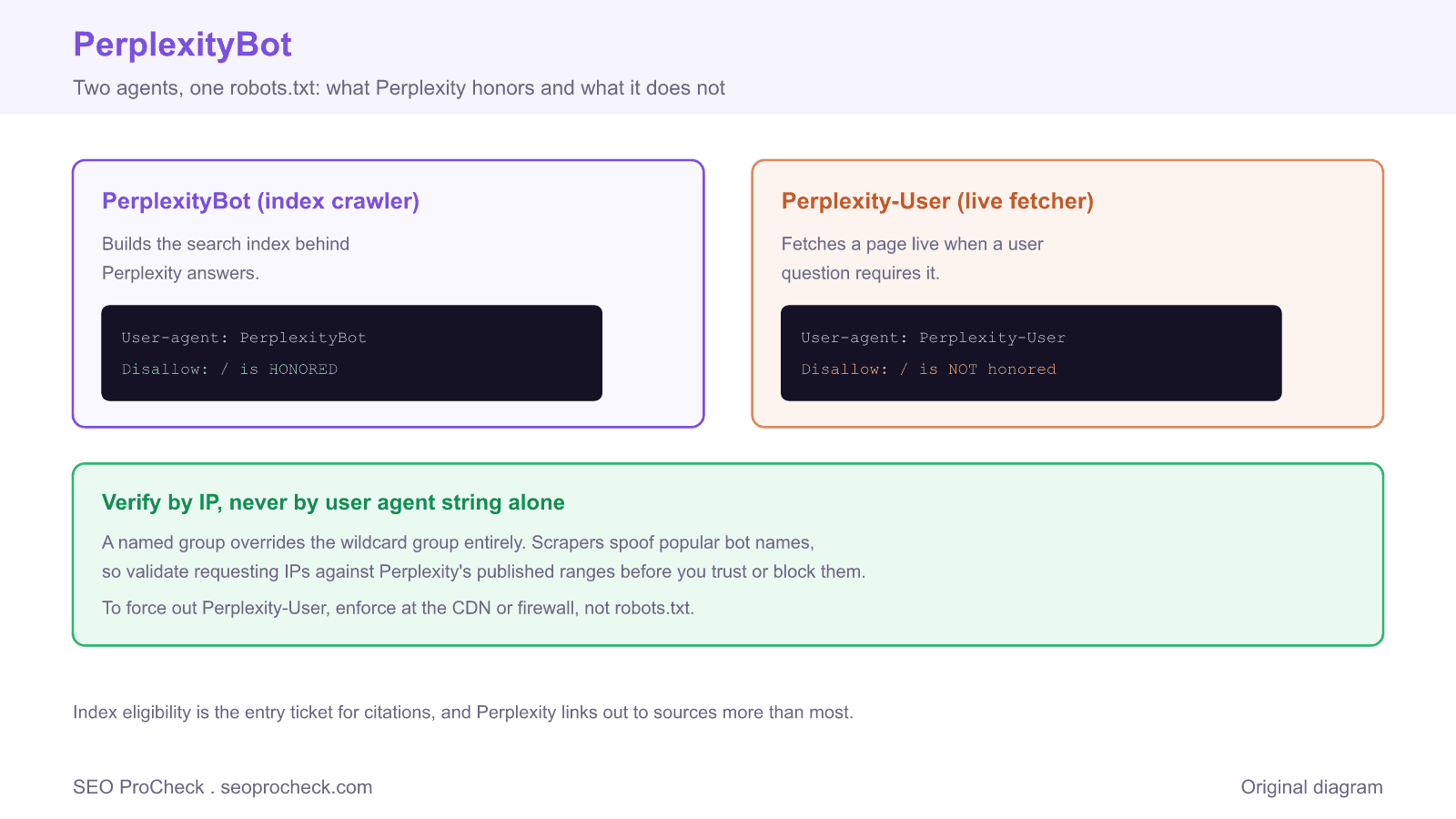
PerplexityBot is the crawler Perplexity uses to build the search index behind its AI answer engine, and blocking it removes you from citations that drive real referral traffic. Perplexity also runs a separate Perplexity-User agent that fetches pages live and generally ignores robots.txt, so the two must be managed differently.
- Block PerplexityBot in robots.txt and your pages age out of Perplexity's index over time.
- Perplexity-User skips robots.txt, so enforce at the CDN or firewall if you truly want it gone.
- A named user agent group overrides the wildcard group entirely.
- Verify requesting IPs against Perplexity's published ranges, since scrapers spoof bot names.
What PerplexityBot is
PerplexityBot is the crawler Perplexity uses to build the search index behind its AI answer engine. If it can't fetch your pages, you are not eligible to be cited in Perplexity's answers, and since Perplexity links out to sources more aggressively than almost any other AI product, that eligibility is real referral traffic, not a vanity metric.
The actual user agent string
This is what shows up in your access logs when the index crawler visits:
Mozilla/5.0 AppleWebKit/537.36 (KHTML, like Gecko; compatible; PerplexityBot/1.0; +https://perplexity.ai/perplexitybot)Perplexity also operates a second, separate agent that fetches a page live when a user's question requires it:
Mozilla/5.0 AppleWebKit/537.36 (KHTML, like Gecko; compatible; Perplexity-User/1.0; +https://perplexity.ai/perplexity-user)These two do different jobs, and robots.txt treats them differently, that split is where most misconfiguration happens. The same crawler-versus-fetcher split exists at Anthropic; see the ClaudeBot entry for how their trio compares.
robots.txt directives vs. what Perplexity actually does
| robots.txt rule | Perplexity's documented behavior |
|---|---|
User-agent: PerplexityBotDisallow: / | Honored. Your pages drop out of Perplexity's index over time and stop appearing as citations sourced from that index. |
User-agent: PerplexityBotDisallow: /drafts/ | Honored. Path-scoped rules work the same as for any REP-compliant crawler, block sections, keep the rest crawlable. |
User-agent: *Disallow: / | Applies to PerplexityBot only when no PerplexityBot-specific group exists. A named group overrides the wildcard group entirely, a common source of "why is it still crawling" confusion. |
User-agent: Perplexity-UserDisallow: / | Generally not honored. Perplexity's docs state user-initiated fetches ignore robots.txt on the grounds that a human explicitly requested that page. Block it at the CDN or firewall if you truly want it gone. |
Crawl-delay: 10 | Non-standard directive; don't count on it. If PerplexityBot hits you too hard, rate-limit at the server or CDN layer instead. |
Allow: exceptions inside a Disallow block | Standard longest-match precedence applies. Full precedence rules with test cases live in the complete robots.txt reference. |
The compliance dispute you should know about
In 2025, Cloudflare published research accusing Perplexity of crawling with undeclared user agents to route around blocks; Perplexity disputed the findings. You don't have to pick a side to take the practical lesson: never trust a user agent string alone. Verify by IP. Perplexity publishes its official IP ranges as JSON, linked from its bot documentation pages, precisely so you can separate the real bot from scrapers wearing its name.
A sane starting policy
Most sites that want AI-answer visibility can start here and adjust from logs:
User-agent: PerplexityBot
Allow: /
Disallow: /search/
Disallow: /cart/
Translation: index the content, stay out of the utility pages that waste crawl and can't be cited anyway. If you run paid content, scope the Disallow to the paywalled paths rather than blocking sitewide, a partial block preserves citation eligibility for the pages you actually want marketed. And whatever policy you pick, write it down somewhere humans will find it, because the next person to edit robots.txt will not read your mind.
How to check PerplexityBot activity on your site
- Grep your access logs:
grep -i "PerplexityBot" access.log | awk '{print $1}' | sort | uniq -c | sort -rn, this gives you requesting IPs by volume. - Validate those IPs against Perplexity's published IP list. Anything claiming to be PerplexityBot from outside those ranges is an impostor.
- Check the status codes you're serving it. A wall of 403s usually means your WAF or bot-management layer is blocking it even though your robots.txt allows it.
- Fetch your own robots.txt and confirm which group actually applies, named group beats wildcard.
- In analytics, segment referrals from
perplexity.ai. That's the payoff side of the ledger: citations turning into visits.
Common mistakes and fixes
- Blocking with the wildcard group and assuming it covers Perplexity-User. It doesn't, user-initiated fetches skip robots.txt. Fix: enforce at the WAF/CDN if blocking is genuinely the goal.
- Allowing the bot in robots.txt while your firewall 403s it. The two layers disagree and the stricter one wins. Fix: audit bot-management rules; several vendors block AI crawlers by default now.
- Relying on
Crawl-delay. It's not part of the standard and support is inconsistent everywhere. Fix: server-side rate limiting. - Blocking PerplexityBot, then asking why competitors get cited and you don't. Index eligibility is the entry ticket. Fix: decide deliberately, per the tradeoffs in the GPTBot vs ClaudeBot vs PerplexityBot comparison.
- Judging compliance from UA strings in logs. Scrapers spoof popular bot names constantly. Fix: IP verification before you accuse anyone of ignoring your rules.
FAQ
Does blocking PerplexityBot remove my existing citations?
Not instantly. Indexed pages age out rather than vanishing the moment you block. And Perplexity-User can still fetch a URL live when a user asks about it specifically, so your content can surface in answers even with the index crawler blocked.
Is PerplexityBot collecting training data for an LLM?
Perplexity positions its crawler as building a retrieval index for its answer engine, not as harvesting foundation-model training data. If that distinction matters to your legal or licensing posture, verify against their current documentation, this area shifts fast.
How often does PerplexityBot crawl?
There's no published schedule. In practice, crawl frequency tracks how often your content changes and how discoverable it is. Fresh, frequently-linked pages get revisited more.
Can PerplexityBot render JavaScript?
Assume no. Like most AI crawlers, it works from server-delivered HTML, so client-side-rendered content is effectively invisible to it, the SSR vs CSR breakdown covers why this matters more for AI bots than for Googlebot.
Should I allow it or block it?
If you want Perplexity citations and the referral clicks that come with them, allow it. If you're pursuing content licensing or have contractual reasons to restrict AI access, block it, but do it at both the robots.txt and firewall layers, and know exactly what you're giving up.
Take this with you
The assistant links open with a question about this page already written. Nothing is sent until you press enter.
Claude Vincent is a technical SEO consultant focused on crawlability, rendering, and AI-search visibility. He writes the field guides and case studies at SEO ProCheck, with a bias toward the durable, unglamorous work that decides whether search engines and AI answer engines can actually read and cite a site.
About SEO ProCheck
Technical SEO consulting and GEO strategy with 20 years of enterprise experience. Case studies, resources, and tools for search and AI visibility.
Work With Me
Technical SEO audits, GEO strategy, site migrations, and international SEO. Hourly consulting for teams who need hands-on support, not just reports.
Subscribe to our newsletter!








Recent Posts
- Most Top Sites Never Say Who They Are in Structured Data October 14, 2026
- Homepage Titles Are Mostly Too Short, Not Too Long October 8, 2026
- Who Actually Serves an llms.txt? 184 Top Sites Measured September 29, 2026