AI Summary
An editorial link is a backlink someone places by their own free choice, because your page genuinely improved what they were writing, with no payment, swap, or form. It is the link type every quality guideline is built around, and the one type you cannot fake at scale.
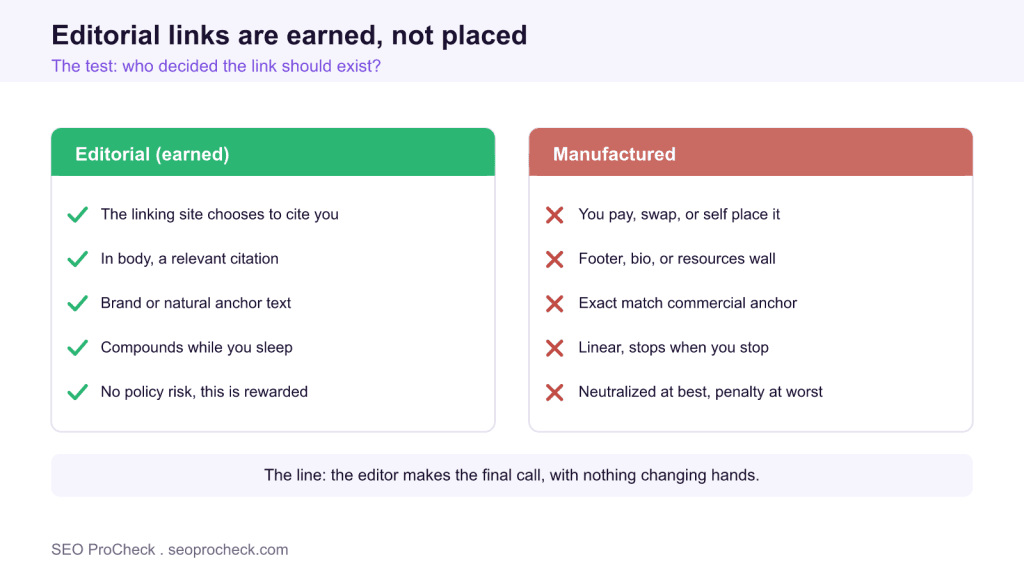
- The test is one question: who decided the link should exist, the publisher or you?
- Earned links appear on pages you do not control, with anchor text you did not choose, inside content written for readers.
- They are earned downstream of something citable: original data, free tools, the definitive explanation, or expert quotes.
- The moment there is a price sheet it is a paid placement, not editorial, whatever the invoice calls it.
An editorial link is a backlink someone places by their own free choice, because your page genuinely improved what they were writing, no payment, no swap, no form you filled out. It's the link type every quality guideline is written around, and the one type you can't fake at scale.
What makes a link "editorial"
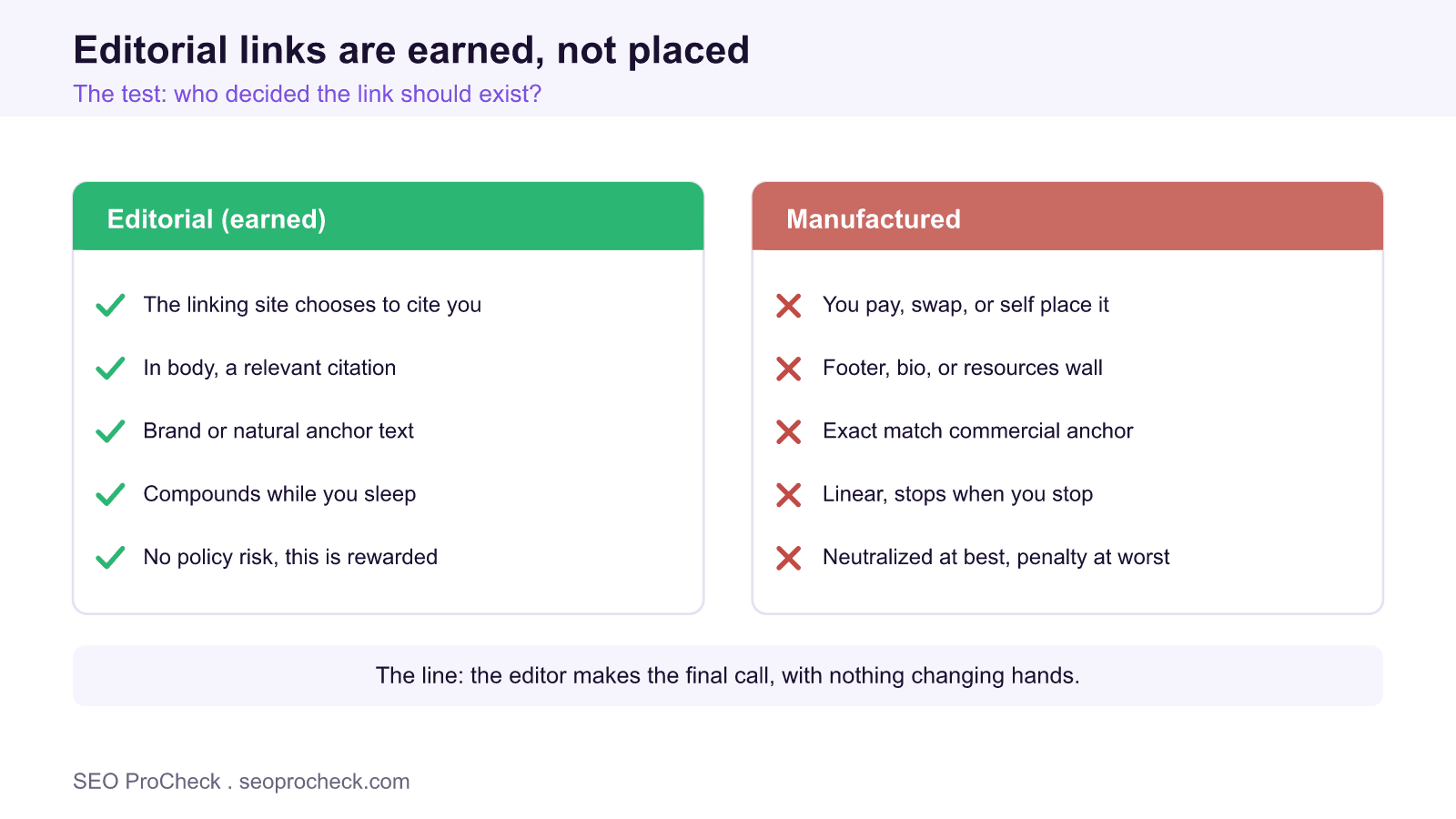
The test is a single question: who decided this link should exist? If a writer, editor, or site owner decided on their own, because your data supported their claim, your tool solved their reader's problem, your explanation was the best one available, the link is editorial. If you decided and then made it happen (bought it, traded it, submitted it, wrote it into a guest post yourself), it's manufactured, whatever the invoice calls it.
This distinction is exactly the line Google's link-spam policies draw. Links "intended to manipulate rankings" are the target of enforcement; links that exist as genuine citations are the signal the whole system was built to measure. Editorial links come with properties that are nearly impossible to counterfeit in bulk: they appear on pages you don't control, with anchor text you didn't choose, in the middle of content written for readers.
Earned vs manufactured: the tell-tale characteristics
| Characteristic | Editorial (earned) | Manufactured |
|---|---|---|
| Who initiates | The linking site, or your pitch merely pointed at something worth citing | You, with payment, exchange, or self-placement |
| Anchor text control | Theirs; usually brand, title, or natural phrasing | Yours; drifts toward exact-match commercial keywords |
| Placement | In-body, where the citation is relevant | Author bios, footers, "resources" walls, inserted paragraphs |
| Surrounding content | Written for the site's real audience | Written to host the link; generic, thin, off-audience |
| Cost structure | Upfront: building something citable, then promotion | Per link, forever, and prices only go up |
| Scalability | Compounds, one strong asset keeps earning while you sleep | Linear, stops the day you stop paying |
| Policy risk | None; this is the behavior being rewarded | Neutralized at best, manual action at worst |
What actually earns editorial links
Nobody links to you as a favor. Editors cite pages that make their own work stronger, which means editorial links are downstream of having something citable:
- Original data and research. The single most reliable earner. A writer needs a number; whoever published the number gets the link. This is the whole logic behind building a linkable asset before doing outreach.
- Free tools. "Use this calculator" is a sentence writers love, and it comes with a link attached.
- Being the definitive explanation. When your page is the one practitioners already share in Slack, writers cite it instead of re-deriving the topic.
- Expert quotes and PR. Journalists cite people who give them usable quotes fast. Source-request platforms and direct journalist relationships turn expertise into citations.
- Digital PR campaigns. Newsworthy data or creative angles pitched to publications, manufactured attention, but the editor still freely chooses to cover and link.
The connective tissue is promotion. Editorial doesn't mean passive: you can pitch, nudge, and publicize aggressively. The line is that the editor makes the final call with nothing changing hands. Finding the writers and pages worth pitching is its own craft, covered in our editorial link prospecting walkthrough.
A concrete example
A regional accounting firm publishes a plain-English breakdown of a new tax rule the week it's announced, with a worked example. A finance writer at a national outlet, racing a deadline, searches the rule, finds the breakdown, and cites it: "as CPA firm X explains, the change affects…" That's an editorial link, the firm never contacted the writer. Compare the same firm paying a "guest posting service" $150 for a link inside a 600-word post about "5 Bookkeeping Tips" on a site that publishes about bookkeeping, CBD, and jet skis in the same week. Same anchor destination, opposite value, opposite risk.
How to check your editorial links
- Google Search Console → Links → Top linking sites. Scan the domains. Recognizable publications and real niche sites you never paid? Those are your editorial wins.
- Ahrefs Webmaster Tools (free) → Backlinks report, filtered to in-content dofollow links. Read the actual pages: does the link sit inside a real sentence, in an article written for humans?
- Check the anchors report. Editorial links skew heavily to brand names, page titles, and natural phrases. A pile of exact-match commercial anchors you "earned" is a sign your vendor was placing, not pitching.
- Cross-reference dates against your promotion history. Links that appeared after a data release or press push are earned outcomes you can reproduce; links with no traceable cause deserve a curious look either way.
- Moz Link Explorer (free tier) for a second index, smaller editorial mentions often show up in one crawler before the other.
Common mistakes (and fixes)
- Buying "editorial links" from a marketplace. The moment there's a price sheet, it's not editorial, it's a paid placement wearing the word as a costume. Fix: if a vendor guarantees placement, walk.
- Doing outreach with nothing to cite. "Great post, link to my homepage?" earns deletions. Fix: build the citable thing first; outreach is distribution, not persuasion.
- Requesting exact-match anchors on earned coverage. Nothing marks a link as negotiated faster, and writers resent it. Fix: let editors phrase their own citations; the brand anchor is worth more anyway.
- Measuring editorial success in link volume. Five citations from real industry publications move you more than fifty from content farms. Fix: track referring domains you'd be proud to show a client, not totals.
- Ignoring unlinked mentions. Writers often name you without linking. Fix: a polite note asking for credit on an existing mention converts remarkably well, the editorial decision was already made.
FAQ
Is a link from a guest post an editorial link?
Usually no, you wrote the content and placed the link yourself, so the host's editorial judgment was never exercised on that citation. A genuine exception: an editor who independently chooses to link your work inside their own article. That's why guest posting at scale reads as a pattern, not as earned coverage.
Are nofollowed editorial links worth anything?
Yes. Google treats rel="nofollow" as a hint rather than a directive these days, and a nofollowed mention from a major publication drives referral traffic, brand searches, and follow-on coverage that often produces followed links. Never discourage a real citation over its rel attribute.
Can you ask for an editorial link without ruining it?
You can pitch; you can't dictate. Pointing a relevant writer to a resource is fine, the link stays editorial because they choose whether, where, and how to cite it. It stops being editorial when compensation or reciprocity enters the deal.
How long does it take to earn editorial links?
Slower than buying and faster than people fear. A strong data asset plus a focused PR push can land citations within weeks; the compounding phase, where links arrive with no outreach at all, typically takes months of the asset ranking and circulating. See our anchor text best practices for what those accumulating citations should look like in your profile.
How do I earn editorial links if I am starting from zero?
Build one genuinely citable asset first, original data, a free tool, or the clearest explanation of a topic, then promote it to the writers and publications who cover that subject. Outreach is distribution, not persuasion: you point relevant people at something worth citing and let them make the call. Without the citable thing, outreach just earns deletions.
Claude Vincent is a technical SEO consultant focused on crawlability, rendering, and AI-search visibility. He writes the field guides and case studies at SEO ProCheck, with a bias toward the durable, unglamorous work that decides whether search engines and AI answer engines can actually read and cite a site.
About SEO ProCheck
Technical SEO consulting and GEO strategy with 20 years of enterprise experience. Case studies, resources, and tools for search and AI visibility.
Work With Me
Technical SEO audits, GEO strategy, site migrations, and international SEO. Hourly consulting for teams who need hands-on support, not just reports.
Subscribe to our newsletter!