

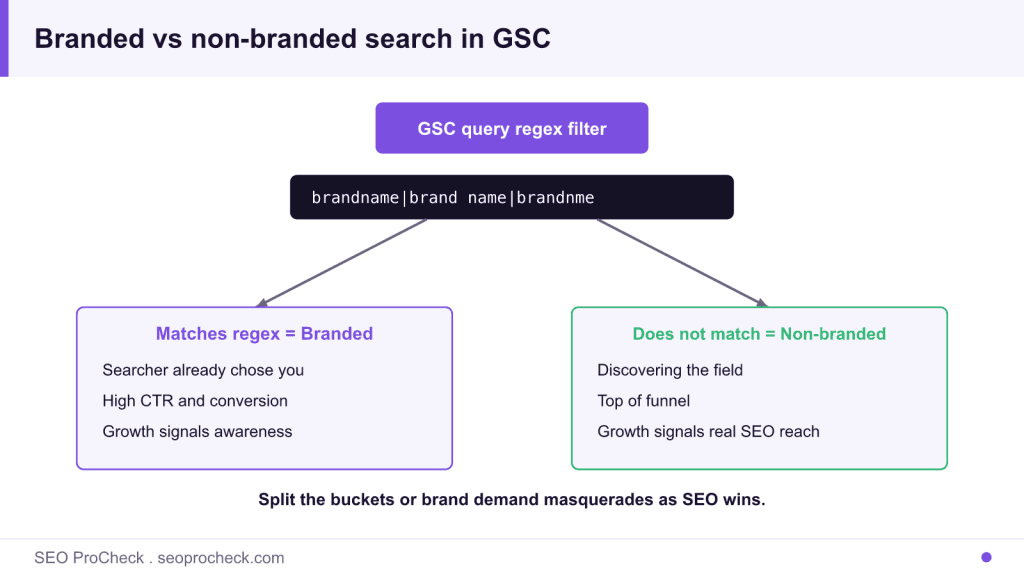
AI Summary
Branded search is any query that contains your company, product, or trademark name, and it signals a searcher who already chose you rather than one shopping the field. Splitting branded from non-branded traffic in Search Console is the whole game: without it, brand demand from PR or ads gets mistaken for SEO wins while a flat non-branded picture hides underneath.
- Branded queries convert better and usually own their SERP.
- Use a GSC query regex filter to split branded from non-branded buckets.
- Include misspellings and product names or branded traffic leaks into the non-branded bucket.
- Rising non-branded search, not branded, is the real test that your content reaches new people.
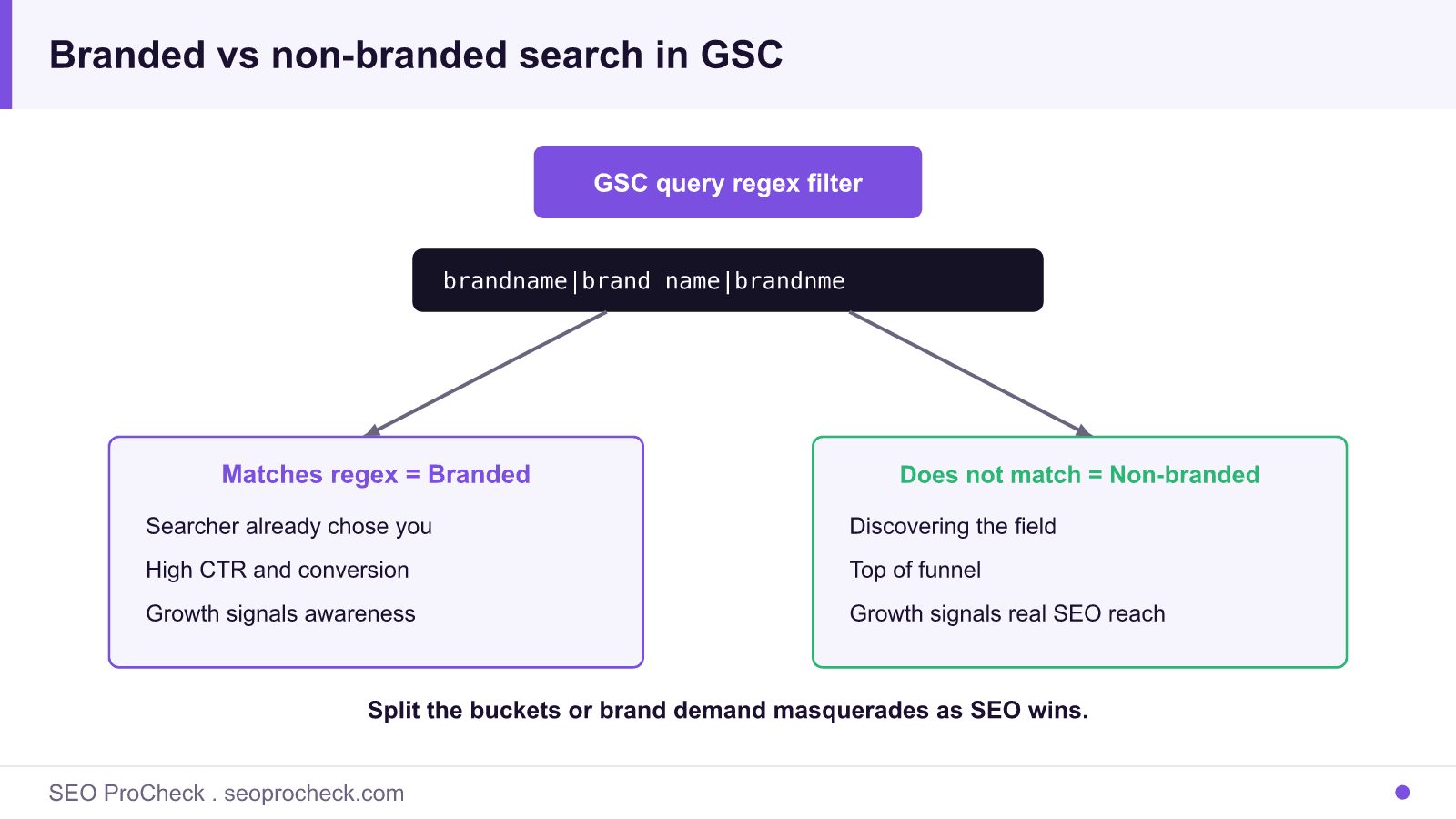
What branded search means
Branded search is any query that contains your company, product, or trademark name, "Mailchimp pricing," "is Patagonia ethical," "Nike air max." The brand word signals the searcher already knows who they want and is looking for you specifically, not shopping the whole field.
Why it matters: branded queries convert far better than generic ones because the intent is already locked in, and branded search volume is one of the cleanest proxies you have for real brand awareness. But if you cannot separate branded from non-branded traffic in your reports, you will mistake brand demand for SEO wins, congratulate yourself for rankings you did not earn, and miss when your actual organic reach is flat. A brand that just ran a big campaign can see branded search jump for reasons that have nothing to do with the SEO team, and that lift will hide a stagnant non-branded picture underneath. Splitting the two is the whole game.
The example: separating branded from non-branded in GSC with a regex filter
Google Search Console lumps all your organic queries together by default, which hides the story. To split them, use the query regex filter. In the Performance report, open the Query filter, choose "Custom (regex)," and enter a pattern that matches your brand and its common misspellings:
brandname|brand name|barndname|brandnmeSet the match type to "Matches regex" to see only branded queries, then flip the same filter to "Doesn't match regex" to see everything non-branded. Now you have two clean buckets. Watch them separately over time: rising branded search means growing awareness (often from PR, ads, or word of mouth), while rising non-branded means your SEO is genuinely reaching new people who did not know you yet.
Real pattern, real gotcha: include misspellings, spacing variants, and any sub-brands or product names people type. "coca cola," "cocacola," and "coke" are all branded for that company. Leave variants out and branded traffic leaks into your non-branded bucket, quietly inflating your "SEO success." Build the regex once, save it, and reuse it in every report.
Branded vs non-branded at a glance
| Signal | Branded search | Non-branded search |
|---|---|---|
| Contains your name | Yes | No |
| Searcher intent | Already chose you | Comparing the field / discovering |
| Typical CTR | Very high (often you own the SERP) | Lower, split across competitors |
| Conversion rate | High | Lower, top-of-funnel |
| What growth signals | Rising brand awareness | Expanding organic reach |
| Where it comes from | PR, ads, word of mouth, past use | Content, rankings, links |
How to track branded search on your own site
- Build your brand regex. List your name, misspellings, spacing variants, sub-brands, and product names. Combine them with the pipe (
|) as shown above. This is your reusable branded pattern. - Split the buckets in GSC. Apply "Matches regex" for branded and "Doesn't match regex" for non-branded. Note clicks, impressions, and average position for each, separately.
- Track the ratio over time. Chart branded vs non-branded clicks month over month. A healthy growing site usually grows non-branded faster; if branded is doing all the work, your SEO reach may be stalling.
- Defend your brand SERP. Search your own brand and check what ranks. If competitors, review sites, or old content sit above your key pages, that is a leak. See how to grow and defend your brand SERP.
- Watch for competitor bidding. Competitors sometimes run ads on your brand name. Check the live SERP for paid results above your organic listing and decide whether to bid defensively.
Common mistakes and how to fix them
- Reporting total organic traffic as SEO success. Branded queries flatter the number without reflecting reach. Fix: always split branded and non-branded before claiming an SEO win.
- Leaving misspellings out of the regex. Branded traffic then leaks into your non-branded bucket. Fix: audit the query list for how people actually type your name and add every variant.
- Ignoring your brand SERP because "we already rank #1." Fix: check what else appears; competitors and negative content above the fold cost you clicks and trust.
- Confusing branded volume with topic demand. Branded search measures awareness of you, not the open market. Fix: size the market with generic search demand, separately from your brand.
- Not measuring non-branded as its own metric. Fix: treat non-branded search as the real test of whether your content is reaching new people.
Building a brand regex that does not leak
The split is only as good as the pattern, so build the regex deliberately and save it. Start from the actual query list in Search Console, not from what you assume people type. Combine your brand, its common misspellings, spacing and hyphenation variants, sub-brands, and product names with the pipe character, for example brandname|brand name|brandnme|productline. Anything you leave out leaks branded traffic into the non-branded bucket and quietly inflates what looks like SEO success. Case does not matter in the GSC regex, but real typos and joined or split spellings do, so add coca cola, cocacola, and coke rather than assuming one form covers them all.
With the pattern saved, apply Matches regex for branded and Doesn't match regex for non-branded, then record clicks, impressions, and average position for each separately. Track the ratio over months. A healthy growing site tends to grow non-branded faster, because that is new people discovering you through content and rankings. If branded is doing all the lifting, awareness is rising (often from PR or ads) while your organic reach stalls, which is exactly the blind spot a combined organic number hides. Reuse the same saved regex in every report so the buckets stay comparable over time.
FAQ
How do I separate branded from non-branded queries in Search Console?
Use the Query filter set to "Custom (regex)." Enter a pattern matching your brand and its variants, then use "Matches regex" for branded and "Doesn't match regex" for non-branded. That gives you two clean, comparable buckets.
Why does branded traffic look like an SEO win when it isn't?
Branded search grows from awareness, PR, ads, and word of mouth, not necessarily from your organic content. If you report combined organic traffic, rising brand demand can mask flat or falling non-branded reach. Split them to see the truth.
Should I include misspellings and product names in my brand regex?
Yes. People fat-finger brand names and search sub-brands and product lines. If those variants aren't in your pattern, that branded traffic wrongly counts as non-branded and distorts both buckets.
Is more branded search always good?
It is good for conversions and a healthy sign of awareness, but if branded is your only growth, your top-of-funnel non-branded search may be stalling. You want both climbing.
Can competitors show up in my branded search results?
Yes, both organically and through paid ads on your brand name. Check your live brand SERP regularly and defend the positions that matter, as covered in defending your brand SERP.
Take this with you
The assistant links open with a question about this page already written. Nothing is sent until you press enter.
Claude Vincent is a technical SEO consultant focused on crawlability, rendering, and AI-search visibility. He writes the field guides and case studies at SEO ProCheck, with a bias toward the durable, unglamorous work that decides whether search engines and AI answer engines can actually read and cite a site.
About SEO ProCheck
Technical SEO consulting and GEO strategy with 20 years of enterprise experience. Case studies, resources, and tools for search and AI visibility.
Work With Me
Technical SEO audits, GEO strategy, site migrations, and international SEO. Hourly consulting for teams who need hands-on support, not just reports.
Subscribe to our newsletter!








Recent Posts
- Most Top Sites Never Say Who They Are in Structured Data October 14, 2026
- Homepage Titles Are Mostly Too Short, Not Too Long October 8, 2026
- Who Actually Serves an llms.txt? 184 Top Sites Measured September 29, 2026