

AI Summary
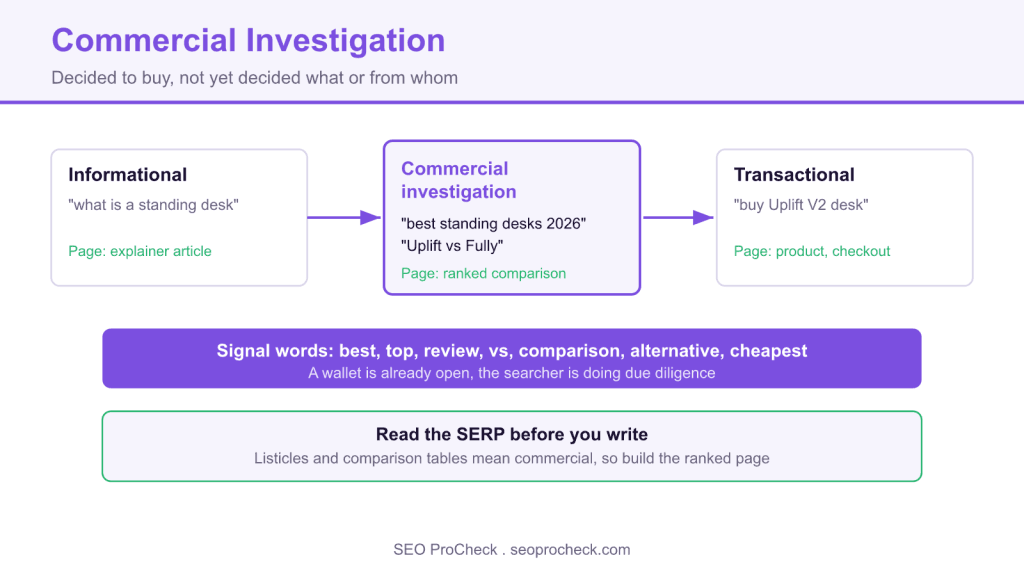
Commercial investigation is the search intent of someone who has decided to buy but has not decided what or from whom, so they compare options, read reviews, and weigh alternatives. These queries quietly decide the sale weeks before checkout, and they are won with ranked comparison and review pages, not product pages or definitions.
- It sits between informational intent (learning) and transactional intent (buying now) on the intent ladder.
- The tell is the modifier: best, top, review, vs, comparison, alternative, cheapest, is X worth it.
- Read the live SERP before writing; listicles and comparison tables mean Google wants a ranked roundup.
- Map commercial queries to comparison or review pages and keep transactional queries on product pages, so they never compete.
What Commercial Investigation Means
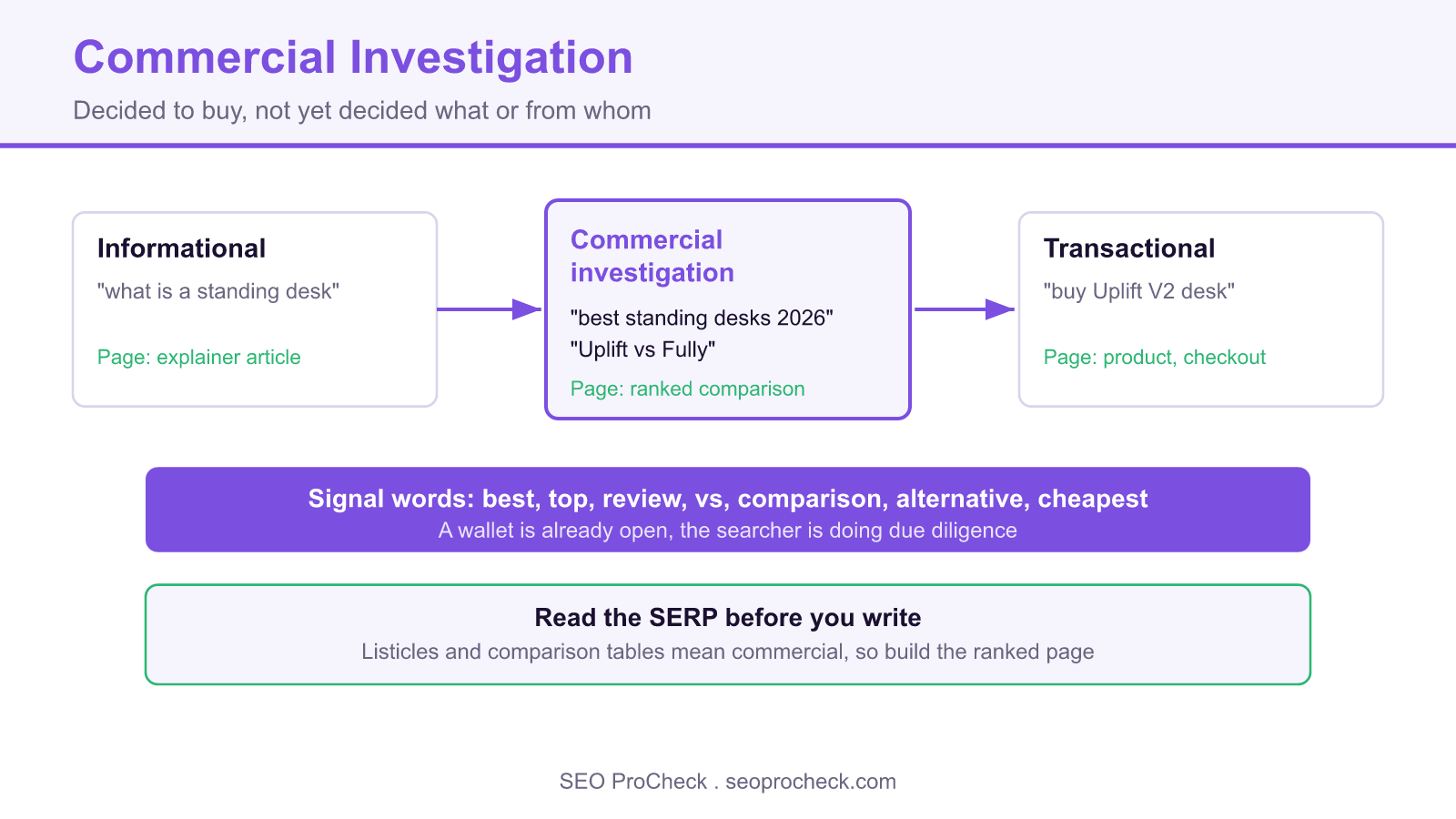
Commercial investigation is the search intent of someone who has decided they want to buy something but hasn't decided what or from whom yet. They are comparing, reading reviews, and weighing options, which makes these queries the ones that quietly decide whether you win the sale weeks before the purchase happens.
Miss this intent and you either write buying guides for people who only wanted a definition, or you slap a checkout button in front of someone who is still three tabs deep in comparison mode. Either way you lose the click that mattered.
Where It Sits in the Intent Ladder
Search intent is usually split into four buckets, and commercial investigation is the one everyone underinvests in. It sits between informational intent (learning) and transactional intent (buying now). The searcher is past "what is a standing desk" and not yet at "buy Uplift V2 desk," but squarely in "best standing desks 2026" and "Uplift vs Fully."
The tell is the modifier. Words like best, top, review, vs, comparison, alternative, cheapest, and is X worth it almost always signal commercial investigation. The person is doing due diligence with a wallet already open. If you want the full framework for reading these signals, the search intent guide lays out all four types and how to optimize for each.
A Real Example: "best" Queries in the Wild
Take "best noise-cancelling headphones under $200." Nobody types that to learn what noise cancelling is; they type it because they have a budget, a use case, and a shortlist to build. The SERP tells you exactly what Google thinks satisfies that intent: it fills up with comparison roundups, ranked lists, and review sites, not product pages and not encyclopedia definitions.
Contrast that with "Sony WH-1000XM5" (someone deep in comparison, leaning toward one model) versus "buy Sony WH-1000XM5" (transactional, ready to check out). Same product, three different intents, three different pages you should serve. The commercial-investigation page is the ranked comparison. Get that page right and you catch the searcher at the exact moment they are deciding, which is far more valuable than catching them after they've already chosen a competitor.
Query Modifiers and the Page They Demand
| Example query | Intent | Signal words | Page type that wins | Wrong page to serve |
|---|---|---|---|---|
| what is a mechanical keyboard | Informational | what is, how does | Explainer article | Product listing |
| best mechanical keyboard for programming | Commercial investigation | best, for [use case] | Ranked comparison / roundup | Single product page |
| Keychron K8 vs Ducky One 3 | Commercial investigation | vs, comparison | Head-to-head comparison | Generic category page |
| Keychron K8 review | Commercial investigation | review, is it worth it | In-depth single review | Homepage |
| buy Keychron K8 | Transactional | buy, price, coupon | Product / checkout page | Blog post |
How to Find and Use Commercial-Investigation Queries
- Pull the modifier keywords. In Ahrefs, Semrush, or Google Keyword Planner, filter your seed term by best, top, review, vs, alternative, comparison. That filter surfaces the commercial layer sitting on top of your informational keywords.
- Read the SERP before you write a word. Search the query and note what ranks. If it's all listicles and comparison tables, Google has already told you the format. Building a single product page against a SERP full of roundups is a losing bet.
- Confirm the intent label. Semrush and Ahrefs both tag keywords with an intent type. Treat the "Commercial" tag as a starting hypothesis, then verify against the live SERP, since the label is a guess and the SERP is the answer.
- Map queries to pages. Assign each commercial query to a comparison or review page, and keep transactional queries on product pages. This is standard keyword mapping, and it prevents your comparison content and product pages from competing with each other.
- Build the page the intent demands. For "best X," that means a genuine ranked list with criteria, prices, pros and cons, and a clear top pick, not a thin affiliate dump. Google's roundups reward pages that actually help someone choose.
Common Mistakes and How to Fix Them
- Serving a product page to a "best" query. The searcher wants options, and a single-product pitch reads as a dead end. Fix: build a comparison page and link out to the individual products from it.
- Writing a definition when they want a decision. Opening a "best CRM for small business" page with three paragraphs on what a CRM is sends comparison shoppers straight back to the SERP. Fix: lead with the ranked shortlist and put the background lower down for the few who need it.
- Thin, samey comparison pages. Ten near-identical "best X" pages with swapped product names fool no one. Fix: add real testing notes, actual prices, a decision matrix, and an opinionated top pick.
- Ignoring how close the money is. Commercial-investigation traffic converts better than pure informational traffic because the buyer is nearly decided. Fix: prioritize these pages in your content plan instead of treating them as afterthoughts to top-of-funnel posts.
- Confusing commercial investigation with transactional intent. Pushing "buy now" at a comparison shopper feels pushy and premature. Fix: use "compare," "see our pick," and "read the full review" as the calls to action, and save the hard sell for the transactional page.
Frequently asked questions
Commercial investigation is comparison mode, the searcher is choosing between options. Transactional is buying mode, they've chosen and want to check out. "Best running shoes" is commercial; "buy Nike Pegasus 41 size 10" is transactional. They need different pages.
The reliable ones are best, top, review, vs, comparison, alternative, cheapest, for [use case], and is X worth it. Any modifier that implies weighing options rather than defining a term or completing a purchase is a commercial signal.
Usually yes. They pull far fewer searches than broad informational terms, but the intent is closer to the sale, so they convert better per visit. A "best" page that ranks can outearn a high-traffic definition page many times over.
Search it and look at the SERP. If Google serves listicles, comparison tables, and review sites, it's commercial. If it serves explainers and encyclopedia-style pages, it's informational. The live results override any tool's intent tag.
Ranked comparisons and roundups for "best" and "vs" queries, and thorough single reviews for "[product] review" queries. In both cases the page has to help the reader actually decide, with criteria, prices, tradeoffs, and a clear recommendation.
Take this with you
The assistant links open with a question about this page already written. Nothing is sent until you press enter.
Claude Vincent is a technical SEO consultant focused on crawlability, rendering, and AI-search visibility. He writes the field guides and case studies at SEO ProCheck, with a bias toward the durable, unglamorous work that decides whether search engines and AI answer engines can actually read and cite a site.
About SEO ProCheck
Technical SEO consulting and GEO strategy with 20 years of enterprise experience. Case studies, resources, and tools for search and AI visibility.
Work With Me
Technical SEO audits, GEO strategy, site migrations, and international SEO. Hourly consulting for teams who need hands-on support, not just reports.
Subscribe to our newsletter!








Recent Posts
- Most Top Sites Never Say Who They Are in Structured Data October 14, 2026
- Homepage Titles Are Mostly Too Short, Not Too Long October 8, 2026
- Who Actually Serves an llms.txt? 184 Top Sites Measured September 29, 2026