

AI Summary
Informational intent is the motivation behind a search where the person wants to understand something, not to buy and not to reach a specific site. Queries like what is a heat pump signal someone building knowledge early in their journey, so the SERP answers with featured snippets, People Also Ask, and in depth guides rather than product listings.
- Informational queries are the largest slice of search volume and how most people first meet a brand.
- Read the live SERP first: a featured snippet, a fat People Also Ask box, and guides mean the intent is informational.
- Match the format to the query shape: definitions want a tight 40 to 55 word answer, how to queries want numbered steps.
- Judge these pages by rankings, assisted conversions, and return visits, not by first click sales.
What informational intent means
Informational intent is the motivation behind a search where the person wants to understand something, not buy, and not reach a specific site. Queries like "how does compound interest work," "what is a heat pump," or "why is my sourdough flat" all signal someone building knowledge, usually early in their journey and nowhere near a wallet. The stakes: informational queries are the largest slice of all search volume, and they are how most people first meet a brand, get them right and you own the top of the funnel; get them wrong and you are invisible until the moment someone is ready to buy from a competitor who taught them first.
It is one of the four search intent types, alongside navigational, commercial investigation, and transactional. The full search intent guide maps how they connect.
A real example, with the SERP evidence
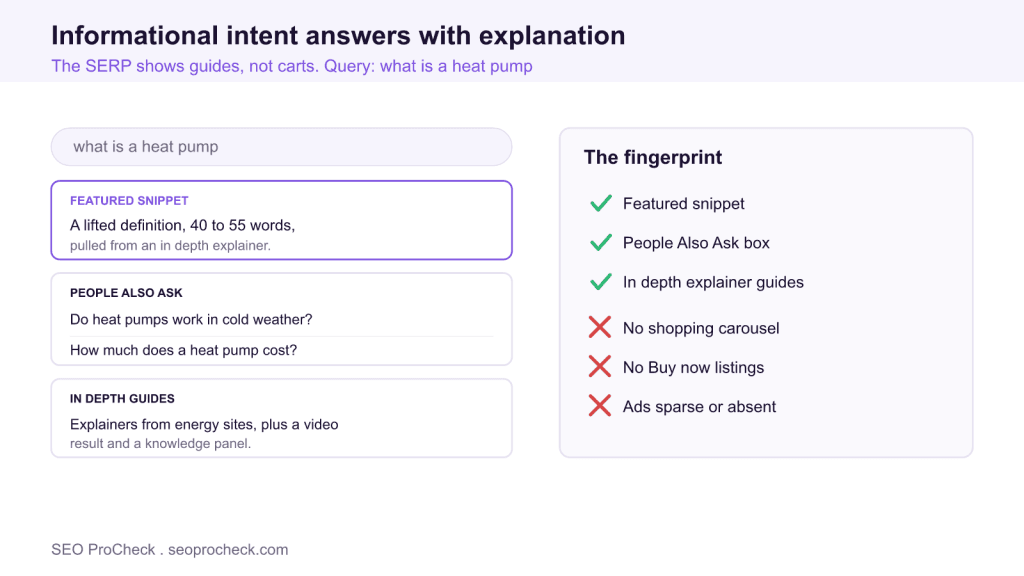
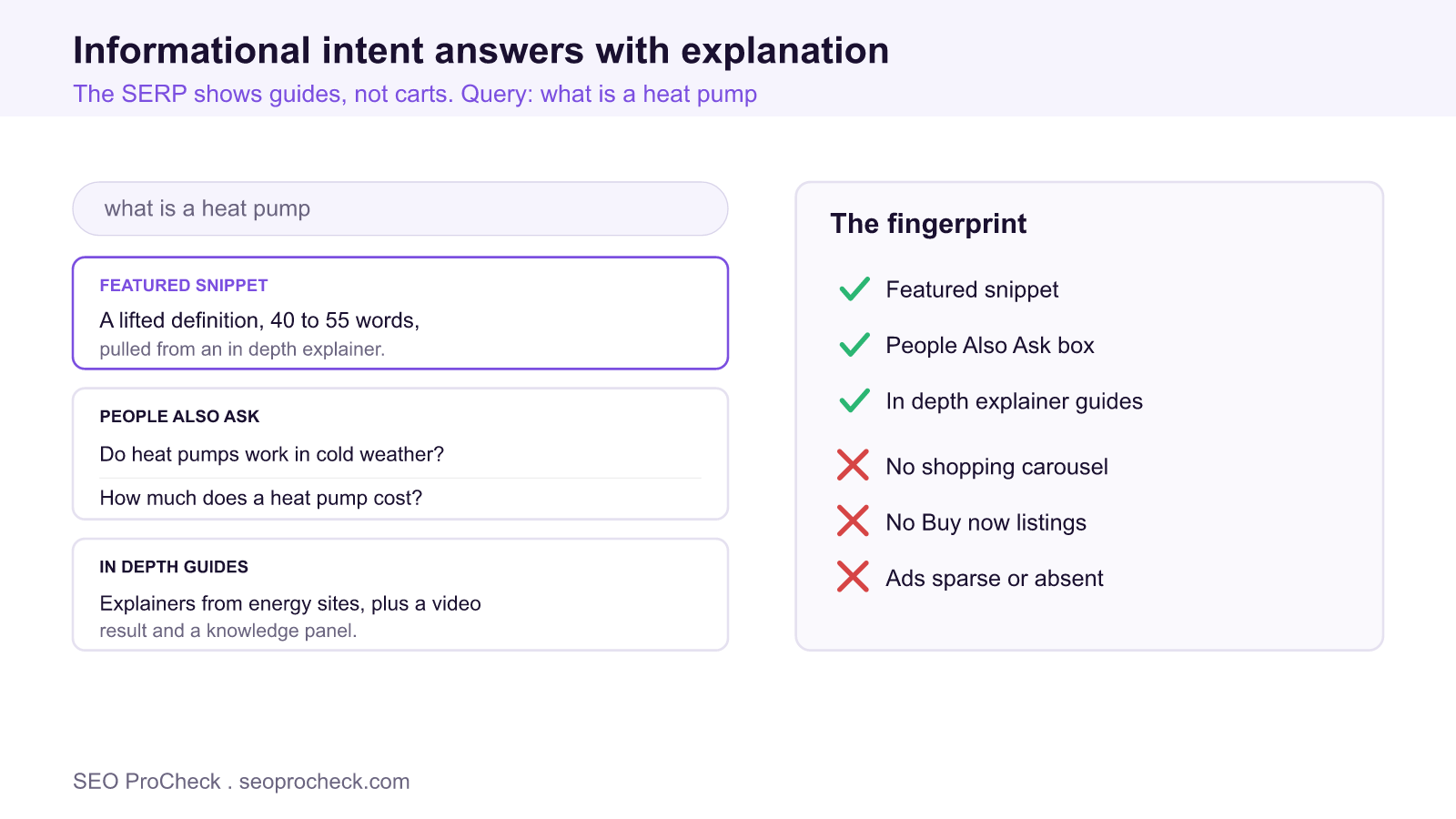
Search what is a heat pump and read the page top to bottom. There is a featured snippet lifting a definition from someone's guide. Under it, a People Also Ask box stacked with "Do heat pumps work in cold weather?" and "How much does a heat pump cost?" Then a run of in-depth explainers from energy sites, a video result, and maybe a knowledge panel, but no shopping carousel, no "Buy now" listings, and ads are sparse or absent. That is the fingerprint of informational intent: Google answers with explanation, not commerce.
Contrast it with the transactional cousin heat pump installer near me, which throws up local packs, service ads, and quote forms. Same product world, opposite results shape, because the first searcher wants to learn and the second wants to hire. If you build a product page for "what is a heat pump," you have misread the SERP and you will not rank; Google has already decided that query wants a guide.
How Google formats informational answers
| Query shape | Format Google tends to reward | What to build |
|---|---|---|
| "what is / what are…" | Featured snippet + definition-led guide | Tight 40 to 55 word answer up top, then depth |
| "how to / how do I…" | Step lists, numbered how-tos, video | Ordered steps, one action per line, HowTo markup |
| "why does / why is…" | Explainer article + PAA expansion | Cause-and-effect prose, answer the follow-ups |
| "best way to / examples of…" | Listicle, comparison table | Scannable list, real examples, no fluff intro |
| "…meaning / …definition" | Featured snippet, dictionary-style | Lead with the one-sentence definition |
The pattern across every row: answer the literal question in the first screen, then go deep for the people who keep reading. That is also how you win the featured snippet, which is the single biggest visibility prize on informational SERPs and the block that increasingly feeds AI Overviews.
How to check informational intent on your own pages
- Read the live SERP first. Search your target query in an incognito window. If you see a featured snippet, a fat People Also Ask box, and guides, not product grids, it is informational. Build accordingly.
- Filter Search Console by question words. In Performance, filter Queries containing "how," "what," "why," or "guide." Those pages are carrying your informational demand; check their average position and impressions.
- Mine People Also Ask. Every PAA question is a sub-topic Google already knows searchers want. Tools like AlsoAsked or AnswerThePublic surface them in bulk; fold the good ones into your page as H3s.
- Check the format match. If a "how to" query is being answered by your wall-of-text essay, restructure into numbered steps. Format mismatch is the quiet reason informational pages stall.
- Watch engagement, not just rank. A page ranking for an informational query that people bounce off fast is a signal the answer is thin, see dwell time and pogo-sticking for what that costs you.
Common mistakes and how to fix them
- Selling on an informational page. Someone learning "what is a heat pump" is not ready for your quote form. Fix: teach first, put a soft next-step CTA at the bottom, and let the transactional page do the closing.
- Burying the answer. A 300-word origin story before the definition loses the snippet and the reader. Fix: lead with the direct answer in the first 55 words, then expand.
- Ignoring People Also Ask. The PAA box is a free content brief. Fix: answer those exact follow-ups on-page, it widens your relevance and can pull you into more boxes.
- Thin content that "technically" answers. Google now rewards depth on informational queries. Fix: cover the sub-questions, add examples, and give a reason to stay instead of bouncing back to the results.
- Measuring informational pages by conversions. Top-of-funnel content rarely converts on the first visit. Fix: judge it by rankings, assisted conversions, and email or return visits, then connect it to your commercial pages.
Why informational intent matters for the whole funnel
People who learn from you at the informational stage come back when they are ready to buy. That is the entire logic of content marketing: earn attention while intent is low, convert it later on your transactional pages. It is also almost entirely non-branded demand, strangers describing a question, which makes it your biggest lever for reaching people who have never heard of you. Internal-link those informational pages into your money pages and you build a path from "just curious" to "ready to buy."
FAQ
What is the difference between informational and commercial intent?
Informational wants to understand ("what is X"); commercial investigation wants to compare before buying ("best X," "X vs Y"). They sit next to each other on the funnel, and many "best of" queries blend the two, which is why the SERP for them often mixes guides with review-site roundups.
Do informational keywords convert?
Rarely on the first click, and that is fine. Their job is reach and trust, not immediate sales. Judged by direct conversions they look weak; judged by assisted conversions, return visits, and the audience they feed into your funnel, they are the foundation the rest of your SEO stands on.
How do I win a featured snippet for an informational query?
Answer the exact question in a tight, self-contained block, a 40 to 55 word paragraph for definitions, a clean numbered list for "how to." Use the question as a heading, keep the answer near the top, and make it easy for Google to lift verbatim.
Is informational intent losing traffic to AI Overviews?
Some, yes, AI Overviews answer straightforward informational questions inline, which can cut clicks on the thinnest queries. The defense is depth and originality: content that goes beyond a one-line answer still earns the click, and often earns the citation inside the overview too.
How many informational pages should a site have?
As many as there are real questions your audience asks, no more. Map them from People Also Ask, keyword research, and support tickets, then build one strong page per genuine question instead of a dozen thin near-duplicates that cannibalize each other.
Claude Vincent is a technical SEO consultant focused on crawlability, rendering, and AI-search visibility. He writes the field guides and case studies at SEO ProCheck, with a bias toward the durable, unglamorous work that decides whether search engines and AI answer engines can actually read and cite a site.
About SEO ProCheck
Technical SEO consulting and GEO strategy with 20 years of enterprise experience. Case studies, resources, and tools for search and AI visibility.
Work With Me
Technical SEO audits, GEO strategy, site migrations, and international SEO. Hourly consulting for teams who need hands-on support, not just reports.
Subscribe to our newsletter!







Recent Posts
- Can AI Crawlers Actually Read Your Site? I Measured 400 of the Biggest September 5, 2026
- The Pre-Publish Quality Gate for AI-Assisted Content August 6, 2026
- AGENTS.md vs llms.txt vs llms-full.txt: Which Agent File Does What July 18, 2026