


AI Summary
Googlebot is the crawler Google uses to discover, fetch, and render pages for its search index. If Googlebot cannot reach or correctly render a page, that page effectively does not exist in Google Search.
- Under mobile first indexing, the smartphone crawler does the primary crawling and ranking.
- For Google Search, Googlebot processes only the first 2 MB of an HTML file (64 MB for a PDF) and defers JavaScript to the Web Rendering Service.
- Verify a genuine visit with reverse then forward DNS to googlebot.com or google.com, never by user agent alone.
- Googlebot is a fleet: Image, Video, InspectionTool, and AdsBot each behave differently.
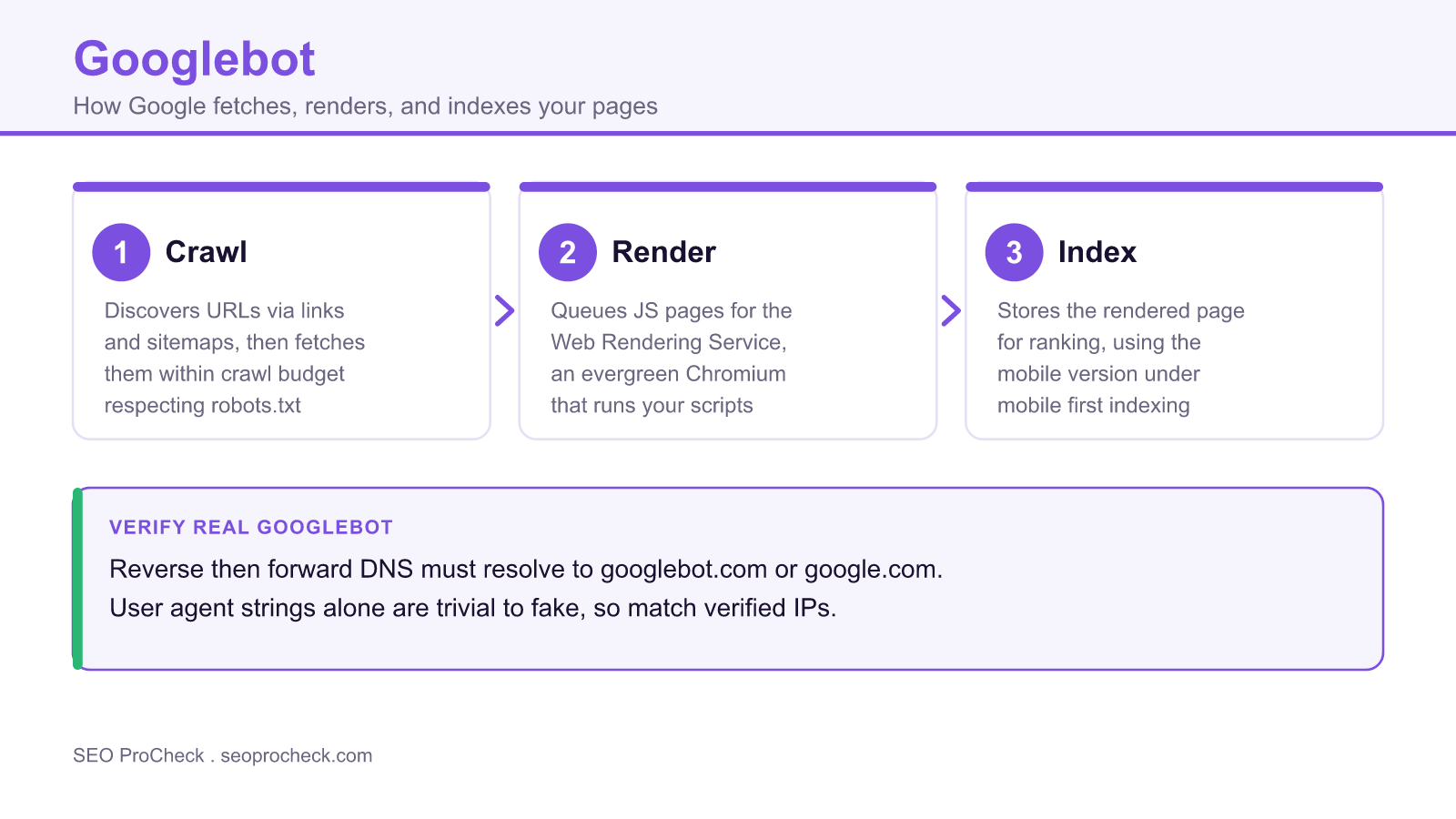
Googlebot is the crawler Google uses to discover and fetch web pages for its search index. If Googlebot can't reach a page, or fetches something different from what users see, that page effectively doesn't exist in Google, no matter how good it is. Everything downstream in SEO starts with what this one bot can fetch, render, and understand.
How Googlebot actually operates
Googlebot discovers URLs through links and sitemaps, schedules them according to crawl budget and its own priorities, and fetches them over HTTP while respecting your robots.txt. Since mobile-first indexing, the smartphone variant does the primary crawling, Google indexes and ranks the mobile version of your page. Fetching is only step one: pages that depend on JavaScript get queued for rendering by the Web Rendering Service, an evergreen Chromium that executes scripts before indexing sees the final content. Two operational details worth knowing: Googlebot only processes the first 15 MB of an HTML file, and it crawls from published IP ranges, which is what makes verification possible.
Real user-agent strings and real verification
These are the strings you'll see in your access logs (Google substitutes the current Chrome version for W.X.Y.Z):
# Googlebot Smartphone (the primary crawler)
Mozilla/5.0 (Linux; Android 6.0.1; Nexus 5X Build/MMB29P) AppleWebKit/537.36
(KHTML, like Gecko) Chrome/W.X.Y.Z Mobile Safari/537.36
(compatible; Googlebot/2.1; +http://www.google.com/bot.html)

# Googlebot Desktop
Mozilla/5.0 AppleWebKit/537.36 (KHTML, like Gecko; compatible;
Googlebot/2.1; +http://www.google.com/bot.html) Chrome/W.X.Y.Z Safari/537.36
Anyone can send those headers, scrapers impersonate Googlebot constantly. Verification is reverse-then-forward DNS:
$ host 66.249.66.1
1.66.249.66.in-addr.arpa domain name pointer crawl-66-249-66-1.googlebot.com.

$ host crawl-66-249-66-1.googlebot.com
crawl-66-249-66-1.googlebot.com has address 66.249.66.1
Genuine Googlebot resolves to googlebot.com or google.com and resolves back to the same IP. Google also publishes the ranges as JSON (developers.google.com/static/search/apis/ipranges/googlebot.json) if you'd rather match against a list.
The Googlebot family: which bot fetches what
"Googlebot" is really a fleet. Knowing which variant is hitting you matters for both log analysis and robots rules.
| Crawler | User-agent token | What it fetches | Notes |
|---|---|---|---|
| Googlebot Smartphone | Googlebot | Pages for the main index, mobile rendering | The primary crawler under mobile-first indexing |
| Googlebot Desktop | Googlebot | Desktop version, mostly for comparison | Minority of crawls on most sites |
| Googlebot-Image | Googlebot-Image/1.0 | Image files for Google Images | Target it in robots.txt to control image indexing separately |
| Googlebot-Video | Googlebot-Video/1.0 | Video files and video landing data | |
| Googlebot-News | Googlebot-News | Robots token for Google News surfaces | A robots directive target, not a distinct fetching agent |
| Google-InspectionTool | Google-InspectionTool/1.0 | URL Inspection live tests, Rich Results Test | If you allowlist only "Googlebot," your own GSC tests break |
| GoogleOther | GoogleOther | Internal research and non-search fetching | Introduced to keep non-search crawls out of Googlebot's name |
| Google StoreBot | Storebot-Google | Product pages, checkout flows for Shopping | Matters for e-commerce parity checks |
| AdsBot-Google | AdsBot-Google | Landing pages for ad quality checks | Ignores wildcard User-agent: * rules; must be named explicitly |
| Google-Extended | Google-Extended | Nothing, it's a robots.txt control token | Governs use of your content for Gemini/AI training; blocking it doesn't affect Search |
How to check it on your own site
- Pull Googlebot's trail from your access logs:
grep -i "googlebot" access.log | awk '{print $1, $7, $9}' | sort | uniq -c | sort -rn | head -50shows which URLs get crawled, how often, and with what status codes. Our guide to server log file analysis for SEO takes this from one-liner to methodology. - Verify the hits are genuine with the reverse/forward DNS check above on a sample of IPs, on a scraped-at site, a surprising share of "Googlebot" is fake.
- Read GSC → Settings → Crawl Stats: requests over time, by response code, by purpose (discovery vs refresh), by Googlebot type. Spikes in 4xx/5xx or a falling crawl rate are early warnings.
- Live-test a URL with URL Inspection → Test Live URL, then View Tested Page: the rendered HTML and screenshot show what Googlebot's renderer produced, the fastest way to catch JavaScript-dependent content going missing. (More on that in how search engines and AI crawlers render pages.)
- Audit your robots.txt against the table above, check that you haven't blocked CSS/JS directories the renderer needs, and that rules meant for one variant aren't catching others. The complete robots.txt reference covers precedence and wildcards.
Common audit mistakes (and fixes)
Trusting the user-agent string alone
Log analyses that count every "Googlebot" UA as Google produce garbage crawl-frequency conclusions and can lead you to allowlist scrapers. Fix: DNS-verify before you trust, and firewall rules should match verified IPs, not UA substrings.
Blocking CSS and JavaScript from crawling
An old habit from a decade ago. The renderer needs those files to see your page the way users do; blocked resources mean Google may index a broken skeleton. Fix: open /wp-includes/, /assets/, and build-output paths to Googlebot.
Forgetting Google-InspectionTool and AdsBot in allowlists
Strict bot management tuned to "Googlebot only" silently breaks GSC live tests and ad quality checks. Fix: allow the whole verified Google fleet by IP range, then control behavior in robots.txt per token.
Reading crawl frequency as a ranking signal
Heavy crawling means Google finds your URLs worth revisiting, it is not a quality score, and thin faceted URLs often get crawled most of all. Fix: judge crawl patterns against what you WANT crawled; wasted fetches on junk parameters are a crawl budget problem, not a compliment.
Accidental cloaking via bot rules
Serving Googlebot a stripped or cached page "for performance" while users get something richer (or vice versa) is a parity failure that can bite hard. Fix: same content, same status codes for verified bots and humans; performance belongs in caching layers, not UA forks.
FAQ
How often does Googlebot crawl my site?
There's no fixed schedule, it's demand-driven, based on how often your content changes, how important Google estimates your URLs are, and what your server can handle. News homepages get fetched constantly; a static brochure page might see weeks between visits. Crawl Stats in GSC gives you your real number.
Can I make Googlebot crawl faster?
Not directly, there's no "crawl harder" button. What works: faster and more reliable server responses, clean internal linking to the pages you care about, fresh sitemaps with accurate lastmod, and killing crawl waste on infinite parameter spaces. Google raises the rate when your site earns it and tolerates it.
Does Googlebot execute JavaScript?
Yes, rendering uses an up-to-date Chromium, so modern JS features work. But rendering is deferred and resource-bound, and anything that requires interaction, relies on blocked resources, or times out won't make it into the index. Server-rendered or static HTML for critical content is still the safer bet.
Is Googlebot the same as the AI crawlers?
No. Googlebot feeds Search. Google-Extended is a separate robots token for AI/Gemini training. OpenAI, Anthropic, and Perplexity run their own bots entirely, see our user-agent entry for how to tell the whole zoo apart.
Why does Googlebot keep hitting URLs that don't exist?
Google retries known-dead URLs for a long time by design, links from other sites, old sitemaps, and historical indexes keep them on the list. Persistent 404/410s are fine and normal. Only worry if the dead URLs are getting generated fresh by your own site.
More Googlebot questions
How do I verify a visitor is really Googlebot?
Run a reverse DNS lookup on the IP; genuine Googlebot resolves to googlebot.com or google.com. Then run a forward DNS lookup on that hostname and confirm it points back to the same IP. Match verified IP ranges in firewall rules, never trust the user agent string alone.
Which Googlebot crawls my site most?
Under mobile first indexing the smartphone crawler does the primary crawling, and that is the version Google indexes and ranks. The desktop variant runs a minority of crawls, mostly for comparison. You can see the split in Search Console under Settings, then Crawl Stats, by Googlebot type.
Does blocking CSS or JavaScript hurt crawling?
Yes. The Web Rendering Service needs those files to see your page the way users do, so blocking them can leave Google indexing a broken skeleton. Open your assets and build output directories to Googlebot so the renderer can load them.
What is the 15 MB limit I keep hearing about?
15 MB is the default for Google's crawlers and fetchers in general; for Google Search, Googlebot processes only the first 2 MB of an HTML file (64 MB for a PDF). That limit applies to the HTML document itself, not to linked images, CSS, or scripts. It only bites pages with enormous inline HTML, but critical content should always sit early in the document.
Is Google-Extended the same as Googlebot?
No. Google-Extended is a robots.txt control token that governs whether your content trains Gemini and other AI models. It fetches nothing itself, and blocking it has no effect on Google Search crawling or ranking.
Take this with you
The assistant links open with a question about this page already written. Nothing is sent until you press enter.
Claude Vincent is a technical SEO consultant focused on crawlability, rendering, and AI-search visibility. He writes the field guides and case studies at SEO ProCheck, with a bias toward the durable, unglamorous work that decides whether search engines and AI answer engines can actually read and cite a site.
About SEO ProCheck
Technical SEO consulting and GEO strategy with 20 years of enterprise experience. Case studies, resources, and tools for search and AI visibility.
Work With Me
Technical SEO audits, GEO strategy, site migrations, and international SEO. Hourly consulting for teams who need hands-on support, not just reports.
Subscribe to our newsletter!








Recent Posts
- Most Top Sites Never Say Who They Are in Structured Data October 14, 2026
- Homepage Titles Are Mostly Too Short, Not Too Long October 8, 2026
- Who Actually Serves an llms.txt? 184 Top Sites Measured September 29, 2026