

AI Summary
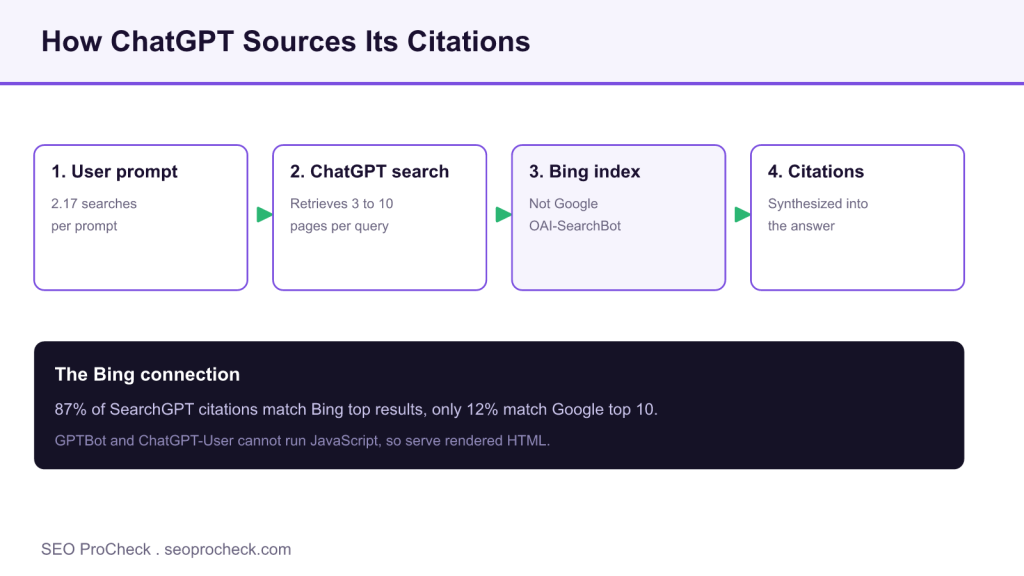
ChatGPT and SearchGPT retrieve results from Microsoft's Bing index, not Google, so Bing indexing and rankings drive your visibility. Seer Interactive found 87% of SearchGPT citations match Bing's top results, while only 12% of ChatGPT citations overlap Google's top 10, so confirm Bing indexing, allow the OpenAI crawlers, and serve rendered HTML.
- ChatGPT uses the Bing index: 87% of SearchGPT citations match Bing top results (Seer Interactive).
- Only 12% of ChatGPT citations rank in Google's top 10 (Ahrefs), so Google rankings barely help.
- Allow OAI-SearchBot and ChatGPT-User in robots.txt, and serve server-side rendered HTML.
- ChatGPT retrieves 3 to 10 pages per search and favors tables, lists, and direct answers.
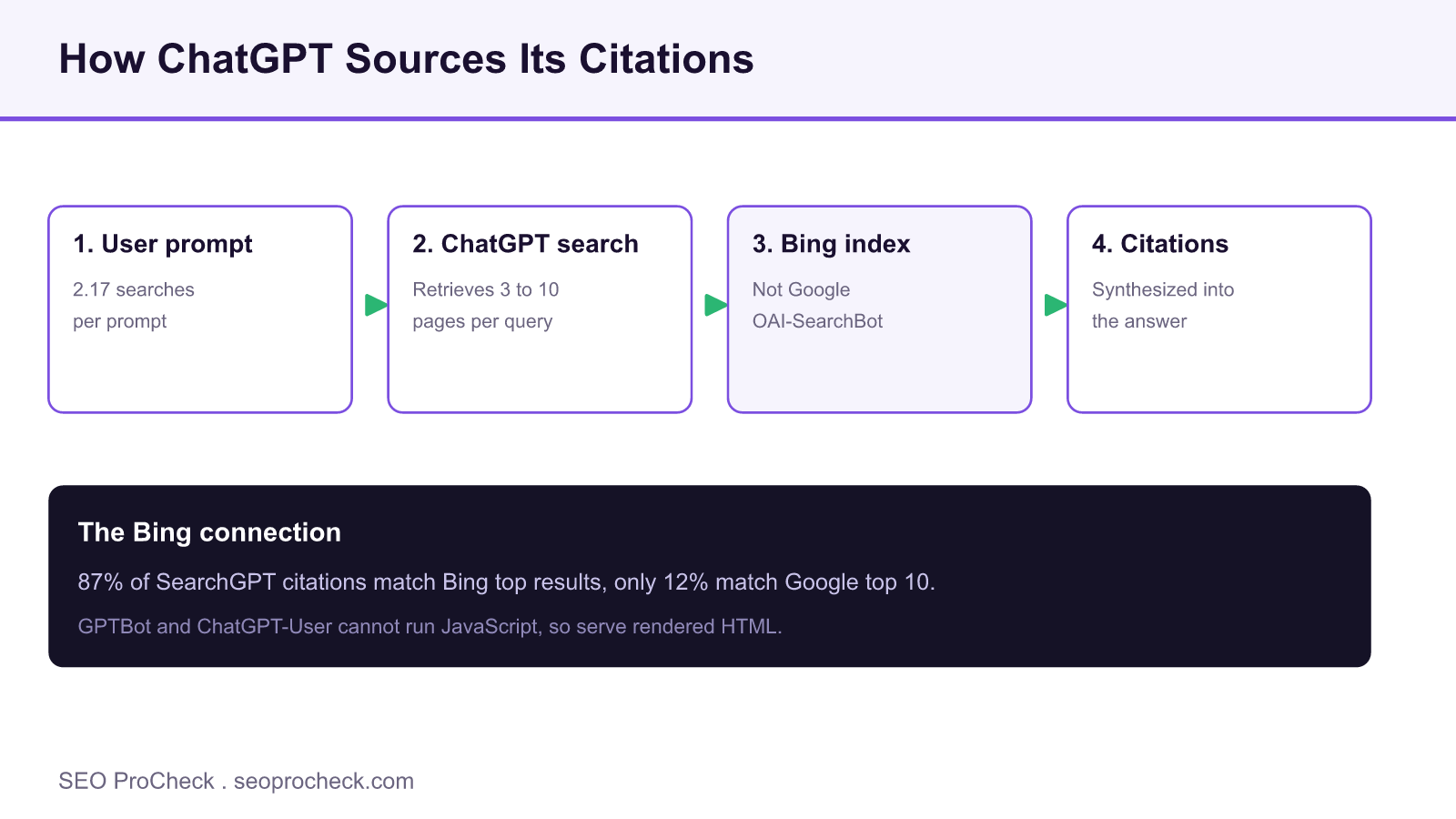
ChatGPT and SearchGPT use Microsoft Bing's index, not Google's. This means your Google rankings have minimal impact on ChatGPT visibility. According to Ahrefs research, only 12% of ChatGPT-cited URLs rank in Google's top 10, while Seer Interactive found 87% of SearchGPT citations match Bing's top organic results.
Key Statistics: ChatGPT Citation Patterns
| Metric | Value | Source |
|---|---|---|
| ChatGPT citations from Google top 10 | 12% | Ahrefs |
| SearchGPT match with Bing top results | 87% | Seer Interactive |
| ChatGPT top citations with zero Google visibility | 25% | Ahrefs |
| ChatGPT top 3 citations with no Google visibility | 50% | Ahrefs |
| Searches per ChatGPT prompt | 2.17 average | Dejan Marketing |
| Pages retrieved per query | 3-10 | Dejan Marketing |
Why Google Rankings Don't Matter for ChatGPT
OpenAI's VP of Engineering confirmed that ChatGPT uses "a set of services and Bing is an important one." The Microsoft-OpenAI partnership, backed by over $13 billion in investments, creates a direct link between Bing's indexed content and ChatGPT's search results.
Key implication: Websites penalized by Bing effectively disappear from ChatGPT. Sites not indexed by Bing won't appear in ChatGPT results regardless of Google ranking.
How to Optimize for ChatGPT Citations
1. Prioritize Bing Indexing
- Submit your site to Bing Webmaster Tools
- Verify Bing has indexed your key pages
- Check Bing rankings for target keywords (not Google)
- Fix any Bing-specific crawling or indexing issues
2. Allow the Right Crawlers
OpenAI operates three crawlers with different purposes:
| Crawler | Purpose | Robots.txt Token |
|---|---|---|
| GPTBot | AI model training | GPTBot |
| ChatGPT-User | Real-time browsing (user queries) | ChatGPT-User |
| OAI-SearchBot | Search indexing | OAI-SearchBot |
Source: OpenAI Bot Documentation
For ChatGPT visibility, you need to allow at least ChatGPT-User and OAI-SearchBot. You can block GPTBot if you don't want your content used for training.
3. Use Server-Side Rendering
According to Vercel's research, ChatGPT explicitly returns: "I cannot read the content of the page because it relies on JavaScript-based rendering."
GPTBot and ChatGPT-User cannot execute JavaScript. If your site uses React, Vue, or Angular with client-side rendering only, ChatGPT will see a blank page.
4. Structure Content for Extraction
ChatGPT retrieves 3-10 pages per query and synthesizes information. Content that gets cited tends to have:
- Clear heading structure (H1, H2, H3)
- Tables with data (2.5x more citations)
- Lists and bullet points (50% of top citations)
- FAQ sections with direct answers
- Specific facts, statistics, and data points
ChatGPT Retrieval Depth
According to Dejan Marketing's analysis, ChatGPT's system prompt instructs it to retrieve "at least 3 and at most 10 pages" per query. It averages 2.17 searches per prompt, meaning it may run multiple searches to answer a single question.
If you're not ranking in Bing's top 10 for your target keywords, your chances of being cited drop significantly.
Your ChatGPT Visibility Checklist
The tactics above reduce to five concrete checks. Run each key page through them before you worry about anything else, because ChatGPT visibility is gated by Bing indexing and clean, rendered HTML. This checklist sits alongside the broader strategy in our GEO fundamentals guide and the per passage tactics in our LLM citation optimization guide.
| Action | Where to do it | Why it matters |
|---|---|---|
| Confirm Bing indexing | Bing Webmaster Tools | ChatGPT and SearchGPT read the Bing index, not Google |
| Allow the right crawlers | robots.txt | OAI-SearchBot and ChatGPT-User must be allowed to appear |
| Serve rendered HTML | Server-side rendering | GPTBot and ChatGPT-User cannot execute JavaScript |
| Add tables and lists | On page content | Structured formats earn more citations than plain prose |
| Answer questions directly | Headings and FAQ | Extractable answers get synthesized into responses |
The single most common reason a well ranked page stays invisible in ChatGPT is a Bing gap: the page ranks in Google but is thin or absent in Bing, so the retrieval step never surfaces it. The second is rendering. A React, Vue, or Angular site that ships an empty HTML shell and paints content with JavaScript hands GPTBot a blank page, because the OpenAI crawlers do not execute scripts. Fix those two first. After that, the structural work pays off: ChatGPT retrieves several pages per query and stitches together the passages it can extract cleanly, so a page built from clear headings, short direct answers, and a data table gives it far more to quote than a wall of prose. Verify each fix by checking your Bing rankings for the target query rather than your Google position, since the Bing result is the one that feeds the model.
Frequently Asked Questions
Does my Google ranking affect ChatGPT visibility?
Minimally. Only 12% of ChatGPT citations overlap with Google's top 10. ChatGPT uses Bing's index, so Bing rankings matter much more.
How do I check if Bing has indexed my site?
Use Bing Webmaster Tools or search "site:yourdomain.com" in Bing. If pages don't appear, submit them through Bing Webmaster Tools.
Should I block GPTBot?
Only if you don't want your content used for AI training. Blocking GPTBot doesn't affect real-time ChatGPT browsing (that uses ChatGPT-User).
How many sources does ChatGPT cite per response?
ChatGPT retrieves 3-10 pages per search and typically runs 2+ searches per complex query. It synthesizes information from multiple sources.
Does ChatGPT use Google or Bing for search?
ChatGPT and SearchGPT use Microsoft Bing's index, not Google's. Seer Interactive found 87% of SearchGPT citations match Bing's top organic results, so your Bing presence matters far more than your Google ranking.
Why does ChatGPT say it cannot read my page?
GPTBot and ChatGPT-User cannot execute JavaScript. If your site renders content client side only, the crawler sees a blank page, so serve important content with server-side rendering.
Sources
- Ahrefs: Only 12% of AI Cited URLs Rank in Google's Top 10
- Seer Interactive: 87% of SearchGPT Citations Match Bing's Top Results
- Search Engine Roundtable: Bing Powers ChatGPT Search
- Dejan Marketing: How ChatGPT Search Results Work
- Vercel: The Rise of the AI Crawler
- OpenAI: Bot Documentation
Related Research
- How AI Search Tools Source Information from Organic Search Results
- AI Crawler Comparison: GPTBot, ClaudeBot, PerplexityBot Guide
- JavaScript and AI Search: Why Server-Side Rendering Matters
Take this with you
The assistant links open with a question about this page already written. Nothing is sent until you press enter.
Claude Vincent is a technical SEO consultant focused on crawlability, rendering, and AI-search visibility. He writes the field guides and case studies at SEO ProCheck, with a bias toward the durable, unglamorous work that decides whether search engines and AI answer engines can actually read and cite a site.
About SEO ProCheck
Technical SEO consulting and GEO strategy with 20 years of enterprise experience. Case studies, resources, and tools for search and AI visibility.
Work With Me
Technical SEO audits, GEO strategy, site migrations, and international SEO. Hourly consulting for teams who need hands-on support, not just reports.
Subscribe to our newsletter!








Recent Posts
- Most Top Sites Never Say Who They Are in Structured Data October 14, 2026
- Homepage Titles Are Mostly Too Short, Not Too Long October 8, 2026
- Who Actually Serves an llms.txt? 184 Top Sites Measured September 29, 2026