

We Analyzed Millions of Publisher Links: How to Syndicate Content for Free
- June 6, 2023
- Cross-Industry

AI Summary
Content syndication means republishing a piece you already own on another relevant platform so it reaches that platform's audience, at no cost beyond effort. It multiplies reach and earns the occasional link when the underlying asset is genuinely worth citing, but it manufactures nothing for thin or off topic content, so relevance and quality decide the outcome.
- The content that earns publisher links clusters around original research, proprietary data, strong visuals, and timely angles.
- Set a canonical tag or a visible attribution link on every syndicated copy so it credits the source rather than competing with it.
- Free routes include republishing on fitting platforms, contributor articles, and assets others want to cite.
- Syndication is a multiplier, not a generator: a weak asset stays weak no matter how widely it travels.
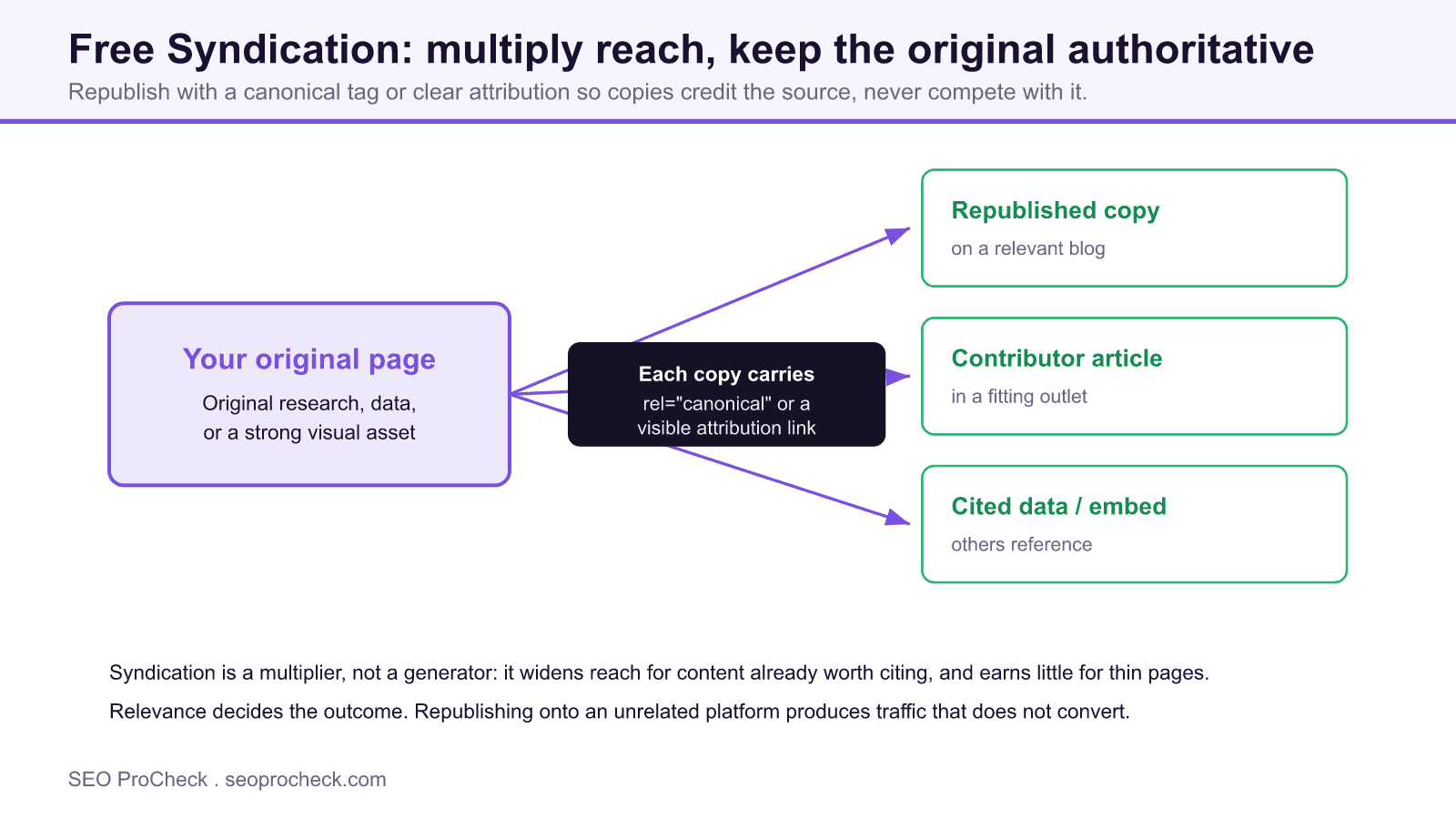
Study the content that earns links from publishers at scale and the same patterns surface again and again: original research, proprietary data, strong visual assets, and timely angles tied to what newsrooms are already covering. Content syndication, republishing your work on relevant third party platforms with proper canonical tags and attribution, is one free way to widen the audience for that content and put it in front of people who can cite it. It is not a magic button. It earns reach and the occasional link when the underlying piece is genuinely worth referencing, and close to nothing when the piece is thin or off topic. Relevance and quality decide the outcome.
What earns publisher links
Looking across a very large body of published content and the links it attracted, the work that earns editorial and publisher links is not random. It clusters around a handful of qualities that make a journalist, blogger, or analyst want to point at it. Understanding those qualities is more useful than chasing any single tactic, because they tell you what to build before you think about distribution.
The clearest pattern is original research and proprietary data. When you publish something nobody else has, a survey you ran, a dataset you compiled, an analysis only you can produce, you become the source. Writers cite sources. A page that restates what everyone already knows gives no one a reason to link, while a page that introduces a new finding becomes a reference point that accumulates citations over time.
Strong visual assets are the second pattern. A clear chart, a well designed diagram, an explanatory map, or an original illustration gives a publisher something to embed and a reason to attribute it back to you. Visuals travel further than text because they are easy to reuse and hard to paraphrase away. Timeliness is the third pattern: content tied to a topic currently in the news, or to a recurring moment editors plan around, lands far more often than the same idea published into a quiet gap. The lesson is that linkable content is built deliberately, a theme we expand on in our guide to digital PR for SEO.
How free syndication works
Content syndication means republishing a piece you already own on a different platform so it reaches that platform's audience. Done correctly it is free, with several legitimate routes that cost nothing but effort.
The first is straightforward republishing on relevant platforms. Many publications, industry blogs, and community sites accept republished work. The mechanics matter: the republished copy should carry a canonical tag pointing back to your original, or at minimum a clear, visible attribution line linking to the source. That tells search engines which version is authoritative and ensures the copy credits you rather than competing with or quietly absorbing your work.
The second route is contributor pieces: writing an original article for a relevant publication, rather than copying an existing one, puts your name and a link in front of that publication's readers and editors. The third, and often the most durable, is producing data and assets that others actively want to cite. When you publish research or a visual that fills a real gap, other writers syndicate it for you by referencing and embedding it without being asked. That earned spread is the version that compounds, and none of these routes replace the basics of earning links honestly, which we cover in our link building fundamentals.
| Free route | How it works | What it earns | Key requirement |
|---|---|---|---|
| Republishing on relevant platforms | Repost your existing piece on an industry blog or community site | Fresh reach plus occasional referral links | A canonical tag or a visible attribution line pointing to your original |
| Contributor articles | Write an original piece for a relevant publication rather than copying one | A byline, a link, and editor relationships | Genuinely original writing that fits the outlet |
| Citable data and assets | Publish research or a visual others actively want to reference | Earned, compounding citations you never had to ask for | Clear titles, a source line, and an easy embed option |
How to apply it
Start with the asset, not the distribution. Before you think about where to syndicate, build something that meets the bar set above: an original finding, a clean visual, or a genuinely useful resource on a topic people are discussing. If the underlying piece is not worth citing, no amount of syndication will manufacture links for it.
Once the asset exists, identify platforms that are topically relevant to it. A piece on a niche subject belongs on sites that cover that niche, not wherever will accept it. Pitch contributor articles or republishing to those specific, fitting outlets, and set the canonical tag or attribution correctly every time so the source page stays authoritative and you never compete against your own syndicated copies.
For data and visual assets, make them easy to cite. Give charts a clear title and a source line, offer an embed option where it makes sense, and present the underlying figures plainly so a writer can reference them with confidence. Then track what happens: note which platforms drove real referrals, which assets attracted unprompted citations, and which topics resonated. That record tells you where to invest next and stops you from repeating distribution that quietly led nowhere.
Caveats
Syndication is a multiplier, not a generator. It widens the audience for content that already deserves attention; it does not make weak content link worthy. The most common disappointment comes from treating distribution as the strategy when the asset itself was never strong enough to earn a citation in the first place.
Relevance is non negotiable. Republishing onto an unrelated platform, or pitching a contributor piece to an outlet whose readers do not care about your topic, produces traffic that does not convert and links that do little for your standing. Technical correctness matters too: a syndicated copy without a canonical tag or clear attribution can dilute the original rather than support it. And the spread is never guaranteed. Some excellent assets get cited widely, others quietly do not, so the honest expectation is steady, uneven returns rather than a reliable surge. Build for quality and relevance, syndicate carefully, and treat every link as earned rather than owed.
FAQ
Not if you handle it correctly. Set a canonical tag on the syndicated copy pointing to your original, or include a clear attribution link back to the source. That tells search engines which version is authoritative and keeps the syndicated copy from competing with your own page.
Content that earns links in the first place: original research, proprietary data, strong visual assets, and timely pieces tied to topics people are already covering. If a piece would not earn a citation on its own merits, syndicating it will not change that.
It can be, when relevance is right. Free routes like contributor pieces, republishing on fitting platforms, and creating assets others want to cite often produce more durable, credible links than paid placement, because the spread is earned. The trade off is that it takes a genuinely strong asset and patience.
An advanced SEO audit identifies your most linkable assets, the gaps worth filling, and where distribution will actually pay off, so your syndication effort goes where it counts.
Claude Vincent is a technical SEO consultant focused on crawlability, rendering, and AI-search visibility. He writes the field guides and case studies at SEO ProCheck, with a bias toward the durable, unglamorous work that decides whether search engines and AI answer engines can actually read and cite a site.
About SEO ProCheck
Technical SEO consulting and GEO strategy with 20 years of enterprise experience. Case studies, resources, and tools for search and AI visibility.
Work With Me
Technical SEO audits, GEO strategy, site migrations, and international SEO. Hourly consulting for teams who need hands-on support, not just reports.
Subscribe to our newsletter!







Recent Posts
- Can AI Crawlers Actually Read Your Site? I Measured 400 of the Biggest September 5, 2026
- The Pre-Publish Quality Gate for AI-Assisted Content August 6, 2026
- AGENTS.md vs llms.txt vs llms-full.txt: Which Agent File Does What July 18, 2026