

AI Summary
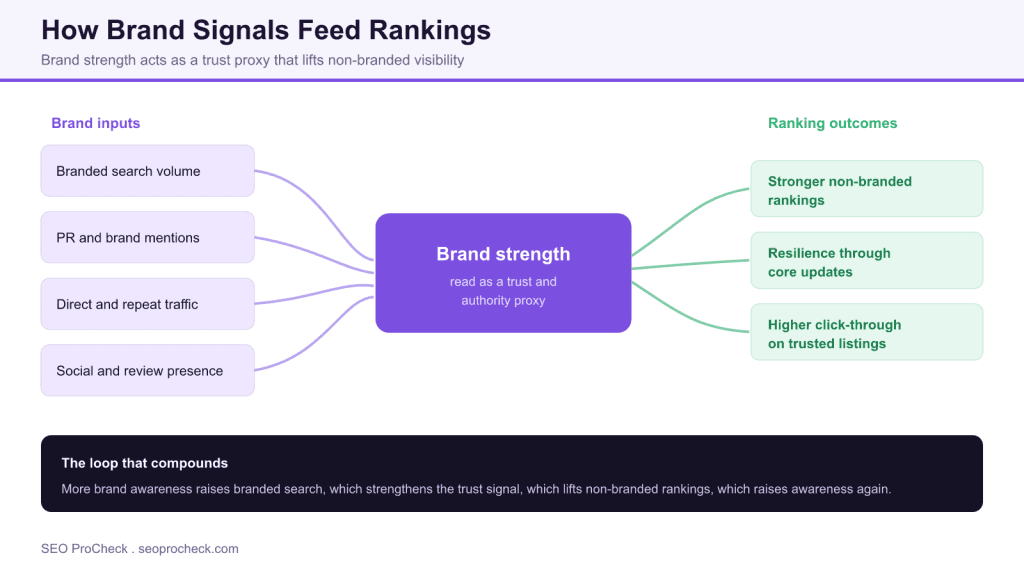
Brand signals are the markers of a recognized, trusted business, branded search demand, mentions, direct traffic, and reputation, and they correlate with stronger rankings even for non-branded queries. Google appears to use brand strength as a proxy for quality and trust, so building genuine awareness supports SEO well beyond the clicks from branded searches themselves.
- Higher branded search volume tends to accompany stronger non-branded rankings across industries.
- Brand strength behaves like a trust signal, adding resilience through core algorithm updates.
- The effect is a loop: awareness raises branded demand, which reinforces trust, which lifts visibility.
- Smaller brands build the same signal through niche authority, not by trying to fake brand metrics.

Research into brand signals examined how brand recognition and branded search volume correlate with non-branded ranking performance. The study analyzed relationships between brand strength and organic visibility.
What counts as a brand signal
Brand signals are the observable traces of a business people actually know and choose on purpose. The most measurable is branded search volume: how many people type your name, or your name plus a product, into search. Around it sit direct and repeat traffic, unlinked and linked brand mentions across the web, a healthy review and social footprint, and a consistent name, logo, and entity across your site and third-party profiles. None of these is a single ranking dial you can turn, but together they describe an entity that search systems can recognize and trust.
Branded Search Correlation
Sites with higher branded search volume showed stronger rankings for non-branded terms. Brand recognition appeared to function as a trust and authority signal. This relationship held across industries and site types.
Correlation is not proof of a direct ranking factor, and it is worth stating plainly: brand strength and good rankings may both flow from the same underlying cause, a genuinely good product with satisfied customers. That caveat does not weaken the practical takeaway, because the activities that build brand demand are the same activities that build the reputation search systems reward.
Brand as Quality Proxy
Google may use brand signals as proxies for content quality and trustworthiness. Established brands with positive reputations showed ranking resilience through algorithm updates. Building brand recognition provided SEO benefits beyond direct traffic from branded searches.
This resilience is the clearest practical payoff. When a core update reshuffles a category, recognizable brands with real demand tend to hold their positions or recover quickly, while anonymous sites that rank on tactics alone are the ones that swing hardest. Brand acts as ballast.
Brand Building for SEO
Traditional brand-building activities (PR, advertising, social presence) showed indirect SEO benefits. Improving brand awareness increased branded search volume, potentially improving non-branded rankings. Integrated marketing approaches combining SEO with brand building outperformed SEO-only strategies.
Small Brand Strategies
Smaller brands can build recognition through niche authority and consistent quality. Becoming the recognized expert in a specific area provided brand benefits within that niche. Focus on building genuine reputation rather than attempting to manipulate brand signals.
Brand signals, how to grow them, and how to measure them
| Signal | How to build it | Where to measure it |
|---|---|---|
| Branded search volume | PR, content, advertising, memorable name | Search Console queries containing your brand |
| Direct traffic | Loyalty, email, offline presence | Analytics direct channel over time |
| Brand mentions | Digital PR, expert commentary, partnerships | Mention monitoring and link tools |
| Review and social proof | Deliver quality, ask happy customers | Review platforms and social listening |
| Entity consistency | Same name, logo, details everywhere | Knowledge panel and profile audits |
What has changed since the study
Brand has only grown more central. Google’s guidance now leans heavily on experience, expertise, authoritativeness, and trust, and trust is largely a brand judgment. In parallel, AI answer engines such as AI Overviews and chat assistants preferentially cite recognizable, well-referenced entities, so a strong brand increasingly decides whether you are named in a generated answer, not just whether you rank in a list of links. The strategic implication is unchanged but sharper: invest in becoming a genuinely recognized name in your niche, and let the ranking benefits follow.
Source: Brand signals research compiled
Frequently asked questions
Do brand signals directly affect Google rankings?
The evidence is correlational rather than a confirmed single ranking factor, but the pattern is consistent: stronger brands rank better for non-branded terms. Whether it is direct or a shared cause with quality, the practical advice is the same, build a real brand.
How does branded search volume relate to SEO?
Higher branded search demand tends to accompany stronger non-branded rankings. It signals a recognized, trusted entity, and growing it through PR and marketing often lifts organic visibility beyond the branded clicks themselves.
Can a small business benefit from brand signals?
Yes. Small brands build the same effect by becoming the recognized authority in a narrow niche. Consistent quality and genuine reputation within a focused area produce brand strength without a large advertising budget.
Why do strong brands survive core updates better?
Brand acts as a trust proxy, so recognizable businesses with real demand tend to hold or quickly recover their rankings when an update reshuffles a category, while sites ranking on tactics alone swing the hardest.
Can I fake brand signals to rank higher?
No. Manufactured mentions and artificial branded searches are detectable and ineffective. The durable path is to earn genuine recognition through a good product, real PR, and satisfied customers.
Do brand signals matter for AI search answers?
Increasingly yes. AI answer engines tend to cite recognizable, well-referenced entities, so a strong brand improves the odds of being named in a generated answer, not just ranked in a list of links.
Related reading on SEO ProCheck:
- Why brand beats a keyword domain: the EMD study
- More cross-industry SEO research
- See how an advanced SEO audit weighs brand and trust signals
Take this with you
The assistant links open with a question about this page already written. Nothing is sent until you press enter.
Claude Vincent is a technical SEO consultant focused on crawlability, rendering, and AI-search visibility. He writes the field guides and case studies at SEO ProCheck, with a bias toward the durable, unglamorous work that decides whether search engines and AI answer engines can actually read and cite a site.
About SEO ProCheck
Technical SEO consulting and GEO strategy with 20 years of enterprise experience. Case studies, resources, and tools for search and AI visibility.
Work With Me
Technical SEO audits, GEO strategy, site migrations, and international SEO. Hourly consulting for teams who need hands-on support, not just reports.
Subscribe to our newsletter!








Recent Posts
- Most Top Sites Never Say Who They Are in Structured Data October 14, 2026
- Homepage Titles Are Mostly Too Short, Not Too Long October 8, 2026
- Who Actually Serves an llms.txt? 184 Top Sites Measured September 29, 2026