

AI Summary
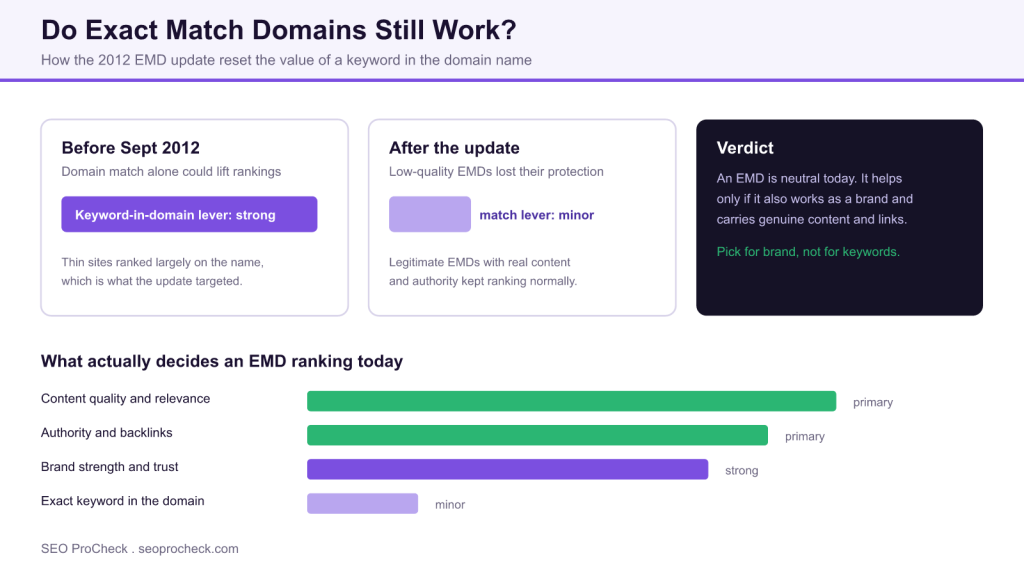
Exact match domains, where the domain name is the target keyword, no longer earn a ranking advantage on their own. Google’s 2012 EMD update removed the boost for low-quality keyword domains, so today an EMD ranks on the same signals as any site: content quality, authority, and brand.
- An EMD is neutral, not harmful and not a shortcut: it competes on merit like any other domain.
- The 2012 update targeted thin sites ranking mainly on the domain name, not legitimate businesses.
- Keyword-in-domain is now a minor signal, well behind content, links, and brand strength.
- Choose a domain for brandability first, and only fold in a keyword if it still reads as a real brand.
Research into exact match domains (EMDs) examined whether domains matching target keywords maintain ranking advantages. The study analyzed EMD performance after Google's EMD algorithm update.
What an exact match domain actually is
An exact match domain is a web address whose name is the phrase you want to rank for, for example bestlondonplumbers.com targeting the query best London plumbers. A partial match domain contains the keyword plus extra words, while a branded domain uses a coined or company name that carries no keyword at all. The distinction matters because the ranking systems treat the keyword in a domain as one weak relevance hint among hundreds of signals, not as a decisive lever.
Historical EMD Advantage
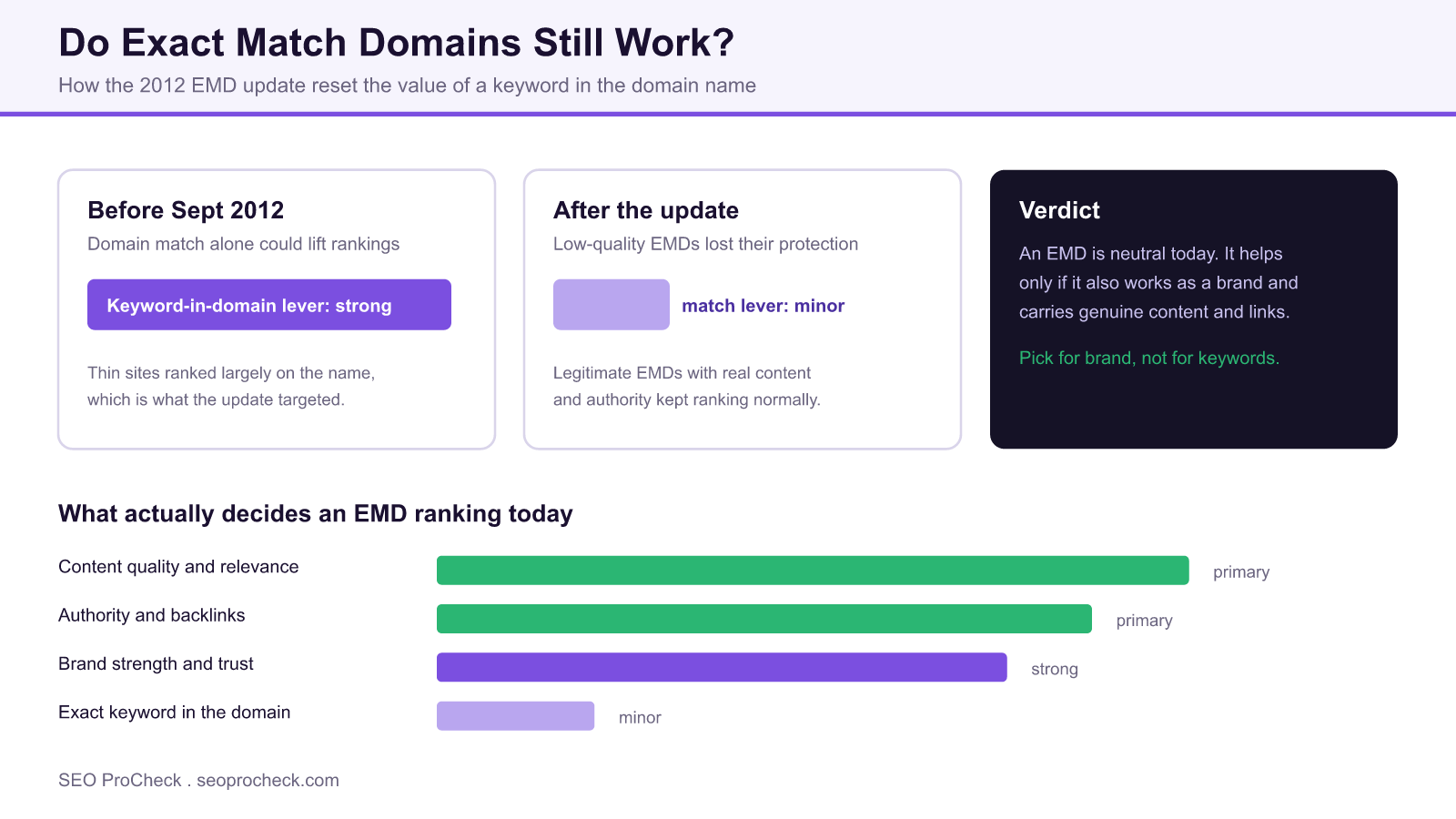
Before Google's 2012 EMD update, exact match domains showed clear ranking benefits for matching keywords. Low-quality sites could rank primarily on domain name match. The update specifically targeted low-quality EMDs while legitimate sites retained benefits.
The mechanism was simple and easy to abuse: a keyword in the domain reinforced the same keyword in the title, the headings, and the anchor text pointing at the site, so a thin page could stack matching signals and outrank stronger competitors. Google rolled out the EMD update in late September 2012 precisely to reduce how often low-quality exact match domains surfaced for their namesake queries.
Current EMD Performance
Post-update research showed EMDs still rank well when combined with quality content and authority. The domain name alone no longer provides significant ranking advantage. EMDs with thin content or manipulative tactics show no special protection.
In day-to-day practice this means an EMD neither helps nor hurts by default. If bestlondonplumbers.com ranks well, it is because the site has genuinely useful pages, earned links, and a real reputation, the same things that would rank a branded domain. Strip those away and the keyword in the name does almost nothing.
Branding Considerations
EMDs can limit brand differentiation and appear spammy to users. Memorable brand names often outperform keyword domains for building loyalty. EMDs may hurt click-through if users perceive them as less trustworthy than branded alternatives.
There is also a growth ceiling to consider. A domain built around one keyword boxes in a business that later expands: cheapflightsdallas.com is awkward once you also sell hotels or serve other cities. Brandable names travel across products and markets, are easier to protect as a trademark, and tend to earn more direct and branded search, which is itself a positive signal.
Strategic Assessment
EMDs remain viable if the domain also works as a brand and supports quality content development. Choosing domains solely for keyword inclusion provides minimal SEO value. Focus on brandability while incorporating keywords naturally if alignment makes sense.
EMD, partial match, and branded domains compared
| Domain type | Example | Ranking lever today | Brand ceiling |
|---|---|---|---|
| Exact match | citycarpetcleaning.com | Minor keyword hint only | Low, hard to extend |
| Partial match | citycarpetpros.com | Slight hint plus brandability | Moderate |
| Branded | Sweeply | None from the name, all from reputation | High, extends easily |
| Keyword plus brand | Sweeply Carpets | Small hint and clear brand | High |
What has changed since the study
Two shifts reinforce the conclusion. First, brand and entity signals have grown more important: consistent brand mentions, branded search demand, and a recognizable identity now feed both classic rankings and the way AI answer engines cite sources. A generic keyword string in a domain does little to build that entity. Second, users have grown more skeptical of obviously keyword-stuffed domains, which can depress click-through even when the page ranks. The safest modern default is to pick a name you would be happy to put on a logo, then judge any keyword overlap as a small bonus rather than a strategy.
Source: Exact match domain research compiled
Frequently asked questions
Do exact match domains still help SEO in 2026?
Only marginally. A keyword in the domain is a minor relevance hint, not a ranking shortcut. EMDs that rank well do so because of strong content, authority, and brand, not because of the name itself.
Did the EMD update penalize all keyword domains?
No. The 2012 EMD update targeted low-quality sites that ranked mainly on their domain name. Legitimate businesses with real content and links kept their rankings and were largely unaffected.
Is an exact match domain bad for SEO?
Not inherently. An EMD is neutral: it will not sink a good site and will not rescue a weak one. The risk is strategic, since a narrow keyword name can look spammy and can limit how the brand grows.
Should I buy an EMD for a new site?
Prefer a brandable name. If a keyword happens to fit naturally and the domain still reads like a real brand, that is fine, but do not choose a domain purely to cram in a keyword.
Can an EMD hurt click-through rates?
It can. Some users perceive heavily keyword-based domains as less trustworthy than a recognizable brand, which can lower click-through even when the listing ranks well in the results.
What matters more than the domain name?
Content quality and relevance, earned authority and backlinks, and overall brand strength. These outweigh a keyword in the domain by a wide margin and are where effort should go.
Related reading on SEO ProCheck:
Claude Vincent is a technical SEO consultant focused on crawlability, rendering, and AI-search visibility. He writes the field guides and case studies at SEO ProCheck, with a bias toward the durable, unglamorous work that decides whether search engines and AI answer engines can actually read and cite a site.
About SEO ProCheck
Technical SEO consulting and GEO strategy with 20 years of enterprise experience. Case studies, resources, and tools for search and AI visibility.
Work With Me
Technical SEO audits, GEO strategy, site migrations, and international SEO. Hourly consulting for teams who need hands-on support, not just reports.
Subscribe to our newsletter!



Recent Posts
- Can AI Crawlers Actually Read Your Site? I Measured 400 of the Biggest September 5, 2026
- The Pre-Publish Quality Gate for AI-Assisted Content August 6, 2026
- AGENTS.md vs llms.txt vs llms-full.txt: Which Agent File Does What July 18, 2026