

The SEO Industry, Honestly: How to Read Case Studies and Revenue Claims
- June 8, 2023
- Cross-Industry
AI Summary
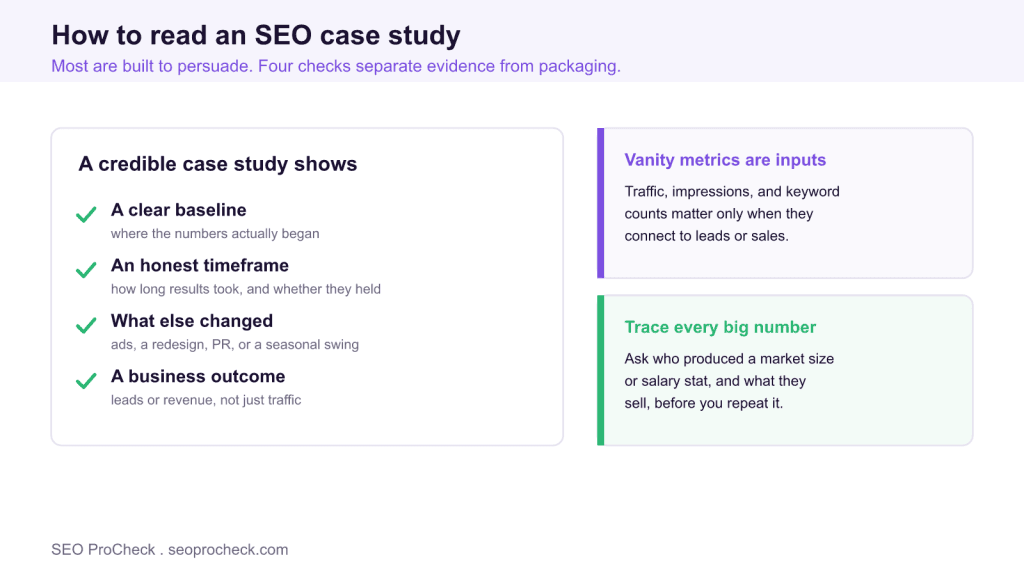
SEO case studies and headline industry numbers can be genuinely useful, but most are built to persuade rather than to inform. Before you trust a success story, look for a clear baseline, a defined timeframe, an honest account of everything else that changed, and a business outcome rather than a flattering chart.
- You are almost never seeing a representative sample: agencies publish wins, not flat quarters, which is survivorship bias in plain sight.
- Separate correlation from causation: ask what else happened in the same window, from ad spend to a redesign to seasonality.
- Treat vanity metrics as inputs; a story silent on revenue is telling you which number it could not show.
- Trace any big market size or salary figure to its original source, and hold your own reporting to the same standard.
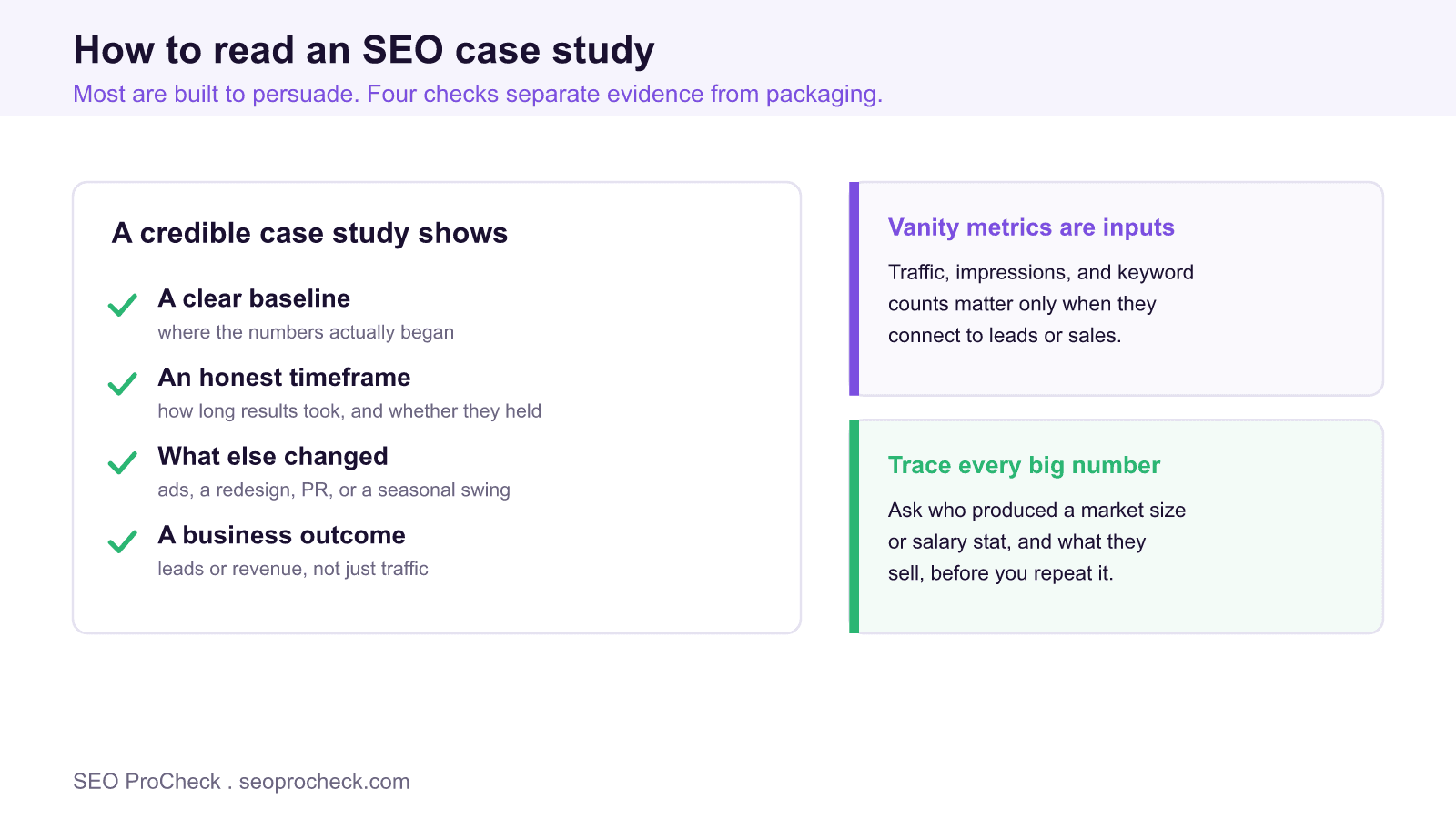
SEO case studies and headline industry numbers can be genuinely useful, but most are built to persuade rather than to inform. Before you trust a success story, look for a clear baseline, a defined timeframe, an honest account of everything else that changed, and a business outcome rather than a flattering chart. Read market-size and salary claims the same way you read any statistic: ask who produced it and why. Then hold your own reporting to the same standard, because the credibility you build is worth more than any number you could borrow.
Open any marketing feed and you will trip over triumph. Traffic multiplied. Rankings conquered. Revenue transformed. The stories are vivid, the charts climb cheerfully to the right, and almost none of them give you what you would need to judge whether the result is repeatable, attributable, or even real. That is not a reason for cynicism. It is a reason to read carefully. Good evidence exists in this field, and learning to separate it from confident packaging is one of the most valuable skills an SEO can develop.
Why SEO success stories deserve scrutiny
The first thing to remember is that you are almost never seeing a representative sample. Agencies and tools publish their wins, not their flat quarters or quiet client churn. That is survivorship bias in plain sight: the campaigns that failed simply never become slides. Selection bias compounds it, because the case chosen for publication is usually the most flattering one available, not a typical engagement.
Then there is the gap between correlation and causation. A site that ran an SEO project also, in the same window, may have launched a new product, increased ad spend, earned press coverage, or simply benefited from a seasonal swing it would have enjoyed regardless. When a story credits a single tactic for a sweeping result, ask what else was happening at the same time. Brand strength, budget, existing domain history, and category demand all push results around, and they rarely appear in the highlight reel.
Watch the time window, too. A chart that begins at a convenient low point and ends at a convenient high point can dramatize almost any trend. And be wary of vanity metrics dressed as outcomes. Traffic, impressions, and keyword counts are inputs. They matter only insofar as they connect to leads, sales, or whatever the business actually needs. A story that celebrates a surge in sessions while staying silent about revenue is quietly telling you which number it could not show.
What a credible case study actually shows
A trustworthy case study does not hide its work. It states a clear baseline so you can see where things began. It defines the timeframe honestly, including how long results took to appear and whether they held afterward. It describes the methodology in enough detail that a competent reader could attempt something similar, rather than gesturing at proprietary magic.
Crucially, it acknowledges what else changed. An honest writeup will tell you the site also redesigned its templates, fixed a longstanding technical issue, or shifted budget, and it will reason carefully about attribution instead of claiming all the credit. Our own look at how click-through behavior varies across positions is a reminder that the same ranking can produce very different traffic depending on context, which is exactly the kind of nuance a credible study respects.
Finally, it ties the work to a business outcome. Rankings and traffic are the path, not the destination. The case studies worth learning from explain what the organization actually gained, and they are comfortable noting the limits of what they can prove. Confidence about uncertainty is a hallmark of honest analysis, not a weakness in it.
Reading industry numbers critically
Big headline figures about market size, agency revenue, and practitioner salaries travel fast because they are easy to quote and hard to check. Before you repeat one, trace it back. Who produced the number, and what do they sell? A figure that makes an entire industry look enormous and indispensable is convenient for anyone who profits from that perception, which does not make it false, but does make it worth verifying.
Ask how the number was gathered. Was it a survey, and if so, who answered it and how were they recruited? Self-selected respondents skew results in predictable directions. Are definitions consistent, so that the thing being measured in one year matches the thing measured in another? Has the figure been passed from one article to the next until the original source is lost and only the impressive digit remains? Many widely cited statistics are quotations of quotations, and the provenance evaporates somewhere along the chain.
None of this means you should ignore industry data. It means you should treat a single dramatic number as a prompt to investigate rather than a fact to bank. The same discipline applies to advice about tactics. Even well-regarded practices, such as the principles in our link building fundamentals guide, are worth understanding mechanistically rather than accepting because someone attached an eye-catching result to them.
How to report your own results honestly
The good news is that the standard you apply to others is the same one that makes your own reporting trustworthy. Start with an honest baseline and write it down before the work begins, so nobody has to reconstruct it later from memory. Be explicit about attribution: note the other changes that happened in the same period, and resist the urge to claim a result your data cannot support.
Report outcomes the business cares about, not just the metrics that happen to look best. Where a result is uncertain, say so plainly. Clients and colleagues remember who told them the truth when a number was soft, and that memory is worth far more than a temporarily impressive slide. The most reliable posture in this field is to under-promise, document carefully, and let durable results speak. It is also, conveniently, the posture that keeps you out of trouble when a clever window closes and the chart stops cooperating.
Frequently asked questions
Not at all. A case study with a clear baseline, an honest timeframe, transparent methodology, and a real business outcome can teach you a great deal. Skepticism is simply the filter that separates those from the ones built only to impress.
Trace it to its original source, identify who produced it and what they sell, and check how it was measured. If you can only find it quoted by people repeating each other, treat it as unverified until you locate the study behind it.
There is no single metric, and any story that offers one deserves a second look. The strongest evidence connects search visibility to a business outcome while accounting for everything else that changed in the same period.
Long enough to show the change held, not just that it spiked. A credible study reports the baseline, the point results appeared, and whether they were still in place months later. A chart that stops at a convenient peak is quietly telling you it could not show what happened next.
Yes, as inputs and early signals, but not as proof of success on their own. Traffic, impressions, and keyword counts matter only insofar as they connect to leads, sales, or whatever the business actually needs. A story that celebrates a surge in sessions while staying silent about revenue is telling you which number it could not show.
Get a clear baseline, honest attribution, and a plan built on evidence rather than headlines.
Claude Vincent is a technical SEO consultant focused on crawlability, rendering, and AI-search visibility. He writes the field guides and case studies at SEO ProCheck, with a bias toward the durable, unglamorous work that decides whether search engines and AI answer engines can actually read and cite a site.
About SEO ProCheck
Technical SEO consulting and GEO strategy with 20 years of enterprise experience. Case studies, resources, and tools for search and AI visibility.
Work With Me
Technical SEO audits, GEO strategy, site migrations, and international SEO. Hourly consulting for teams who need hands-on support, not just reports.
Subscribe to our newsletter!







Recent Posts
- Can AI Crawlers Actually Read Your Site? I Measured 400 of the Biggest September 5, 2026
- The Pre-Publish Quality Gate for AI-Assisted Content August 6, 2026
- AGENTS.md vs llms.txt vs llms-full.txt: Which Agent File Does What July 18, 2026