

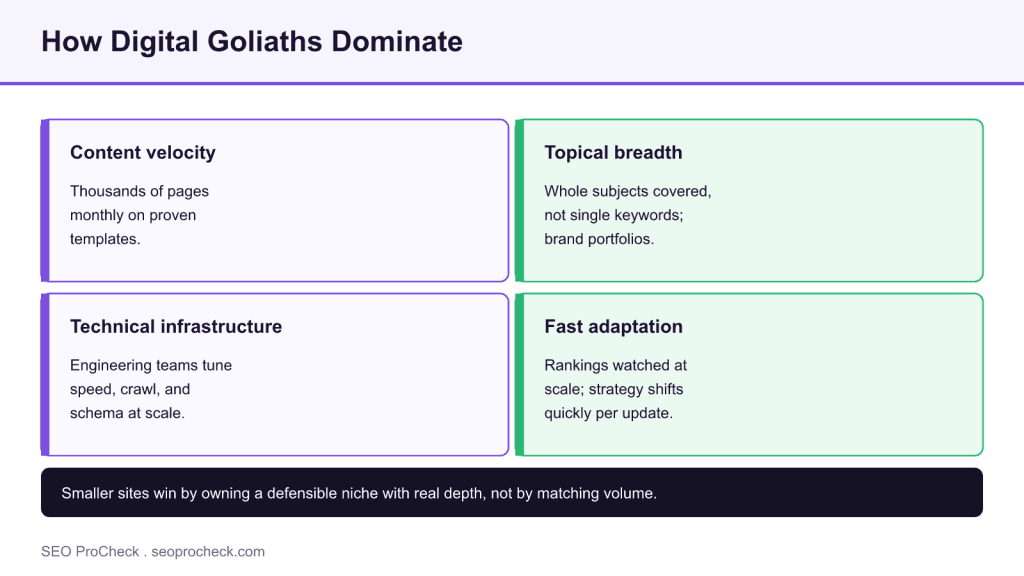
Detailed analyzed how the largest digital publishers hold and grow search visibility. Their edge comes from four levers: enormous content velocity on proven templates, topical breadth that blankets whole subjects, heavy technical infrastructure, and fast adaptation to algorithm changes. Smaller sites cannot match the volume, but they can win defensible niches with real depth.
- Goliaths pair volume with systematic optimization, not volume alone.
- They dominate whole subjects, often through portfolios of focused brands.
- Dedicated engineering teams tune architecture, speed, and structured data at scale.
- Small sites compete by owning a narrow niche these giants have not prioritized.

Detailed's quarterly analysis series examines the SEO strategies of major digital publishers to reveal patterns in how dominant sites maintain and grow their search visibility. The Q1 report analyzed tactics used by the largest content-focused websites, providing insights that smaller publishers can adapt while understanding the scale advantages these sites possess.
Content Velocity at Scale
The largest content sites publish at volumes impossible for smaller competitors to match. Sites like Fandom publish thousands of new pages monthly, leveraging user-generated content and extensive editorial teams. This content velocity creates compounding advantages: more ranking opportunities, more internal linking possibilities, and more data on what performs well.
However, raw volume alone doesn't explain success. These sites combine quantity with systematic optimization. New content follows proven templates, targets researched keywords, and launches with existing internal link networks supporting it. The combination of volume plus optimization creates self-reinforcing growth cycles.
Topical Authority Through Breadth
Major publishers dominate topics through comprehensive coverage. Rather than targeting individual keywords, they systematically cover entire subject areas with hundreds or thousands of interconnected pages. This breadth signals topical authority to Google while capturing traffic across the full spectrum of related searches.
The cluster approach extends to subdomain strategies. Sites like Dotdash Meredith operate dozens of focused brands, each building deep authority in specific verticals. Investopedia dominates finance, Healthline dominates health, Byrdie dominates beauty. This portfolio approach provides both depth within niches and diversification across them.
Technical Execution
Large publishers invest heavily in technical SEO infrastructure. Dedicated engineering teams optimize site architecture, page speed, and crawl efficiency. They implement structured data at scale, A/B test title tags systematically, and maintain clean internal linking structures despite site complexity. Technical excellence compounds content advantages.
Adaptation and Experimentation
The report noted that successful large publishers continuously adapt to algorithm changes and SERP evolution. They monitor rankings at scale, identify patterns quickly, and adjust strategies across their portfolios. This adaptation capability, supported by dedicated SEO teams and data infrastructure, enables faster response to changes than smaller competitors can manage.
Implications for Smaller Publishers
Competing directly with digital goliaths is impractical for most sites. The strategic takeaways focus on finding defensible niches these giants haven't prioritized, building genuine topical authority through comprehensive coverage within focused areas, and maintaining technical excellence even at smaller scale. Depth in specific verticals can compete with breadth across many.
Source: Detailed.com
Adapting Goliath Tactics at Small Scale
You cannot out-publish Fandom or out-engineer Dotdash Meredith, and trying to is a fast way to burn a budget. What you can do is borrow the logic behind each tactic and run a lightweight version of it. The table below translates the goliath playbook into moves a small team can actually execute.
| Tactic | Goliath version | Small-site version |
|---|---|---|
| Content velocity | Thousands of templated pages monthly | A steady, realistic cadence on a tight topic, quality gated |
| Topical breadth | Whole subjects across brand portfolios | One narrow subject covered end to end with clusters and pillar pages |
| Internal link networks | Automated linking across huge sites | Deliberate internal linking between every related page you own |
| Fast adaptation | Dedicated teams monitoring at scale | A simple monthly review of rankings and a short list of fixes |
Where Small Sites Actually Win
The honest lesson from the report is that direct competition on volume is a losing game, but depth is not. Giants optimize for breadth, which means they often cover a niche thinly to check a box. That thin coverage is your opening. Pick a subject narrow enough that you can become the most complete, most current, most genuinely useful resource on it, then build real topical authority there. Depth in one vertical can and does outrank breadth spread across many.
Frequently Asked Questions
How do large publishers dominate so many search results?
Through a combination of levers, not one trick. They publish at very high volume on proven templates, cover entire subjects rather than single keywords, invest in technical infrastructure, and adapt quickly to algorithm changes. The volume and the systematic optimization reinforce each other.
Is publishing more content the secret to their success?
Volume matters, but raw output alone does not explain it. Their new content follows tested templates, targets researched keywords, and launches into an existing internal link network. Volume without that optimization does not create the same compounding growth.
What is the portfolio or brand strategy these sites use?
Groups like Dotdash Meredith run many focused brands, each owning a vertical, such as Investopedia in finance or Healthline in health. This gives them deep authority within each niche and diversification across niches at the same time.
Can a small site compete with these publishers?
Not on volume, but yes on depth. Giants often cover a niche thinly. A small site that becomes the most complete and current resource on a narrow subject can build genuine topical authority and outrank broad but shallow coverage.
What role does technical SEO play for large publishers?
A significant one. Dedicated engineering teams tune site architecture, page speed, and crawl efficiency, and implement structured data at scale. Clean technical execution lets their content advantages compound instead of being held back by site problems.
What is the single most useful takeaway for a smaller team?
Find a defensible niche the giants have not prioritized and own it completely. Match the logic of their tactics at a smaller scale, keep technical quality high, and compete on depth rather than trying to match their output.
Take this with you
The assistant links open with a question about this page already written. Nothing is sent until you press enter.
Claude Vincent is a technical SEO consultant focused on crawlability, rendering, and AI-search visibility. He writes the field guides and case studies at SEO ProCheck, with a bias toward the durable, unglamorous work that decides whether search engines and AI answer engines can actually read and cite a site.
About SEO ProCheck
Technical SEO consulting and GEO strategy with 20 years of enterprise experience. Case studies, resources, and tools for search and AI visibility.
Work With Me
Technical SEO audits, GEO strategy, site migrations, and international SEO. Hourly consulting for teams who need hands-on support, not just reports.
Subscribe to our newsletter!








Recent Posts
- Most Top Sites Never Say Who They Are in Structured Data October 14, 2026
- Homepage Titles Are Mostly Too Short, Not Too Long October 8, 2026
- Who Actually Serves an llms.txt? 184 Top Sites Measured September 29, 2026