


AI Summary
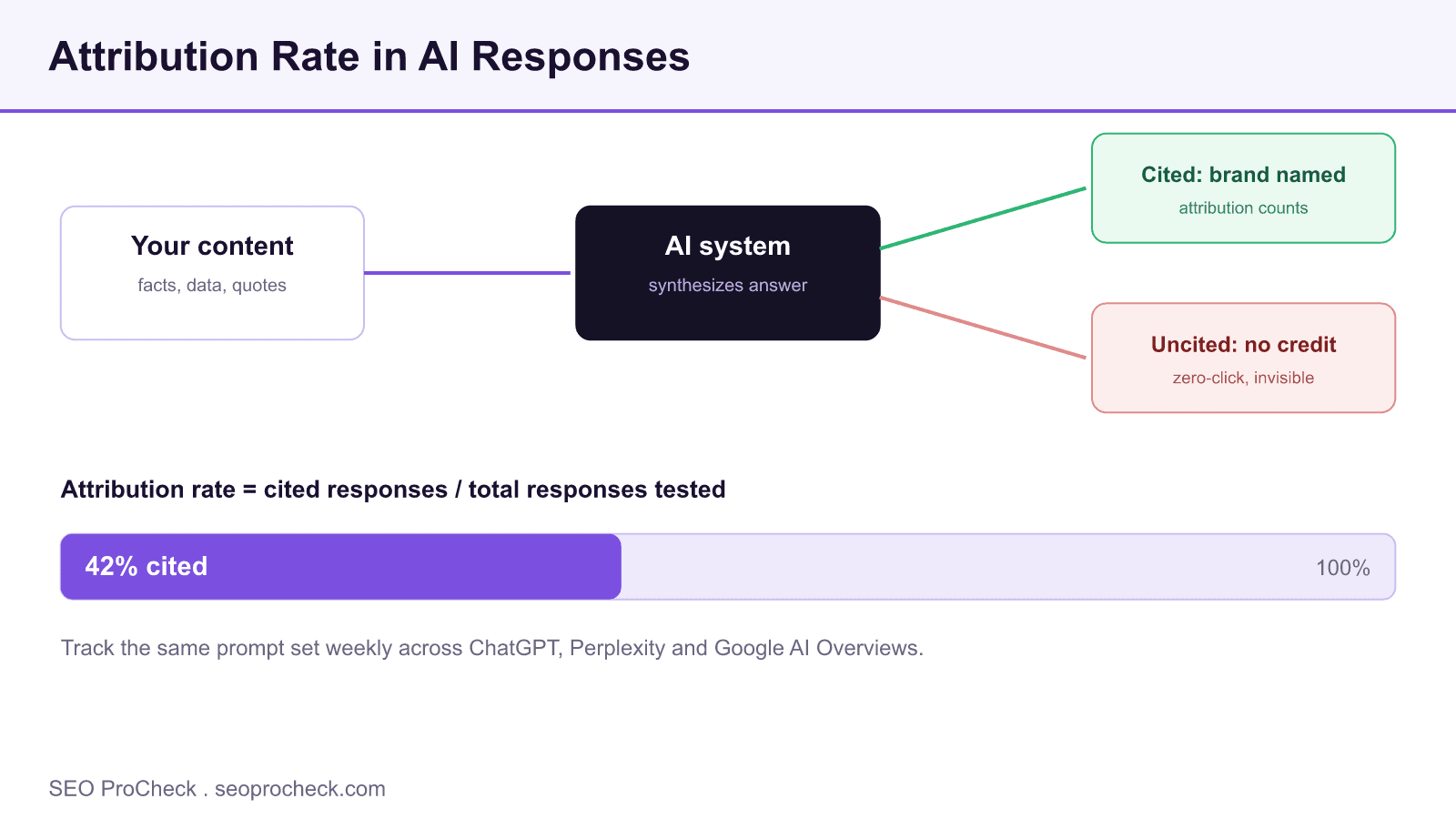
Attribution rate in AI responses is the share of AI answers that actually name or credit your brand when they use your information. It is the generative-search equivalent of a citation rate, and it matters because an uncredited answer gives you zero visibility even when your content did the work.
- Element code CO-007: brand not being attributed in AI-generated answers.
- Measure it as cited responses divided by total responses tested across a fixed prompt set.
- Distinctive data, clear branding and recognized authors raise the odds of a credit.
- Track it weekly across ChatGPT, Perplexity and Google AI Overviews, because each attributes differently.
Quick Reference
Element Code: CO-007
Issue: Brand not being attributed in AI-generated responses
Impact: Missing credit and awareness from AI citations
Fix: Improve brand signals and content authority for attribution
Detection: AI response monitoring
What Is This Issue?
Attribution rate measures how often your brand is credited when AI systems use your content.
Why This Matters for Your Website
Attribution provides brand visibility even in zero-click scenarios.
How to Fix This Issue
- Strong branding: Clear brand identity
- Unique insights: Distinctive information
- Author authority: Known experts
Tools for Detection
- AI monitoring: Track attribution rates
AI Search and GEO Considerations
Attribution is the new citation metric for GEO.
TL;DR (The Simple Version)
Track whether AI systems credit your brand when using your content. Improve attribution with stronger branding and unique insights.
What attribution rate actually measures
When an AI system answers a question using facts you published, one of two things happens: it names you (a citation, a linked source, a brand mention) or it does not. Attribution rate is simply how often the first case occurs. Formally: cited responses divided by total responses tested for a fixed set of prompts. It is the generative-search cousin of an AI citation rate, and it is the metric that tells you whether your work is building brand equity or quietly feeding an answer with no credit attached.
This sits inside the broader discipline of generative engine optimization. Classic SEO asks whether you rank; attribution asks whether, when the machine speaks your facts out loud, your name comes with them.
Why an uncited answer still costs you
In a zero-click world, a user may get the full answer without ever visiting your site. If your brand is named, you still gain awareness, trust and the occasional follow-up click. If it is not, you get nothing measurable while your competitor, who did get named, compounds recognition. Over thousands of answers, attribution rate becomes a real share-of-voice number for the AI layer of search.
How to measure it without guessing
You cannot improve what you do not sample. Build a fixed prompt set that mirrors how real users ask about your space, then run it on a schedule.
- Write 20 to 50 representative prompts. Mix informational ("how does X work"), commercial ("best tool for Y") and brand-adjacent queries.
- Run them across engines. ChatGPT, Perplexity and Google AI Overviews each select and credit sources differently, so test all three.
- Record the outcome per prompt. Cited by name, cited with a link, or absent. Keep the raw answers so you can see why.
- Compute the rate. Cited divided by total, per engine and overall. Repeat weekly so you have a trend, not a snapshot.
| Signal | Why it lifts attribution | Practical move |
|---|---|---|
| Distinctive data | Unique numbers and findings are quotable and hard to source elsewhere | Publish original research, benchmarks or first-hand results |
| Clear brand identity | A named, consistent brand is easier for a model to attribute | Consistent name, logo and boilerplate across the web |
| Named authors | Recognized experts give the model a person to credit | Bylines with real bios and credentials, linked to profiles |
| Entity presence | Being a known entity ties facts back to you | Strengthen your knowledge graph footprint and sameAs links |
What actually moves the number
Attribution favors sources that are distinctive and hard to replace. If your page repeats what a hundred others say, a model has no reason to credit you specifically. If you publish the original benchmark, the specific number, or the named methodology, you become the natural thing to cite. Author authority and a strong entity footprint reinforce this: a model that recognizes the person or brand behind a claim is likelier to name them. This is a content problem as much as a technical one; explore the wider set of content signals on our content GEO checks hub.
Common mistakes
- Treating one screenshot as data. A single ChatGPT answer proves nothing; attribution varies run to run. Sample repeatedly.
- Only checking Google. Perplexity and ChatGPT have their own selection logic and often cite different sources.
- Chasing citations for commodity facts. Aim to be cited on the claims where you are genuinely the best source.
- Ignoring crawlability. If an engine cannot fetch or render your page, it cannot cite you no matter how good the content is.
FAQ
What is a good attribution rate?
There is no universal benchmark yet, because it depends on your niche, competitors and the prompts you test. The useful figure is your own trend line: measure a fixed prompt set weekly and work to raise your share of cited answers relative to your baseline and your competitors.
How is attribution rate different from AI citation?
They are closely related. An AI citation is a single instance of being credited; attribution rate is the aggregate, the percentage of answers across a prompt set where you are credited. One is an event, the other is the metric built from many events.
Can I force an AI system to cite me?
No. You cannot compel attribution, but you can make it far more likely by being the distinctive, crawlable, clearly branded source for a claim. Original data and recognized authorship do most of the heavy lifting.
Which tools track attribution rate?
A growing set of GEO monitoring tools sample AI answers across engines and report mention and citation frequency. You can also build a lightweight version yourself with a fixed prompt list and a spreadsheet, which is often enough to see the trend.
Does schema markup improve attribution?
Indirectly. Schema helps machines parse who you are and what a page is about, which supports entity recognition and disambiguation. It is not a switch that guarantees a citation, but it removes ambiguity that can otherwise cost you the credit.
Why did my attribution drop after being steady?
Model updates, a competitor publishing fresher or more distinctive data, or a crawlability regression can all move it. This is exactly why you track it continuously rather than measuring once; a drop is a prompt to investigate, not a verdict.
Take this with you
The assistant links open with a question about this page already written. Nothing is sent until you press enter.
Claude Vincent is a technical SEO consultant focused on crawlability, rendering, and AI-search visibility. He writes the field guides and case studies at SEO ProCheck, with a bias toward the durable, unglamorous work that decides whether search engines and AI answer engines can actually read and cite a site.
About SEO ProCheck
Technical SEO consulting and GEO strategy with 20 years of enterprise experience. Case studies, resources, and tools for search and AI visibility.
Work With Me
Technical SEO audits, GEO strategy, site migrations, and international SEO. Hourly consulting for teams who need hands-on support, not just reports.
Subscribe to our newsletter!








Recent Posts
- Most Top Sites Never Say Who They Are in Structured Data October 14, 2026
- Homepage Titles Are Mostly Too Short, Not Too Long October 8, 2026
- Who Actually Serves an llms.txt? 184 Top Sites Measured September 29, 2026