

AI Summary
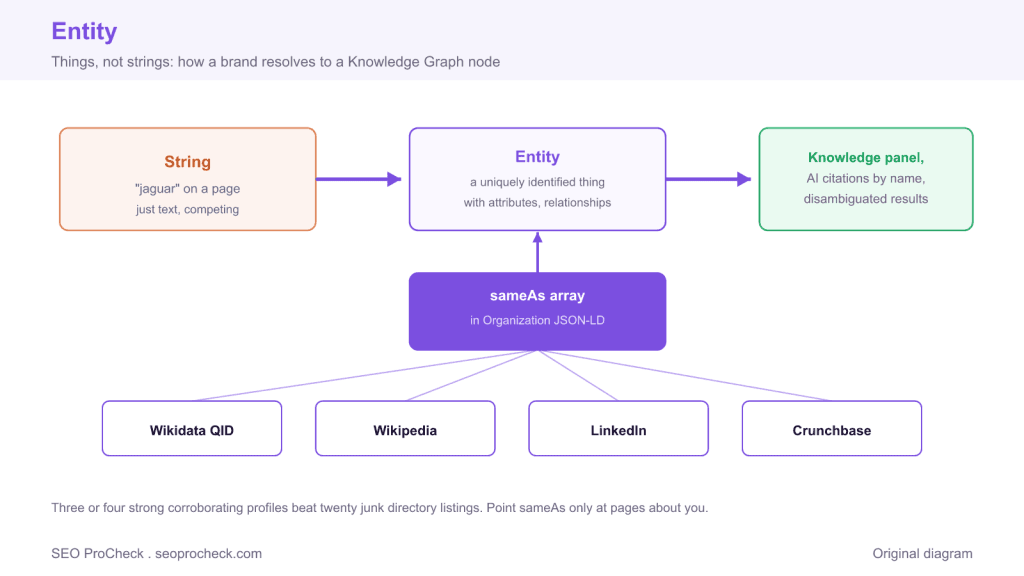
An entity is any thing Google can identify uniquely, such as a person, company, product, or place, separate from the words used to name it. Resolving your brand to an entity in the Knowledge Graph is what earns a knowledge panel and gets you cited by name in AI answers instead of losing the query to a competitor.
- The cheapest lever is a sameAs array in your Organization schema pointed at Wikidata, Wikipedia, LinkedIn, and Crunchbase.
- Three or four strong corroborating profiles beat twenty junk directory listings.
- Give the entity one home URL and a stable @id that every template references.
- Keep your canonical name identical across your site, Google Business Profile, and social handles.
What an entity is
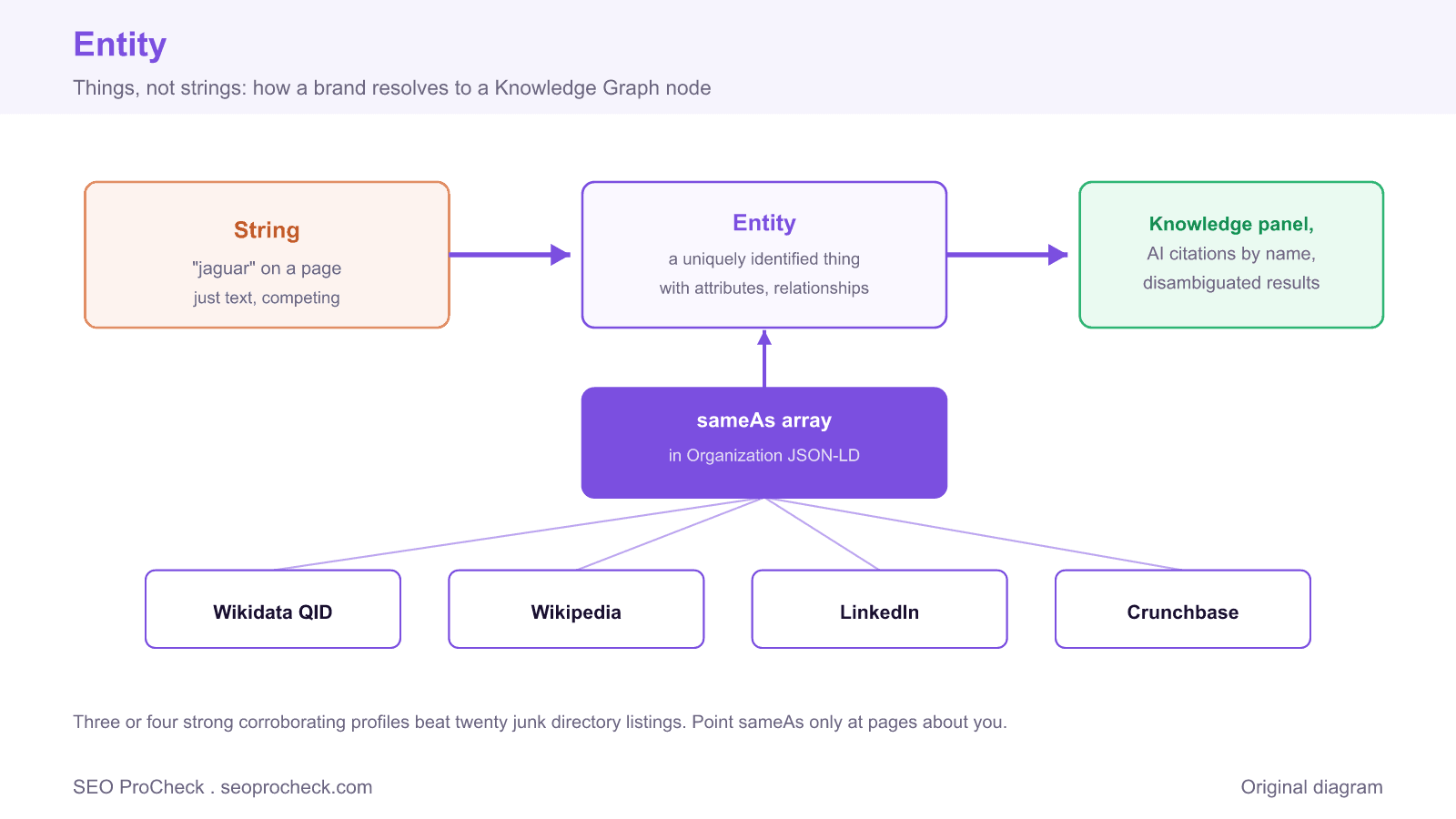
An entity is any thing Google can identify uniquely, a person, company, product, place, or concept, separate from the words people use to name it. If Google can resolve your brand to an entity in its Knowledge Graph, you get treated as a known thing with attributes and relationships; if it can't, you're just a string that happens to appear on some pages, competing against every other use of that string.
That distinction has real money attached. Entity resolution is what decides whether your brand gets a knowledge panel, whether AI Overviews and chatbots cite you by name or paraphrase a competitor, and whether "jaguar" queries send people to the cat, the car, or you. Google framed this shift itself back in 2012 with the Knowledge Graph launch: "things, not strings."
A concrete example: sameAs disambiguation
The cheapest way to tell machines exactly which thing you are is the sameAs property in your Organization or Person schema, pointed at authoritative identity databases. Here's the pattern, using Google's own Wikidata entry (Q95) as the target:
{
  "@context": "https://schema.org",
  "@type": "Organization",
  "name": "Google",
  "url": "https://www.google.com/",
  "sameAs": [
    "https://www.wikidata.org/wiki/Q95",
    "https://en.wikipedia.org/wiki/Google"
  ]
}
Swap in your own brand and your own Wikidata/Wikipedia/LinkedIn/Crunchbase URLs. Each sameAs value is a vote saying "the thing on this domain is the same thing described over there." Three or four strong corroborating profiles beat twenty junk directory listings. The full implementation pattern, connecting your Organization, WebSite, and Person nodes into one linked object, is covered in our guide to @graph and JSON-LD nesting.
Entity signals and where to encode them
| Signal | What it tells machines | Where to encode it |
|---|---|---|
| Canonical name | The one string that names you | name in Organization schema, site title, Google Business Profile, social handles, identical everywhere |
| Identity corroboration | "This site = that database record" | sameAs array in JSON-LD → Wikidata, Wikipedia, LinkedIn, Crunchbase |
| Formal identifiers | Machine-grade uniqueness | Wikidata QID; identifier property for DUNS, LEI, ISNI where you have them |
| Self-description | What kind of thing you are | description in schema, About page first paragraph, Wikidata item description |
| Relationships | How you connect to other entities | founder, parentOrganization, memberOf, brand properties in the same @graph |
| Topical association | What subjects you're an authority on | about and mentions on articles; internal links from topic content to the About page |
Give the entity a home URL
Machines resolve entities to URLs, so designate one page, usually your About page, as the canonical "entity home." Give your Organization node a stable @id (e.g. https://example.com/#organization), declare the full node once on the entity home, and reference that same @id from the publisher and author fields on every other template. Then aim your external corroboration at it: Wikidata's "official website" statement, your LinkedIn website field, press-kit bios. One page accumulating all identity evidence beats the same signals scattered across a homepage, a contact page, and three landing pages that each tell half the story.
How to check your entity status
- Query the Knowledge Graph Search API for your brand:
curl "https://kgsearch.googleapis.com/v1/entities:search?query=YOUR+BRAND&key=API_KEY&limit=3"(free key from Google Cloud Console). A result with your name, akg:/g/orkg:/m/id, and a healthyresultScoremeans you exist as an entity. - Search your exact brand name in an incognito window. Panel on the right? Google has resolved you. Ten blue links and a "did you mean" instead? You haven't crossed the threshold yet.
- Paste your homepage into Schema.org's validator (validator.schema.org) and confirm the
sameAsURLs parse inside your Organization node, not orphaned in a separate block. - Open each
sameAsURL by hand. Dead LinkedIn pages and abandoned Twitter handles corroborate nothing. - Check whether a Wikidata item for you already exists (search at wikidata.org). If one exists with wrong facts, fix it there first, Google inherits those errors.
Common mistakes
- Inconsistent naming. "Acme Inc.", "Acme Software", and "AcmeSoft" across your site, GBP, and socials reads as three weak candidate entities instead of one strong one. Pick one canonical form and enforce it.
- sameAs pointing at search results or category pages. The property means identity, not relevance. Link only pages that are literally about you.
- Creating a Wikidata item stuffed with promo language. It'll get flagged or deleted, and you lose the reference Google trusts most. Neutral facts with citations only.
- Schema on the homepage only. Reference the same Organization
@idfrom every template so each page reinforces the entity rather than starting from scratch. - Treating entity work as one-and-done. Rebrands, acquisitions, and new executives all change the graph. Re-run the KG API check quarterly.
FAQ
Is an entity the same thing as a keyword?
No. A keyword is a string people type; an entity is the thing the string refers to. "Apple" is one keyword but at least two major entities. Google's systems map queries to entities before ranking anything.
Do I need a Wikipedia page to be an entity?
No. Wikipedia helps enormously, but plenty of entities in Google's graph come from Wikidata, structured data, Google Business Profile, and licensed databases. A well-referenced Wikidata item plus consistent schema is an achievable path for most businesses; a Wikipedia article is not.
How long does it take for entity signals to register?
Schema changes get re-read within days of a recrawl, but graph-level changes, a new panel, corrected attributes, typically lag weeks to months. That's normal; don't churn your markup while waiting.
What's the difference between an entity and a knowledge panel?
The entity is the database record; the knowledge panel is one UI surface that renders it. You can be a recognized entity without a panel, but never the reverse.
How do I check whether Google sees my brand as an entity?
Query the Knowledge Graph Search API for your brand name and look for a result with a kg id and a healthy result score, then search your exact brand in an incognito window and see whether a knowledge panel appears. A panel means Google has resolved you; ten blue links means you have not crossed the threshold yet.
What should the sameAs array point at?
Point each sameAs value at a page that is literally about your organization, such as your Wikidata item, Wikipedia article, LinkedIn company page, or Crunchbase profile. Avoid search results, category pages, and dead profiles, since the property means identity, not relevance.
For the full playbook, audits, entity homes, corroboration strategy, see our deep dive on entity SEO and the property-level walkthrough of Organization schema and sameAs.
Claude Vincent is a technical SEO consultant focused on crawlability, rendering, and AI-search visibility. He writes the field guides and case studies at SEO ProCheck, with a bias toward the durable, unglamorous work that decides whether search engines and AI answer engines can actually read and cite a site.
About SEO ProCheck
Technical SEO consulting and GEO strategy with 20 years of enterprise experience. Case studies, resources, and tools for search and AI visibility.
Work With Me
Technical SEO audits, GEO strategy, site migrations, and international SEO. Hourly consulting for teams who need hands-on support, not just reports.
Subscribe to our newsletter!







Recent Posts
- Can AI Crawlers Actually Read Your Site? I Measured 400 of the Biggest September 5, 2026
- The Pre-Publish Quality Gate for AI-Assisted Content August 6, 2026
- AGENTS.md vs llms.txt vs llms-full.txt: Which Agent File Does What July 18, 2026