

AI Summary
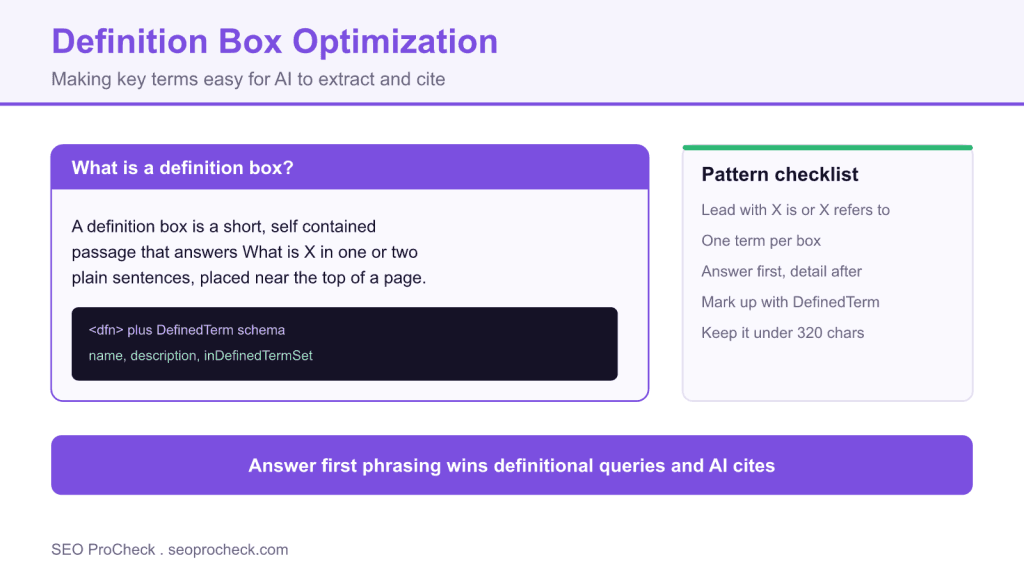
Definition box optimization means writing short, self contained passages that answer What is X in one or two plain sentences, placed where they are easy to find and marked up as defined terms. These passages are among the most extractable and most cited content an AI system can pull from your page.
- Element code CO-012, a content and GEO extractability check.
- Answer first phrasing such as X is or X refers to is the highest value pattern.
- One term per box, placed near the top, with the definition before the detail.
- DefinedTerm schema gives the definition a machine readable label.

Quick Reference
Element Code: CO-012
Issue: Content lacks clear definitions for key terms
Impact: Missing definitional search opportunities
Fix: Add clear, structured definitions for key concepts
Detection: Content audit
What Is This Issue?
Clear definitions are highly extractable for AI and search features.
Why This Matters for Your Website
Definitional content is prime for AI citation. Clear definitions are easily extracted.
How to Fix This Issue
- Define terms: Clear, concise definitions
- Use format: "X is..." or "X refers to..."
- Mark up: DefinedTerm schema
Tools for Detection
- Content audit: Check definition coverage
AI Search and GEO Considerations
Definitions are highly extractable and citable.
TL;DR (The Simple Version)
Add clear definitions for key terms using formats like "X is..." that AI can easily extract.
Why definitions are prime citation material
Definitional queries are extremely common, and the answer to them is short, factual, and easy to verify. That combination makes a well written definition one of the most quotable things on your site. When a model needs to explain a term inside a longer answer, it reaches for a clean, self contained sentence that stands on its own, which is exactly what a definition box provides.
The answer first pattern
The pattern that works is to lead with the term and a plain statement of what it is, then add detail after. Compare two openings for the same term. A weak version buries the definition: "There are many factors to consider before we can understand this concept, which has evolved over time." A strong version leads with it: "A canonical tag is an HTML element that tells search engines which URL is the preferred version of a page." The second sentence can be lifted verbatim into an answer. The first cannot.
Structure and placement
- One term per box. Do not fold three concepts into one paragraph. Each definition should be independently extractable.
- Definition before detail. State what the term is in the first sentence, then expand with why it matters and how it is used.
- Near the top. Place the primary definition high on the page so both readers and extractors reach it quickly.
- Plain language. Avoid circular definitions that use the term to define itself, and keep the core statement under roughly 320 characters.
Marking up defined terms
Wrap the term in a <dfn> element for semantic HTML, and where it fits your content model, add DefinedTerm structured data with name, description, and inDefinedTermSet so the definition has a machine readable label. A glossary page can express its entries as a DefinedTermSet containing many DefinedTerm items. The schema does not replace clear writing, it reinforces a definition that is already clean.
What changed since: AI answer engines lean heavily on definitional content because it is short and low risk to quote. A page that owns the clean definition of a term is now frequently the cited source when that term appears in a generated answer, which makes the answer first pattern more valuable than it was in classic search.
Reference table
| Pattern | Example phrasing | When to use it |
|---|---|---|
| Direct is | A sitemap is a file that lists a site's URLs | Concrete objects and features |
| Refers to | Crawl budget refers to how many pages a bot fetches | Abstract concepts and processes |
| Category plus trait | Hreflang is an attribute that signals page language | Terms best defined by their class |
| Short expansion | A 301 is a permanent redirect that passes ranking signals | When one detail aids understanding |
Frequently Asked Questions
What is a definition box?
A definition box is a short, self contained passage that answers What is X in one or two plain sentences, placed near the top of a page. It is written so an AI system or search feature can extract it without needing surrounding context.
How should I phrase a definition for AI extraction?
Lead with the term and a direct statement, using patterns like X is or X refers to, then add detail afterward. The first sentence should make complete sense on its own so it can be quoted verbatim.
What is DefinedTerm schema?
DefinedTerm is a schema.org type that labels a defined term with a name, description, and the set it belongs to. A glossary can use a DefinedTermSet containing many DefinedTerm entries, giving each definition a machine readable identity.
How long should a definition be?
Keep the core statement to one or two sentences, roughly under 320 characters, then expand with detail in following sentences. Short enough to quote cleanly, long enough to be accurate and unambiguous.
Should I define more than one term per box?
No. Use one term per box so each definition is independently extractable. Folding several concepts into a single paragraph makes it harder for a model to lift a clean answer for any one of them.
Do definitions help with featured snippets too?
Yes. The same answer first, self contained phrasing that AI systems extract also wins classic featured snippets and people also ask boxes, so a good definition earns visibility across both traditional and AI search.
Related SEO ProCheck checks
Claude Vincent is a technical SEO consultant focused on crawlability, rendering, and AI-search visibility. He writes the field guides and case studies at SEO ProCheck, with a bias toward the durable, unglamorous work that decides whether search engines and AI answer engines can actually read and cite a site.
About SEO ProCheck
Technical SEO consulting and GEO strategy with 20 years of enterprise experience. Case studies, resources, and tools for search and AI visibility.
Work With Me
Technical SEO audits, GEO strategy, site migrations, and international SEO. Hourly consulting for teams who need hands-on support, not just reports.
Subscribe to our newsletter!







Recent Posts
- Can AI Crawlers Actually Read Your Site? I Measured 400 of the Biggest September 5, 2026
- The Pre-Publish Quality Gate for AI-Assisted Content August 6, 2026
- AGENTS.md vs llms.txt vs llms-full.txt: Which Agent File Does What July 18, 2026