


AI Summary
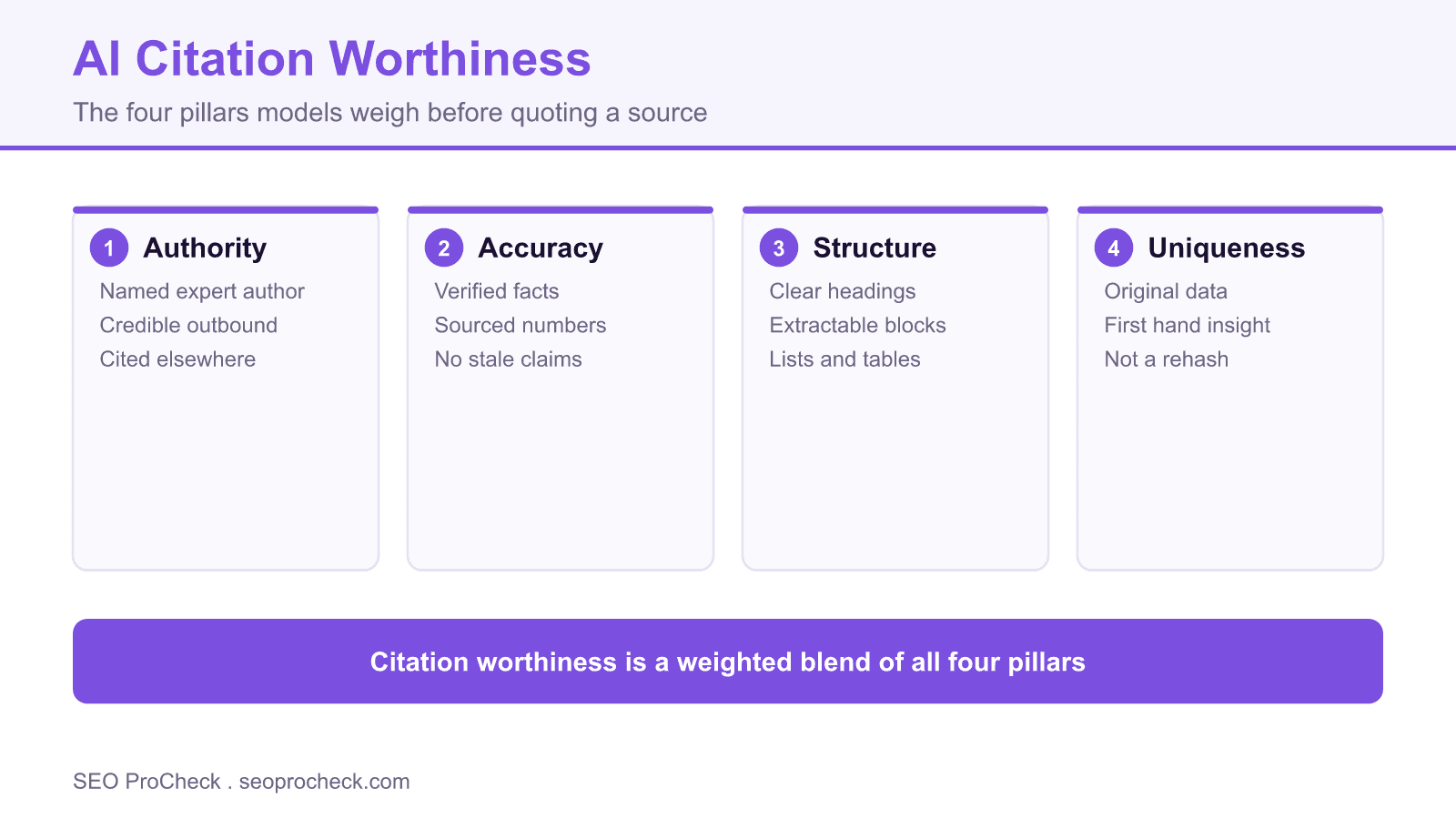
AI citation worthiness is a composite estimate of how likely a page is to be quoted or cited inside an AI generated answer. It blends four pillars, authority, accuracy, structure, and uniqueness, and you raise the score by strengthening the weakest pillar rather than chasing one signal.
- Element code CO-015, the composite metric at the center of generative engine optimization.
- Four pillars feed the score: authority, accuracy, structure, and uniqueness.
- Retrieval systems must first find your page, then judge it worth quoting, so both matter.
- Original data and first hand insight are the hardest pillars for competitors to copy.
Quick Reference
Element Code: CO-015
Issue: Content does not meet AI citation quality thresholds
Impact: Not selected for AI citations
Fix: Improve content quality factors that influence AI citation
Detection: Quality analysis
What Is This Issue?
Citation worthiness combines authority, accuracy, structure, and uniqueness.
Why This Matters for Your Website
Being cited in AI responses is the goal of GEO.
How to Fix This Issue
- Authority: Expert authors, credible sources
- Accuracy: Verified facts
- Structure: Well-organized
- Uniqueness: Original insights
Tools for Detection
- Quality scoring: Assess citation factors
AI Search and GEO Considerations
This is the composite GEO metric. Optimizing citation worthiness is the core objective.
TL;DR (The Simple Version)
Improve authority, accuracy, structure, and uniqueness to increase AI citation likelihood.
Why citation worthiness is a composite, not a single tactic
Being cited in an AI answer is a two step problem. First a retrieval layer has to surface your page as a candidate. Then a generation step decides whether the page is worth quoting over the other candidates. A page can win retrieval and still lose the citation because its claims are unverifiable or its structure is hard to extract. That is why citation worthiness is modeled as a blend rather than a single lever.
The four pillars, and how to strengthen each
- Authority: a named author with real credentials, credible outbound sourcing, and evidence the page or its author is referenced elsewhere. Add a proper author box and link claims to primary sources.
- Accuracy: facts that are verified and dated, numbers that carry a source, and no stale claims. Inaccurate pages are quietly filtered out even when they rank.
- Structure: clear headings phrased as the questions users ask, extractable blocks, and lists or tables. This is the pillar most sites can improve fastest.
- Uniqueness: original data, first hand experience, or a synthesis that does not exist elsewhere. A page that only restates the consensus gives a model no reason to cite it specifically.
Diagnosing which pillar is holding you back
Score each pillar honestly on a simple scale before you touch the page. Most underperforming pages are not weak everywhere, they are strong on three pillars and failing one. A well researched, well written page with no author attribution is failing on authority. A page packed with expert insight buried in long paragraphs is failing on structure. Fixing the single weakest pillar usually moves citation outcomes more than polishing a pillar that is already strong.
How to test it
Query the AI systems you care about, ChatGPT, Perplexity, Google AI Overviews, and Gemini, with the questions your page answers. Note which sources they cite and what those sources do that yours does not. This is slow but it is the only ground truth for whether your changes are working, because there is no public citation worthiness number to read off a dashboard.
What changed since: as AI answer surfaces have matured, uniqueness and verifiable accuracy have pulled ahead of raw keyword optimization. Pages that contribute a genuinely new fact, dataset, or experience are cited far more reliably than pages that summarize what everyone already published.
Reference table
| Pillar | What it measures | Fastest way to strengthen it |
|---|---|---|
| Authority | Author credibility and external references | Add a credentialed author box and cite primary sources |
| Accuracy | Verified, current, sourced claims | Date facts and attach a source to every number |
| Structure | Extractability of the page | Use question headings, short answer blocks, and tables |
| Uniqueness | Original value not found elsewhere | Add first hand data, tests, or lived experience |
Frequently Asked Questions
What is an AI citation worthiness score?
It is a composite estimate of how likely a page is to be quoted inside an AI generated answer. It combines authority, accuracy, structure, and uniqueness into one judgment rather than depending on a single ranking factor.
How is citation worthiness different from ranking?
Ranking decides whether your page appears in a list of results. Citation worthiness decides whether an AI system quotes your page inside its answer. A page can rank well yet never be cited if its claims are unverifiable or its structure is hard to extract.
Which pillar should I improve first?
Improve your weakest pillar. Score authority, accuracy, structure, and uniqueness honestly, then fix the one that is failing. Most pages are strong on three pillars and lose citations because of one gap, often missing author attribution or buried structure.
How do I know if a page is being cited by AI?
Ask the AI systems you care about the questions your page answers, then note which sources they cite. Comparing your page against the sources that do get cited is the most reliable feedback, since there is no public citation score to read from a tool.
Does original data really matter for AI citations?
Yes. Original data, first hand testing, and lived experience are the hardest signals for competitors to copy and the clearest reason for a model to cite you specifically. Pages that only restate the consensus give models no reason to prefer them.
Can strong writing alone earn AI citations?
Rarely on its own. Clear writing helps structure and readability, but without credible authorship, verifiable accuracy, and something unique to say, a well written page still competes with many equally polished ones. All four pillars work together.
Related SEO ProCheck checks
- Content Freshness Score
- AI Answer Snippet Optimization
- Topical Authority Mapping for AI
- All content and GEO checks
Take this with you
The assistant links open with a question about this page already written. Nothing is sent until you press enter.
Claude Vincent is a technical SEO consultant focused on crawlability, rendering, and AI-search visibility. He writes the field guides and case studies at SEO ProCheck, with a bias toward the durable, unglamorous work that decides whether search engines and AI answer engines can actually read and cite a site.
About SEO ProCheck
Technical SEO consulting and GEO strategy with 20 years of enterprise experience. Case studies, resources, and tools for search and AI visibility.
Work With Me
Technical SEO audits, GEO strategy, site migrations, and international SEO. Hourly consulting for teams who need hands-on support, not just reports.
Subscribe to our newsletter!








Recent Posts
- Most Top Sites Never Say Who They Are in Structured Data October 14, 2026
- Homepage Titles Are Mostly Too Short, Not Too Long October 8, 2026
- Who Actually Serves an llms.txt? 184 Top Sites Measured September 29, 2026