

AI Summary
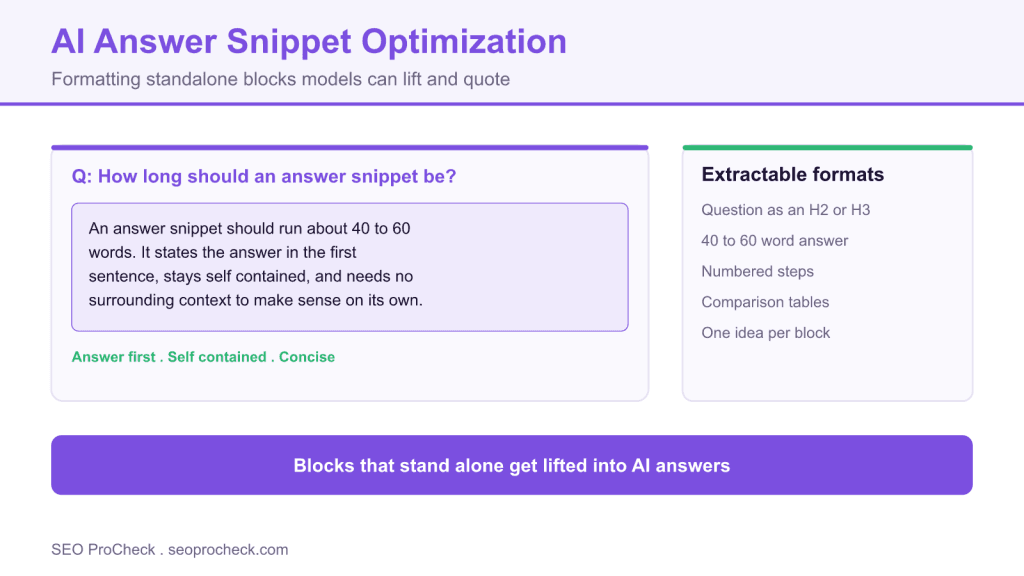
AI answer snippet optimization is the practice of formatting short, self contained blocks that an AI system can lift directly into its response. The core recipe is a question style heading, a direct answer in the first sentence, and a block of roughly 40 to 60 words that makes sense with no surrounding context.
- Element code CO-011, a content and GEO extractability check.
- Target answer blocks of about 40 to 60 words that state the answer first.
- Each block should be self contained and readable out of context.
- Question headings, numbered steps, and tables are the formats models lift most.
Quick Reference
Element Code: CO-011
Issue: Content not formatted for AI snippet extraction
Impact: Less likely to be quoted in AI responses
Fix: Format content with clear, extractable answer snippets
Detection: AI response analysis
What Is This Issue?
AI systems extract snippets to include in responses. Clear, standalone snippets are more likely quoted.
Why This Matters for Your Website
Being quoted in AI responses is high-value visibility.
How to Fix This Issue
- Direct statements: Clear, quotable facts
- Self-contained: Snippets make sense alone
- Concise: 40-60 word blocks
Tools for Detection
- Snippet testing: Test extractability
AI Search and GEO Considerations
Optimizing for snippet extraction is core GEO.
TL;DR (The Simple Version)
Format content with clear, self-contained answer snippets that AI can easily extract and quote.
What extraction actually looks for
AI systems assemble answers by pulling passages from sources and stitching them together. The passages that get pulled are the ones that read as complete thoughts on their own. If your best sentence depends on the paragraph before it to make sense, it will not survive extraction. So the whole discipline is writing blocks that stand alone.
The snippet recipe
- Lead with the answer. The first sentence should answer the question directly, before any setup or background.
- Keep it self contained. The block should make sense if it were the only thing a reader saw, with no unresolved "this" or "as mentioned above".
- Hold it to roughly 40 to 60 words. Long enough to be complete, short enough to quote cleanly. Break longer explanations into multiple standalone blocks.
- Head it with the question. Use an H2 or H3 phrased the way users actually ask, so the block is clearly matched to an intent.
Formats that extract well
Prose is not the only extractable form. Numbered steps are pulled almost verbatim for how to questions. Comparison tables are lifted for versus and difference queries. Short bulleted lists work for enumerations. The common thread is that each unit, a step, a row, a bullet, carries one idea and can be understood on its own. Walls of undifferentiated text are the hardest thing for a model to extract cleanly.
Testing extractability
The fastest test is to copy a single block out of your page, paste it somewhere with no context, and read it cold. If it fully answers the question by itself, it is extractable. If you find yourself needing the previous paragraph to explain it, rewrite it. Then query the AI systems you care about with the target question and see whether your phrasing shows up in the answer.
What changed since: classic SEO optimized whole pages for a keyword. Answer engines optimize at the passage level, so the unit of work has shrunk from the page to the individual block. A page can rank while none of its passages are quotable, which is why block level self containment is now its own discipline.
Reference table
| Format | Ideal length | Best for |
|---|---|---|
| Answer paragraph | 40 to 60 words | What is and why questions |
| Numbered steps | One clause per step | How to and process questions |
| Comparison table | 3 to 6 rows | Versus and difference queries |
| Short bullet list | 3 to 6 items | Enumerations and checklists |
Frequently Asked Questions
What is AI answer snippet optimization?
It is formatting short, self contained blocks that an AI system can lift directly into its response. The recipe is a question style heading, a direct answer in the first sentence, and a block of about 40 to 60 words that reads well out of context.
How long should an answer snippet be?
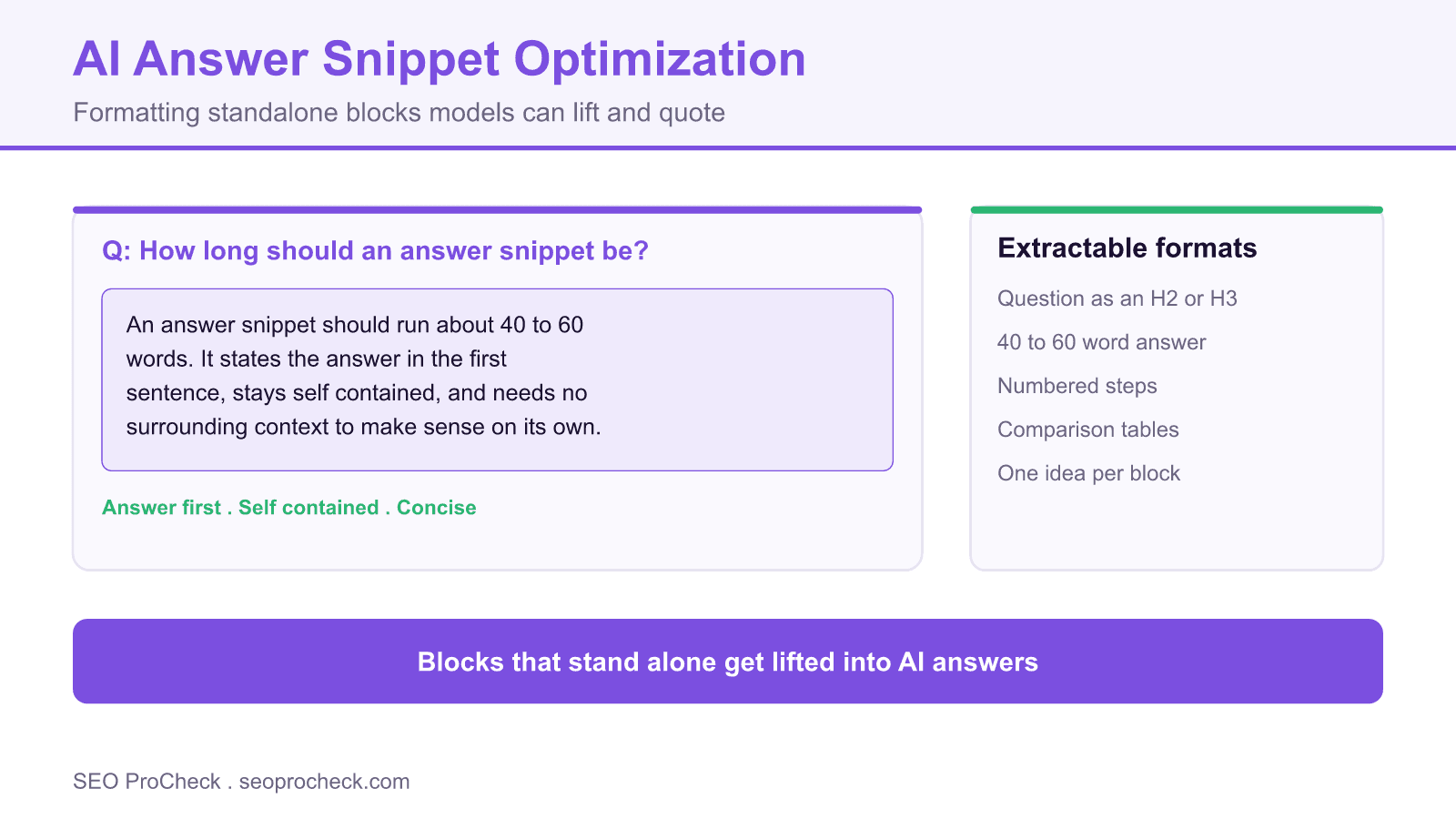
Aim for roughly 40 to 60 words. That is long enough to answer completely and short enough to quote cleanly. Break longer explanations into several standalone blocks rather than one long passage.
What does self contained mean for a snippet?
It means the block makes full sense on its own, with no unresolved references like this or as mentioned above. If a reader saw only that block, it would still answer the question without needing the surrounding text.
Which content formats do AI systems extract most?
Question headings followed by a direct answer, numbered steps for how to queries, comparison tables for versus queries, and short bulleted lists for enumerations. Each unit should carry one idea and stand on its own.
How do I test whether my content is extractable?
Copy one block out of the page, read it with no context, and check whether it fully answers the question alone. If it needs the previous paragraph to make sense, rewrite it. Then query AI systems with the target question to see if your phrasing appears.
Is snippet optimization different from ranking a page?
Yes. Ranking works at the page level, while answer engines extract at the passage level. A page can rank without any of its passages being quotable, so making individual blocks self contained is a separate and increasingly important task.
Related SEO ProCheck checks
- Definition Box Optimization
- AI Citation Worthiness Score
- Content Freshness Score
- All content and GEO checks
Take this with you
The assistant links open with a question about this page already written. Nothing is sent until you press enter.
Claude Vincent is a technical SEO consultant focused on crawlability, rendering, and AI-search visibility. He writes the field guides and case studies at SEO ProCheck, with a bias toward the durable, unglamorous work that decides whether search engines and AI answer engines can actually read and cite a site.
About SEO ProCheck
Technical SEO consulting and GEO strategy with 20 years of enterprise experience. Case studies, resources, and tools for search and AI visibility.
Work With Me
Technical SEO audits, GEO strategy, site migrations, and international SEO. Hourly consulting for teams who need hands-on support, not just reports.
Subscribe to our newsletter!








Recent Posts
- Most Top Sites Never Say Who They Are in Structured Data October 14, 2026
- Homepage Titles Are Mostly Too Short, Not Too Long October 8, 2026
- Who Actually Serves an llms.txt? 184 Top Sites Measured September 29, 2026