

AI Summary
Expert attribution rate measures the share of your content that carries a clear, credentialed, named author rather than a generic admin byline or no author at all. It matters because named expertise is a core E-E-A-T signal that Google and AI answer engines use to judge whether content is trustworthy.
- Attribute substantive pages to a named human author, never to admin or a brand only byline.
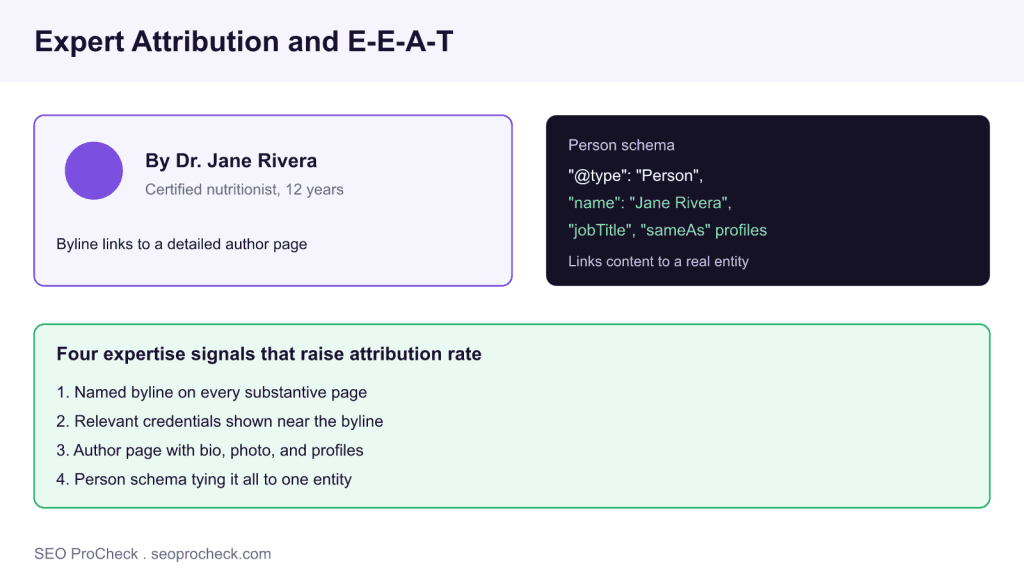
- Show relevant credentials near the byline and link to a detailed author page with a bio and photo.
- Add Person schema with jobTitle and sameAs profiles so the author resolves to a real entity.
- Element code CO-013: a content GEO check that flags content lacking expert author attribution.
What expert attribution rate means
Expert attribution rate is the proportion of your substantive content that is credited to a clearly identified, credentialed human author. A site where most articles carry a named expert byline, a visible credential, and a linked bio page has a high attribution rate. A site where articles are published under a generic admin account, a brand name, or no author at all has a low one. Within the SEO ProCheck framework this is check CO-013 in the content GEO group, which flags content that lacks expert author attribution and therefore misses a key expertise signal.
Why attribution matters for your website
Google evaluates content through E-E-A-T: Experience, Expertise, Authoritativeness, and Trustworthiness. These are not direct ranking inputs, but they describe what the ranking systems are built to reward, and they are central to the Quality Rater guidelines, especially for Your Money or Your Life topics such as health, finance, and safety. Author attribution is one of the most tangible expertise signals a site can control. A named expert with real credentials tells both human raters and automated systems that a qualified person stands behind the claims.
The AI search layer raises the stakes. When an answer engine decides which sources to trust and cite, provenance matters. Content tied to an identifiable expert with a track record is a safer citation than anonymous text, so clear attribution improves your odds of being referenced in AI Overviews and assistant answers. Anonymous content, by contrast, gives a model no entity to trust.
How to fix low attribution
Four moves raise the attribution rate, and they compound. First, add named bylines: every substantive page should credit a real person, never an admin login or a bare brand name. Second, show credentials: place the relevant qualification near the byline, for example a medical degree on a health article or years of hands on experience on a trade topic, so expertise is visible before the reader scrolls. Third, build author pages: give each author a dedicated page with a detailed bio, a photo, areas of expertise, and links to external profiles and published work, then link every byline to it. Fourth, add Person schema: mark up the author with structured data including name, jobTitle, a description, and sameAs links to authoritative profiles, so the author resolves to a single real world entity rather than a floating name.
Match the author to the topic. Attribution only signals expertise when the named person is genuinely qualified for the subject. A finance writer bylined on a medical page adds little. The goal is a credible, verifiable match between the author's demonstrated expertise and the claims on the page.
How to detect the issue
Run an author audit across the site. Sample published URLs and record how many carry a named author versus admin or none, whether credentials appear, whether the byline links to a real author page, and whether Person schema is present and valid. Content management systems often default new posts to a generic account, so the fastest wins are usually bulk reassigning orphaned posts to real authors and enriching thin author pages. Track the rate over time so you can show the share of attributed content climbing.
AI search and GEO considerations
Expert attribution is a durable trust signal for AI systems that weigh source credibility before citing. Reinforce it by keeping author entities consistent across the site, connecting them with sameAs links to established external profiles, and pairing bylines with genuine experience cues such as first hand testing or original data. Consistent, verifiable authorship makes your content a safer and more frequent citation across answer engines.
Attribution maturity levels
| Level | What the byline shows | Expertise signal |
|---|---|---|
| None | No author, or admin account | Absent |
| Basic | Named author, no credentials or page | Weak |
| Good | Named author, credentials, linked bio page | Strong |
| Complete | All of the above plus valid Person schema and sameAs | Strongest, entity linked |
Frequently Asked Questions
What is expert attribution rate?
It is the share of your substantive content credited to a clearly identified, credentialed human author rather than an admin account, a brand name, or no author. A higher rate signals more expertise to search engines and AI systems.
Does author attribution affect rankings?
Not as a direct ranking factor, but it is a core expertise signal within E-E-A-T, which Google's ranking systems are built to reward. It matters most on Your Money or Your Life topics like health and finance.
What is check CO-013?
CO-013 is the SEO ProCheck content GEO check for expert attribution. It flags content that lacks a clear expert author, which means the page is missing an important expertise and trust signal.
How do I add expert attribution correctly?
Give each page a named author, show relevant credentials near the byline, link to a detailed author page with a bio and photo, and add Person schema with jobTitle and sameAs profiles so the author resolves to a real entity.
Does the author need to match the topic?
Yes. Attribution only signals expertise when the named person is genuinely qualified for the subject. A credible, verifiable match between the author's expertise and the page content is what carries weight.
How does attribution help AI search?
Answer engines weigh source credibility before citing. Content tied to an identifiable expert with a track record is a safer citation than anonymous text, so clear attribution improves your chances of being referenced in AI answers.
Related checks
Quick Reference
Element Code: CO-013
Issue: Content lacks expert author attribution
Impact: Missing expertise signals
Fix: Add clear expert author attribution to content
Detection: Author analysis
What Is This Issue?
Expert attribution signals credibility. Content with identified experts is more trustworthy.
Why This Matters for Your Website
E-E-A-T is crucial. Expert attribution is a key expertise signal.
How to Fix This Issue
- Author bylines: Named authors
- Credentials: Relevant expertise
- Author pages: Detailed bios
- Schema: Person schema
Tools for Detection
- Author audit: Check attribution
AI Search and GEO Considerations
Expert attribution is a key trust signal for AI.
TL;DR (The Simple Version)
Add expert author bylines with credentials. Create author pages and use schema markup.
Claude Vincent is a technical SEO consultant focused on crawlability, rendering, and AI-search visibility. He writes the field guides and case studies at SEO ProCheck, with a bias toward the durable, unglamorous work that decides whether search engines and AI answer engines can actually read and cite a site.
About SEO ProCheck
Technical SEO consulting and GEO strategy with 20 years of enterprise experience. Case studies, resources, and tools for search and AI visibility.
Work With Me
Technical SEO audits, GEO strategy, site migrations, and international SEO. Hourly consulting for teams who need hands-on support, not just reports.
Subscribe to our newsletter!





Recent Posts
- Can AI Crawlers Actually Read Your Site? I Measured 400 of the Biggest September 5, 2026
- The Pre-Publish Quality Gate for AI-Assisted Content August 6, 2026
- AGENTS.md vs llms.txt vs llms-full.txt: Which Agent File Does What July 18, 2026