

Algorithm Visibility SERP Feature Optimization
- December 26, 2018
- Technical and GEO, SERP Features

AI Summary
SERP feature optimization means structuring a page so it can be pulled into results beyond the standard links, such as featured snippets, People Also Ask, AI overviews and rich results. The same habits win most of them: a direct answer up top, question style headings, clean lists and tables, and valid schema that matches the visible content.
- Element code TE-004: content not structured for SERP features and rich results.
- Answer the query directly in the first paragraph, in roughly 40 to 55 words.
- Use question headings and add a real FAQ block to target People Also Ask.
- Ship valid FAQ, HowTo or Product schema and confirm it with the Rich Results Test.
Quick Reference
Element Code: TE-004
Issue: Content not optimized for SERP features and rich results
Impact: Missing featured snippets, knowledge panels, and AI overviews
Fix: Structure content for featured snippet and rich result capture
Detection: SERP tracking tools
What Is This Issue?
SERP features like featured snippets and AI overviews require specific content structures. Optimizing for these increases visibility.
Why This Matters for Your Website
SERP features dominate above-fold search results. Capturing them significantly increases visibility.
How to Fix This Issue
- Answer format: Direct answers in first paragraph
- Lists and tables: Structured data formats
- Question headings: Match featured snippet queries
Tools for Detection
- SERP tracking: Monitor feature presence
AI Search and GEO Considerations
Featured snippets and AI overviews share similar optimization approaches.
TL;DR (The Simple Version)
Structure content to capture SERP features by providing direct answers, using lists/tables, and matching question formats.
SERP Feature Targets and How to Win Them
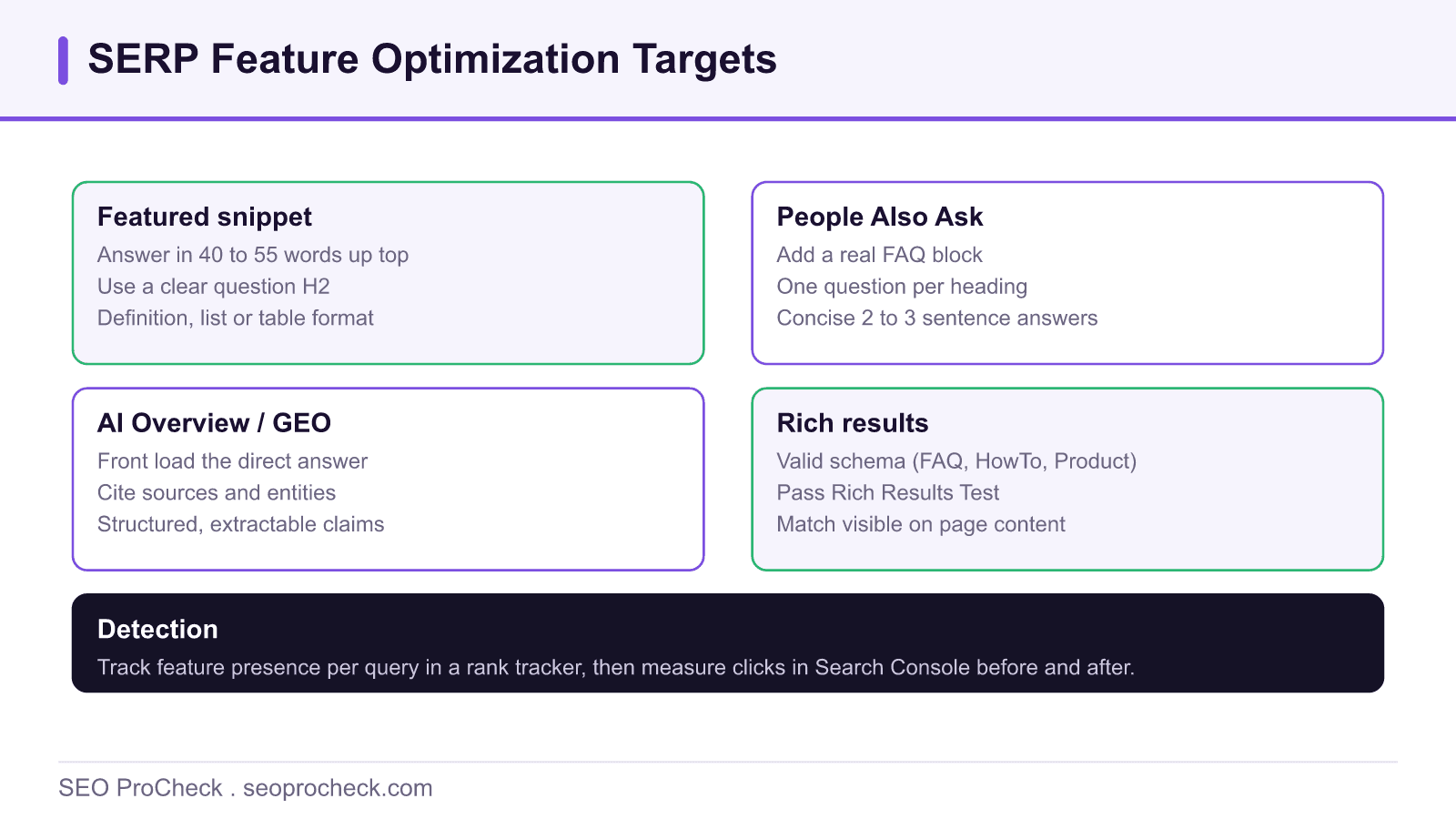
The diagram above breaks the opportunity into four targets, and the table below turns each into a concrete action. The unifying idea is that these features reward pages that make the answer easy to lift: a clear question, a direct response, and a predictable format. Optimizing for one feature usually improves your odds on the others, because a featured snippet, a People Also Ask entry and an AI overview all draw on the same clean, structured answers.
| SERP feature | What triggers it | How to optimize | How to detect |
|---|---|---|---|
| Featured snippet | A concise, direct answer to a clear question | Answer in 40 to 55 words up top, use a question heading, add a definition, list or table | Rank tracker feature flag on the query |
| People Also Ask | Related follow up questions | Add a real FAQ block, one question per heading, concise answers | PAA presence in the SERP for your terms |
| AI overview | Synthesizable, well sourced answers | Front load the answer, cite entities, keep claims structured and extractable | Manual SERP checks and AI visibility tools |
| Rich results | Valid structured data plus matching content | Add FAQ, HowTo or Product schema, pass the Rich Results Test | Search Console enhancement reports |
These same structuring habits carry over into how you organize a whole subject, which is where topic clusters come in, and into how you report the resulting visibility, covered in our notes on enterprise SEO reporting. You can browse related checks in the SEO checks library.
Frequently Asked Questions
What are SERP features?
SERP features are the results Google shows beyond the ten blue links, such as featured snippets, People Also Ask, AI overviews, image packs and rich results. They often sit above the standard listings and take the majority of attention on the page.
How do I win a featured snippet?
Answer the target question directly and concisely near the top of the page, ideally in 40 to 55 words, under a heading that matches how people phrase the query. Definitions, ordered steps and small tables are the formats Google most often lifts.
What is the difference between a featured snippet and an AI overview?
A featured snippet quotes one page's answer with a link, while an AI overview synthesizes several sources into a generated summary. Both reward clear, direct, well structured answers, so optimizing for one tends to help with the other.
How do I optimize for People Also Ask?
Add a genuine FAQ section that uses the real questions people search, with one question per heading and a concise two to three sentence answer beneath each. This matches the format People Also Ask draws from.
Do I need schema to get rich results?
Yes, most rich results require valid structured data such as FAQ, HowTo or Product schema, and the markup must match the content visible on the page. Validate it with the Rich Results Test before relying on it.
How do I track SERP feature performance?
Use a rank tracker that records which features appear for each target query, then measure the change in clicks and impressions in Search Console before and after you optimize. That pairing shows whether capturing a feature actually earned traffic.
Take this with you
The assistant links open with a question about this page already written. Nothing is sent until you press enter.
Claude Vincent is a technical SEO consultant focused on crawlability, rendering, and AI-search visibility. He writes the field guides and case studies at SEO ProCheck, with a bias toward the durable, unglamorous work that decides whether search engines and AI answer engines can actually read and cite a site.
About SEO ProCheck
Technical SEO consulting and GEO strategy with 20 years of enterprise experience. Case studies, resources, and tools for search and AI visibility.
Work With Me
Technical SEO audits, GEO strategy, site migrations, and international SEO. Hourly consulting for teams who need hands-on support, not just reports.
Subscribe to our newsletter!
Recent Posts
- Homepage Titles Are Mostly Too Short, Not Too Long October 8, 2026
- Who Actually Serves an llms.txt? 184 Top Sites Measured September 29, 2026
- Finding a Competitor's Sitemap, and Turning It Into a Change Log September 15, 2026