

AI Summary
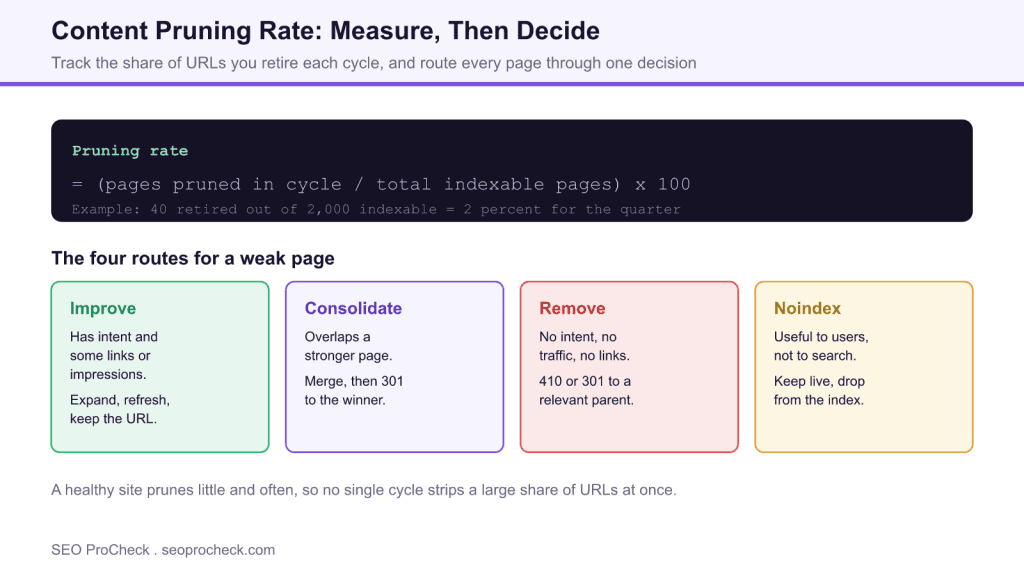
Content pruning rate is the share of indexable URLs you retire each cycle, calculated as pages pruned divided by total indexable pages. Track it to keep pruning steady, and route every weak page to one of four outcomes: improve, consolidate, remove, or noindex.
- Rate = pages pruned / total indexable pages, times 100
- Four routes: improve, consolidate, remove, or noindex
- Prune little and often to avoid a risky mass deletion
- Never prune on a single metric such as traffic alone
Content pruning rate turns a vague instinct, that a site has too much dead weight, into a number you can track. It is the share of your indexable URLs retired in a cycle, and watching it over time tells you whether you are maintaining quality steadily or letting weak pages pile up until a painful purge becomes necessary.
How to calculate it
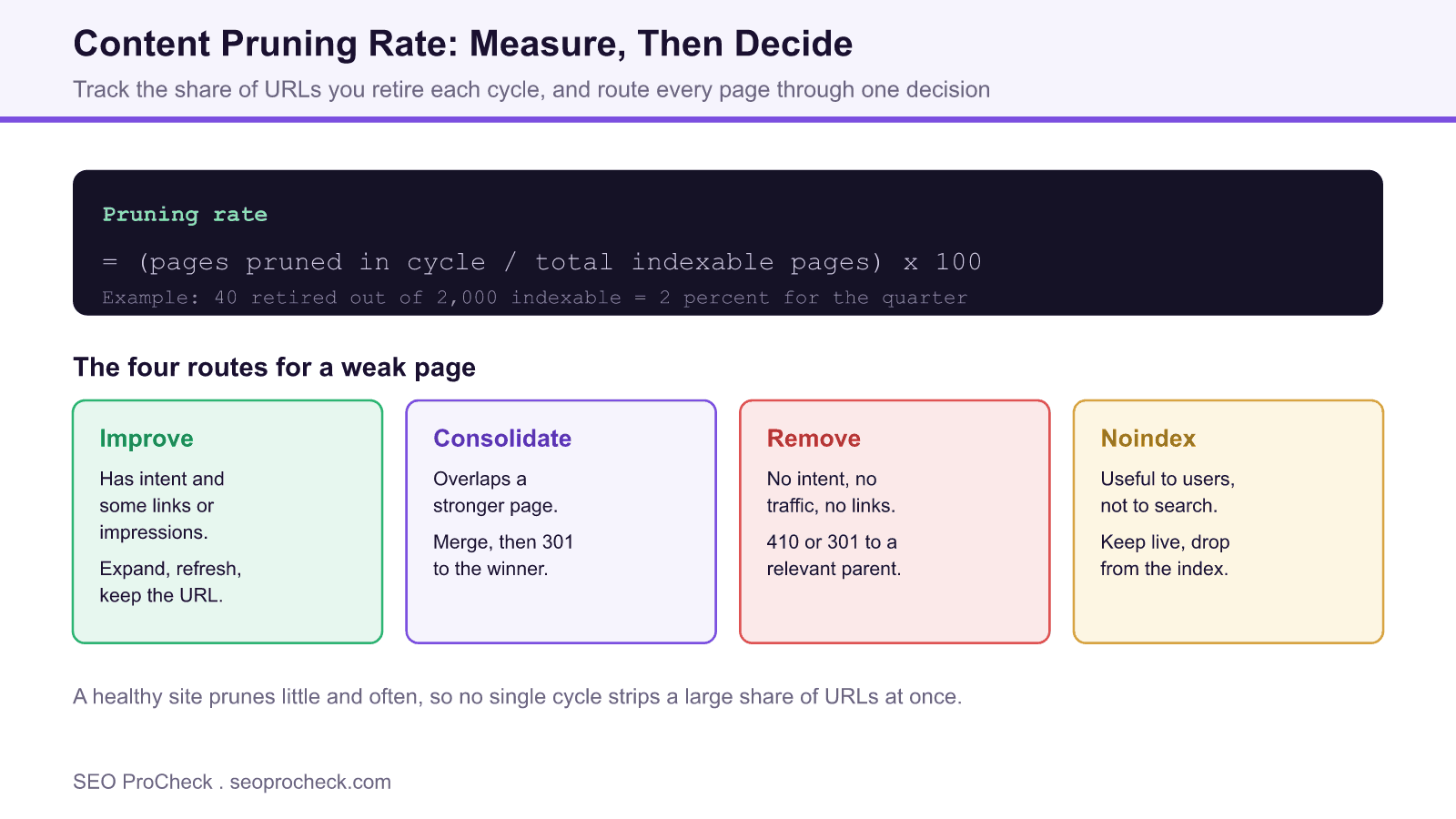
The formula is straightforward: divide the number of pages you pruned in a cycle by your total indexable pages, then multiply by one hundred. If you retired 40 URLs out of 2,000 indexable pages in a quarter, your pruning rate for that quarter is 2 percent. Measured consistently, the trend is more useful than any single reading: a sudden spike usually means neglect caught up with you, while a steady low rate signals an audit habit that is working.
What pruning actually means
Pruning is not simply deleting pages. It is routing each weak URL to the right outcome. A page that still serves intent and has some links or impressions should be improved, not cut. A page that overlaps a stronger one should be consolidated and redirected. A page with no intent, traffic, or links can be removed. A page that helps users but has no place in search can be kept live with a noindex directive. Only the last three count toward your pruning rate; improving a page in place does not.
| Route | When to use it | Mechanism |
|---|---|---|
| Improve | Page has intent plus some links or impressions | Expand and refresh, keep the URL live and indexed |
| Consolidate | Page overlaps a stronger page | Merge the content, then 301 to the winner |
| Remove | No intent, no traffic, no links | 410, or 301 to a relevant parent |
| Noindex | Useful to users but not to search | Keep live, add a noindex directive |
Why the rate matters
Search engines assess quality at the site level as well as the page level, so a large volume of thin, outdated, or duplicative pages can weigh on the templates and topics you actually care about. Pruning concentrates authority, internal links, and crawl attention on the content that earns traffic. The danger is overcorrection: a mass deletion can remove pages that quietly carried links or converted, and it can break internal linking. Tracking the rate keeps pruning deliberate rather than reactive.
Building a repeatable pruning habit
The healthiest pattern is little and often. Maintain a content inventory, then on a quarterly or twice yearly cadence score each URL against intent, performance, and link equity, and assign it to improve, consolidate, remove, or noindex. Never prune on a single metric such as traffic in isolation, because a page can have zero clicks yet hold valuable backlinks or serve a real navigational need. Redirect removed URLs where a relevant target exists, and update internal links so you are not pointing readers or crawlers at retired pages. Done this way, your pruning rate stays low and steady, and no single cycle ever has to strip out a large share of the site at once.
Element Code: TE-007
Quick Reference
Issue: Site has accumulated low-quality or outdated content
Impact: Dilutes site quality signals
Fix: Implement content pruning strategy
Detection: Content audit, traffic analysis
What Is This Issue?
Accumulated thin, outdated, or underperforming content can dilute overall site quality. Regular pruning maintains quality standards.
Why This Matters for Your Website
Site quality affects all pages. Low-quality content drags down the whole site.
How to Fix This Issue
- Audit content: Identify underperformers
- Decide fate: Improve, consolidate, or remove
- Regular schedule: Ongoing maintenance
Tools for Detection
- Analytics: Identify low-traffic pages
TL;DR (The Simple Version)
Regularly audit and prune low-quality content to maintain overall site quality signals.
Frequently Asked Questions
What is content pruning rate?
Content pruning rate is the share of your indexable URLs that you retire in a given cycle, calculated as pages pruned divided by total indexable pages. It is a way to quantify how aggressively a site is trimming weak content, so you can keep pruning steady rather than lurching between neglect and mass deletion.
What counts as pruning a page?
Pruning means removing a page from the index or the site through one of several routes: deleting and returning 410, redirecting with 301 to a stronger page, consolidating several thin pages into one, or applying noindex so the page stays live for users but leaves search. Improving a page in place is not pruning.
Is pruning content good or bad for SEO?
Handled well, pruning helps. Removing thin, outdated, or duplicative pages concentrates authority and crawl attention on the content that earns traffic, and it can lift overall quality signals. Handled badly, mass deletion can remove pages that had value, break internal links, and cause traffic loss, which is why the rate matters.
How do I decide which pages to prune?
Audit each URL against intent, performance, and links. If a page serves real intent and has some traffic or links, improve it. If it overlaps a stronger page, consolidate and redirect. If it has no intent, traffic, or links, remove it. If it helps users but not search, noindex it. Never prune on a single metric such as traffic alone.
What is a healthy pruning rate?
There is no universal number, but healthy sites tend to prune little and often rather than stripping a large share of URLs in one cycle. A steady, low single digit percentage each quarter, driven by a repeatable audit, is easier to measure and safer than an annual purge. Watch for spikes, which signal accumulated neglect.
How often should I run a content audit?
For most sites a quarterly or twice yearly audit keeps the pruning rate steady and prevents low quality content from accumulating. Large or fast publishing sites benefit from a rolling audit tied to a content inventory, so weak pages are caught continuously rather than in a single large pass.
Related SEO ProCheck Checks and Guides
- How to Run a Content Audit That Moves Traffic
- Content Audit
- Thin Content
- Thin Content Study: How Much Content is Enough?
Take this with you
The assistant links open with a question about this page already written. Nothing is sent until you press enter.
Claude Vincent is a technical SEO consultant focused on crawlability, rendering, and AI-search visibility. He writes the field guides and case studies at SEO ProCheck, with a bias toward the durable, unglamorous work that decides whether search engines and AI answer engines can actually read and cite a site.
About SEO ProCheck
Technical SEO consulting and GEO strategy with 20 years of enterprise experience. Case studies, resources, and tools for search and AI visibility.
Work With Me
Technical SEO audits, GEO strategy, site migrations, and international SEO. Hourly consulting for teams who need hands-on support, not just reports.
Subscribe to our newsletter!








Recent Posts
- Most Top Sites Never Say Who They Are in Structured Data October 14, 2026
- Homepage Titles Are Mostly Too Short, Not Too Long October 8, 2026
- Who Actually Serves an llms.txt? 184 Top Sites Measured September 29, 2026