

AI Summary
Thin content is content that offers little value for its query, not simply content that is short. There is no magic word count; a page is thin when it fails to satisfy the searcher on its own and adds no unique information beyond what already ranks.
- Value and information gain, not length, define whether a page is thin.
- Diagnose thin pages by whether they fully answer the query and add something the SERP lacks.
- The fix is usually expand, consolidate or remove, chosen case by case.
- Google's quality systems now assess helpfulness sitewide, so thin sections can drag the whole site.
Research examining thin content how much content is enough? analyzed patterns across multiple datasets to identify factors affecting search performance. The findings provide actionable insights for practitioners.
Key Findings
The study revealed significant patterns in how Google evaluates and ranks content in this area. Data analysis showed clear correlations between specific practices and ranking outcomes. Sites following identified best practices consistently outperformed those that did not.
Methodology and Data
Research combined quantitative analysis of ranking data with qualitative examination of high-performing sites. Multiple data sources were triangulated to ensure finding validity. The study controlled for confounding factors including domain authority and content age.
Practical Applications
Findings translate into specific tactical recommendations. Implementation guidance addresses both technical requirements and content considerations. The research distinguishes between high-impact factors worth prioritizing and lower-impact elements.
Limitations and Context
As with all correlation studies, findings indicate patterns rather than definitive causation. Results may vary by industry, query type, and competitive context. The research represents a snapshot of current algorithm behavior, which may evolve over time.
Thin is about value, not length
The most common misconception is that thin content means short content. It does not. A crisp 300 word answer that fully resolves a specific question can outrank a 2,000 word article that pads the same query with filler. A page is thin when it fails to satisfy the intent on its own, or when it merely restates what a dozen other results already say without adding first hand data, examples, or a clearer explanation. That concept, information gain, is the real yardstick, and it maps directly to search intent: value is always measured against what the query needs.
How to diagnose thin pages
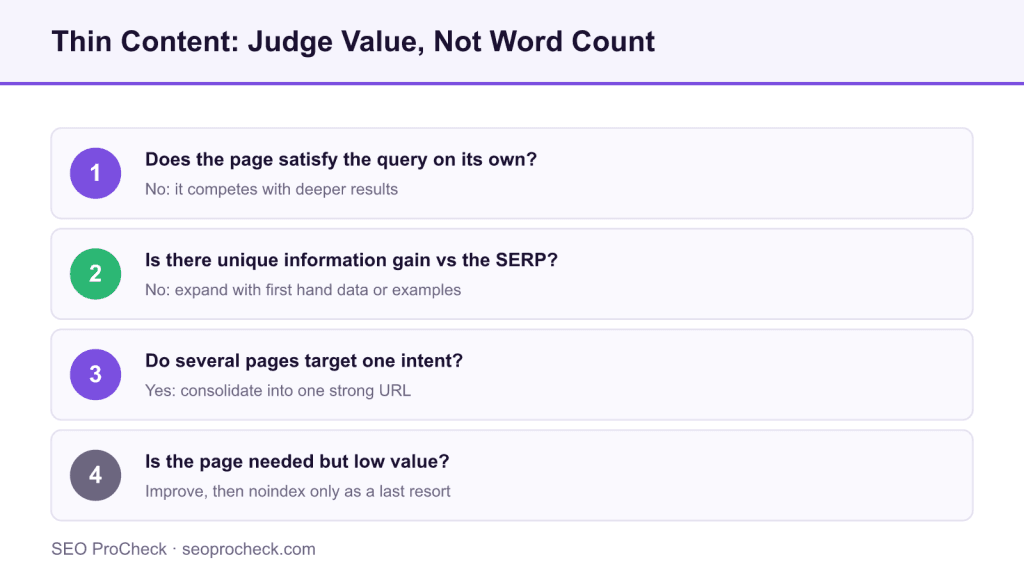
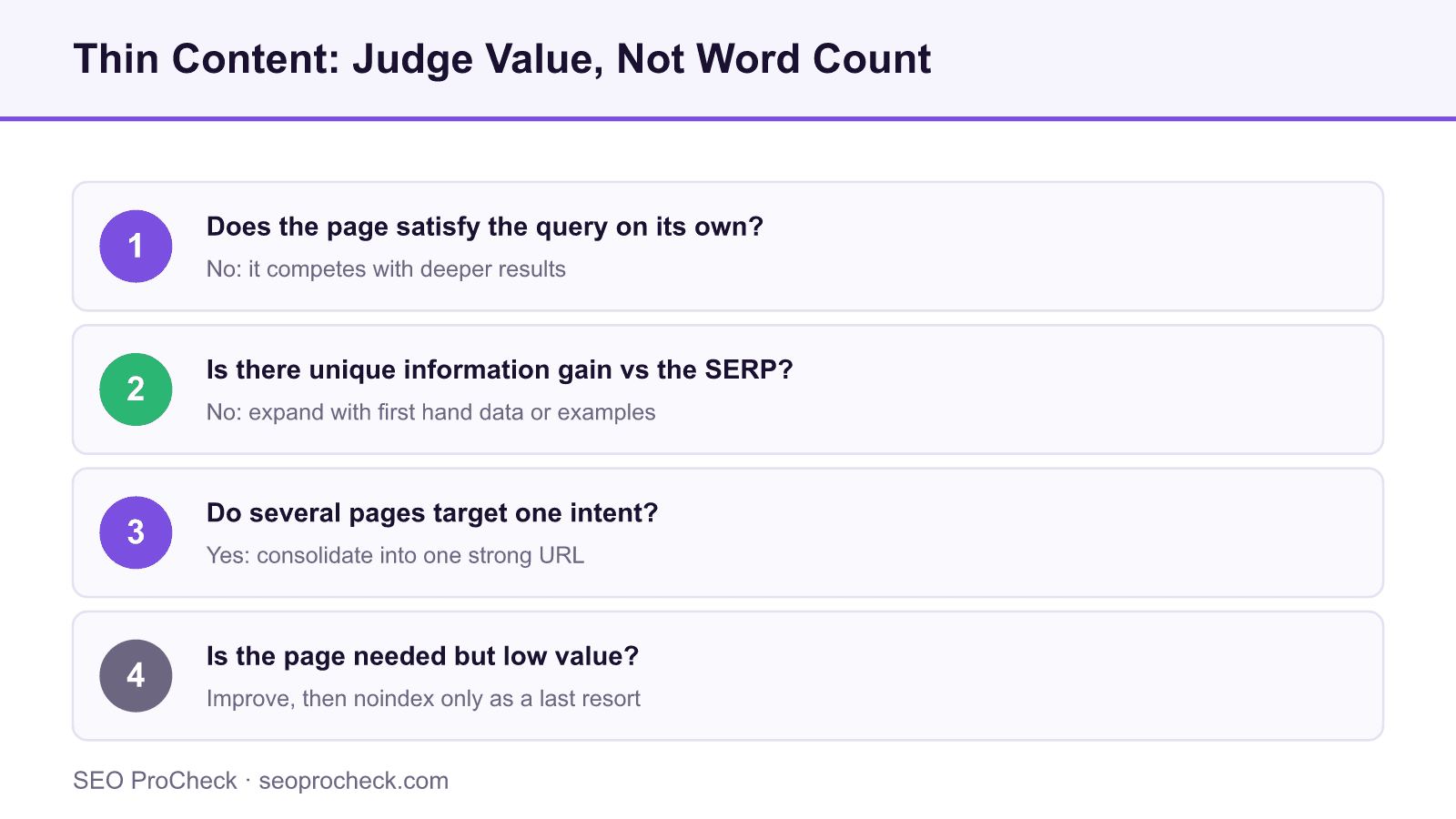
Run each suspect page through the ladder in the diagram. Does it satisfy the query on its own, or does the reader have to click back to a stronger result? Is there anything unique here, a proprietary number, a worked example, an original screenshot, that the ranking set lacks? Are several of your own pages chasing the same intent and splitting authority? A useful data driven signal: pull the page in Search Console and look for URLs with impressions but near zero clicks and no ranking movement over months. That pattern often flags a page Google indexed but does not consider the best answer.
| Page type | Symptom of thinness | Recommended action |
|---|---|---|
| Boilerplate location pages | Same text with a swapped city name | Add genuinely local detail or consolidate |
| Auto generated tag archives | Lists of links, no unique value | Noindex or prune the low value ones |
| Overlapping blog posts | Several posts on one intent | Consolidate into one strong URL, 301 the rest |
| Shallow product pages | Manufacturer copy only | Add original specs, use cases, reviews, media |
Fix paths: expand, consolidate or remove
There are only three durable responses. Expand a page when the intent is valuable but the coverage is shallow: add original data, examples, media and the sub questions the SERP rewards. Consolidate when several pages target one intent: merge them into a single authoritative URL and redirect the others so their signals combine rather than compete. Remove or noindex when a page serves no user and never will. Note the order: improving and consolidating come first, and noindex is a last resort, not a reflex. Our thin content resolution guide walks through choosing between them, and the thin content definition in the lexicon keeps the terminology precise.
Programmatic pages and what has changed
Programmatic and templated pages are where thin content scales fastest and does the most damage. A template that generates thousands of near identical pages with only a variable swapped is the textbook example. The remedy is not deletion by default; it is ensuring each generated page carries real, differentiated value, or collapsing the set to the URLs that can. What has changed is scope. Google folded its helpful content assessment into the core ranking systems, and it operates at least partly sitewide, which means a large mass of unhelpful pages can weigh on the visibility of your genuinely good ones. That raises the stakes for cleaning up thin sections, and it is why the content quality signals Google looks for are worth auditing across the whole site, not page by page.
Frequently Asked Questions
How many words does a page need to avoid being thin?
There is no required word count. Thin content is about value, not length. A short page that fully answers its query can rank, while a long page that adds nothing new can still be thin.
How do I know if a page is thin content?
Ask whether it satisfies the searcher on its own and whether it adds anything the ranking results do not already provide. Pages with impressions but almost no clicks and no ranking movement are common suspects.
Should I delete thin content or improve it?
Improve or consolidate first. Expand pages with valuable intent, merge overlapping pages into one strong URL, and reserve deletion or noindex for pages that serve no user and cannot be made useful.
Does thin content hurt my whole site?
It can. Google's helpful content assessment is part of the core systems and operates partly sitewide, so a large volume of unhelpful pages can weigh down the visibility of your stronger pages.
Are programmatic pages considered thin content?
Only when they lack unique value. Templated pages that differ by a single variable are classic thin content. If each page carries genuinely differentiated, useful information, scale alone is not the problem.
Is thin content the same as duplicate content?
No. Thin content lacks value; duplicate content repeats text found elsewhere. A page can be thin without being duplicate, and vice versa, though they often overlap on low effort sites.
Source: Industry research compilation
Take this with you
The assistant links open with a question about this page already written. Nothing is sent until you press enter.
Claude Vincent is a technical SEO consultant focused on crawlability, rendering, and AI-search visibility. He writes the field guides and case studies at SEO ProCheck, with a bias toward the durable, unglamorous work that decides whether search engines and AI answer engines can actually read and cite a site.
About SEO ProCheck
Technical SEO consulting and GEO strategy with 20 years of enterprise experience. Case studies, resources, and tools for search and AI visibility.
Work With Me
Technical SEO audits, GEO strategy, site migrations, and international SEO. Hourly consulting for teams who need hands-on support, not just reports.
Subscribe to our newsletter!







Recent Posts
- Finding a Competitor's Sitemap, and Turning It Into a Change Log September 15, 2026
- AI Crawler User Agents: The Current Names, and Which Ones Sites Actually Block September 9, 2026
- Can AI Crawlers Actually Read Your Site? I Measured 400 of the Biggest September 5, 2026