

AI Summary
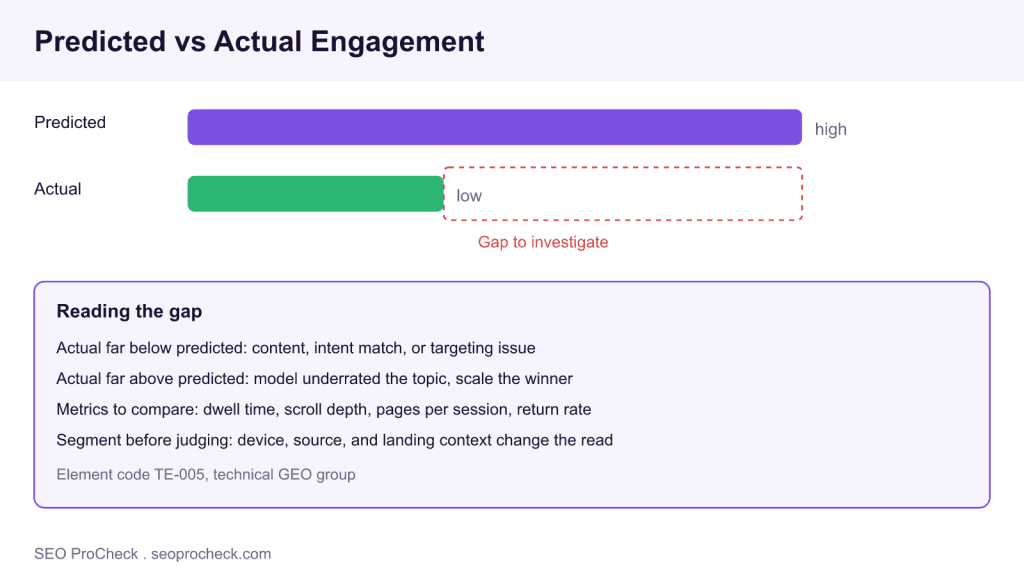
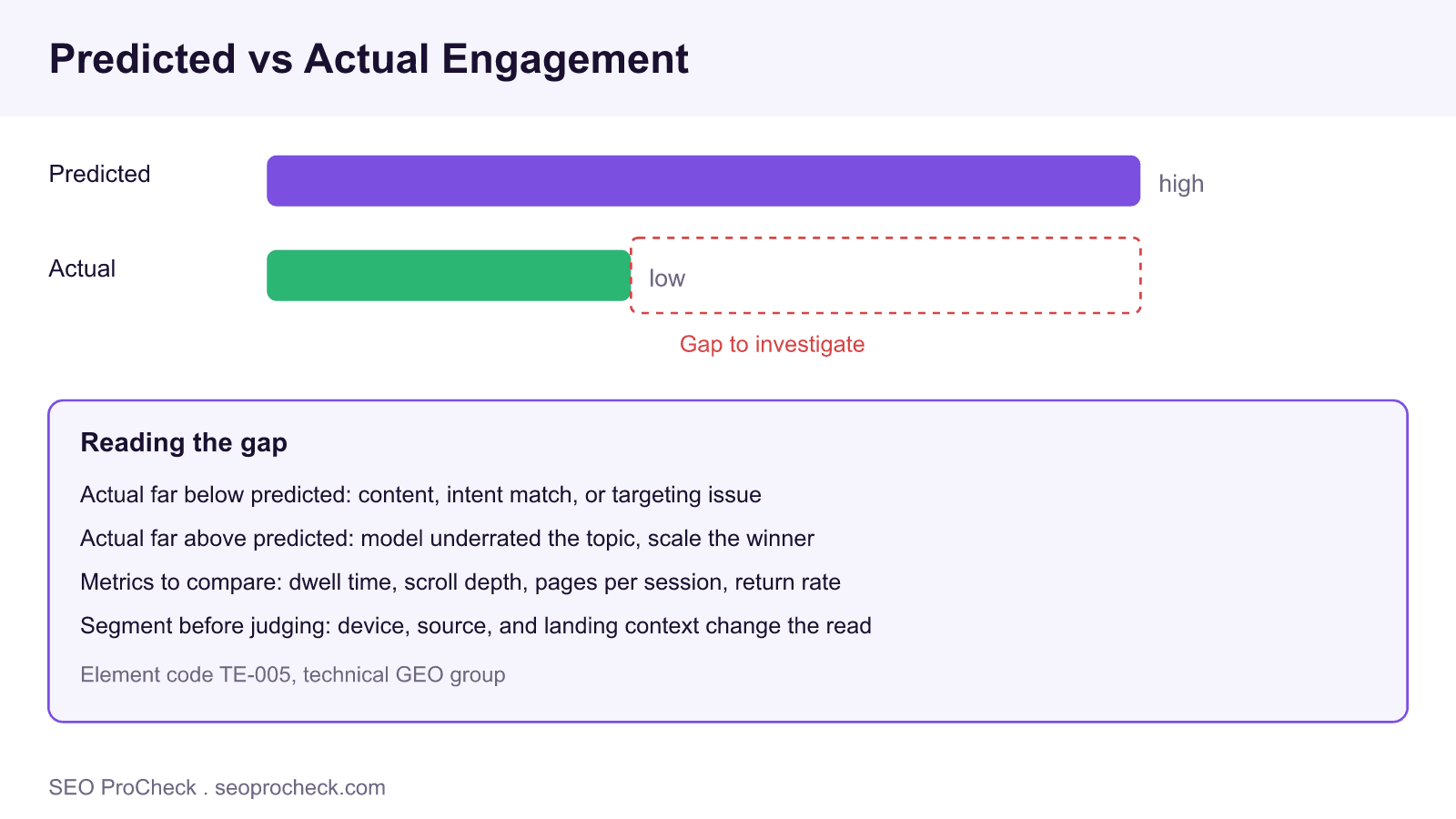
Engagement prediction accuracy measures how closely a page's real engagement, such as dwell time and scroll depth, matches what you expected before publishing. A wide gap is a diagnostic signal: it points to either a content and targeting problem or a flaw in the prediction model, and both are worth investigating.
- Compare predicted engagement with actual analytics per page, not just traffic volume.
- Actual far below predicted usually means weak content, wrong intent match, or poor targeting.
- Actual far above predicted flags an underrated winner you should scale and study.
- Element code TE-005: a technical GEO check that surfaces gaps between expected and observed engagement.
What engagement prediction accuracy is
Engagement prediction accuracy describes how well your expectation of a page's performance matches what actually happens once real users arrive. Before publishing, most teams form a prediction, whether formal from a model or informal from experience, about how a page should engage its audience: how long people will stay, how far they will scroll, how many will click deeper or return. Engagement prediction accuracy is the comparison between that expectation and the observed reality. Within the SEO ProCheck framework this is check TE-005 in the technical GEO group, and it treats a large gap between predicted and actual engagement as a signal worth investigating rather than a verdict on its own.
Why the gap matters for your website
The value here is diagnostic. A consistent, sizable gap between what you expected and what you observed almost always points to one of two root causes, and separating them is the whole exercise. Either the content has a problem, it does not satisfy the intent behind the query, it targets the wrong audience, or it fails to deliver on the promise of its title and snippet, or the prediction itself was wrong, built on a flawed assumption about demand, difficulty, or audience. Both findings are useful. A content problem tells you what to improve. A prediction problem tells you to recalibrate how you forecast, so future planning gets sharper.
Reading the direction of the gap guides the response. When actual engagement falls well below prediction, treat the page as underperforming and audit it for intent mismatch, thin or off target content, a misleading title, or a slow experience that pushes users away before they engage. When actual engagement runs well above prediction, you have found an underrated winner: the model or your intuition undervalued the topic, and the right move is to study why, then invest more in that theme and expand the coverage that is clearly resonating.
How to fix and act on the gap
Work through three steps. First, compare the right metrics. Put predicted against actual for engagement measures, not just raw traffic: average engagement time, scroll depth, pages per session, and return visitor rate all describe engagement more honestly than sessions alone. Second, identify patterns. Group the pages with the biggest gaps and look for what they share, a content type, a topic cluster, a traffic source, or a device, because the pattern usually names the cause. Third, iterate on both sides. Fix the content where the content is the problem, and adjust your prediction inputs where the model is the problem, so accuracy improves over successive cycles.
Segment before you judge
A raw gap can mislead if you read it unsegmented. The same page can look like a failure and a success at once depending on the slice. A page can engage desktop visitors from organic search deeply while mobile visitors from social bounce, and the blended average hides both truths. Before concluding that content is weak, segment by device, traffic source, and landing context, and compare like with like. Often the gap is concentrated in one segment, which turns a vague content problem into a specific, fixable one, for example a mobile layout issue rather than a writing issue.
How to detect the issue
Detection is an analytics comparison. Track engagement metrics in your analytics platform, hold them next to the expectation you set at publish time, and flag pages where the two diverge beyond a threshold you define. The point is not to chase a perfect forecast, which is impossible, but to catch the outliers where reality and expectation disagree loudly, because those outliers are where the learning is. Over time, a shrinking average gap is evidence that both your content and your forecasting are getting better.
AI search and GEO considerations
Engagement patterns increasingly inform how content is surfaced and how confidently answer engines lean on a source. Pages that genuinely hold attention and satisfy intent are better positioned across both classic search and AI answers, so closing large negative gaps, where real engagement trails expectation, protects visibility. Treat persistent underperformance as a prompt to strengthen the content itself rather than a metric to explain away.
Interpreting the prediction gap
| Observation | Likely cause | Recommended action |
|---|---|---|
| Actual far below predicted | Intent mismatch, thin or off target content | Audit and rework content, fix title and snippet |
| Actual far above predicted | Model underrated demand | Scale the winner, expand the cluster |
| Gap only on mobile | Layout or speed issue on one device | Fix the mobile experience, not the copy |
| Gap only from one source | Traffic quality or expectation mismatch | Recalibrate targeting for that source |
| Small gap across the board | Prediction is well calibrated | No action, keep the current model |
Frequently Asked Questions
What is engagement prediction accuracy?
It is how closely a page's real engagement, such as dwell time and scroll depth, matches what you expected before publishing. A large gap is a diagnostic signal that points to either a content and targeting problem or a flaw in the prediction itself.
What does it mean when actual engagement is far below prediction?
It usually means the content does not match search intent, targets the wrong audience, or fails to deliver on its title and snippet. Audit the page for intent fit, quality, and experience before assuming the prediction was wrong.
What does it mean when actual engagement beats prediction?
You have found an underrated winner. The forecast undervalued the topic, so study why it resonated and invest more in that theme by expanding the surrounding cluster.
What is check TE-005?
TE-005 is the SEO ProCheck technical GEO check that surfaces gaps between predicted and actual engagement, so you can investigate whether the cause is content quality, targeting, or the prediction model.
Which metrics should I compare?
Compare engagement measures, not just traffic: average engagement time, scroll depth, pages per session, and return visitor rate. These describe whether people actually engaged, which raw session counts do not.
Why segment the data before acting?
Because a blended average can hide opposite truths. A page may engage desktop organic visitors deeply while mobile social visitors bounce. Segmenting by device, source, and context turns a vague gap into a specific, fixable cause.
Related checks
Element Code: TE-005
Quick Reference
Issue: Content engagement does not match predictions or expectations
Impact: May indicate content quality or targeting issues
Fix: Analyze gaps between predicted and actual engagement
Detection: Analytics comparison
What Is This Issue?
When content performs differently than expected, it indicates either prediction model issues or content problems needing investigation.
Why This Matters for Your Website
Understanding engagement gaps helps improve both content and prediction accuracy.
How to Fix This Issue
- Compare metrics: Expected vs actual
- Identify patterns: What causes mismatches?
- Iterate: Improve content and predictions
Tools for Detection
- Analytics: Track engagement metrics
TL;DR (The Simple Version)
Analyze why content engagement differs from expectations to improve both your content and your predictions.
Take this with you
The assistant links open with a question about this page already written. Nothing is sent until you press enter.
Claude Vincent is a technical SEO consultant focused on crawlability, rendering, and AI-search visibility. He writes the field guides and case studies at SEO ProCheck, with a bias toward the durable, unglamorous work that decides whether search engines and AI answer engines can actually read and cite a site.
About SEO ProCheck
Technical SEO consulting and GEO strategy with 20 years of enterprise experience. Case studies, resources, and tools for search and AI visibility.
Work With Me
Technical SEO audits, GEO strategy, site migrations, and international SEO. Hourly consulting for teams who need hands-on support, not just reports.
Subscribe to our newsletter!








Recent Posts
- Most Top Sites Never Say Who They Are in Structured Data October 14, 2026
- Homepage Titles Are Mostly Too Short, Not Too Long October 8, 2026
- Who Actually Serves an llms.txt? 184 Top Sites Measured September 29, 2026