

AMPs help Monetti cut page load time by 84%, grow Google Ads conversions by 19%
- September 3, 2020
- Uncategorized

AI Summary
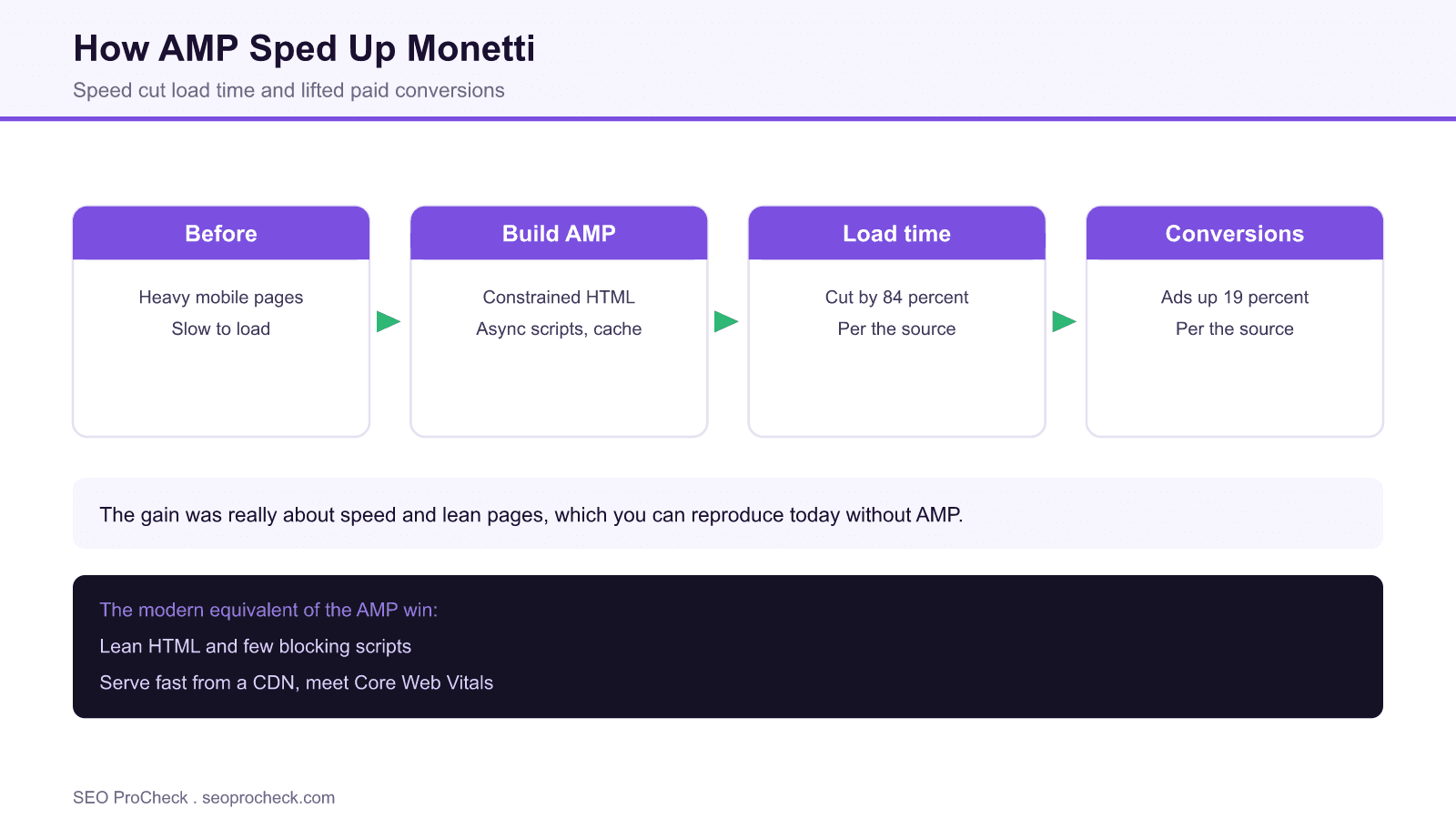
According to the source case study, Monetti built AMP pages that cut mobile page load time by 84 percent and grew Google Ads conversions by 19 percent. The deeper lesson is that the win came from speed and disciplined lightweight pages, an outcome you can now achieve without AMP by optimizing the standard responsive page.
- The source reports Monetti cut page load time by 84 percent using AMP.
- Google Ads conversions grew by 19 percent, driven largely by faster landing pages.
- The real lever was speed and page discipline, not the AMP format itself.
- Google dropped the AMP requirement for Top Stories in 2021; Core Web Vitals now judge any fast page.
This SEO case study documents a successful optimization initiative, providing actionable insights for practitioners. The documented approach demonstrates how strategic SEO implementation drives measurable results.
Initial Situation
Understanding the starting point is essential context for evaluating any case study. This documentation covers the initial challenges, competitive position, and business objectives that shaped the SEO strategy.
Strategy and Approach
The strategic approach combined multiple SEO disciplines to address identified opportunities. Key decisions around prioritization and resource allocation provide a template for similar initiatives.
Implementation
Moving from strategy to execution required specific technical implementations, content development, and process changes. This case study documents the practical steps that translated strategy into action.
Results and Learnings
The outcomes demonstrate effectiveness through measurable improvements in rankings, traffic, and business metrics. Analysis of successes and challenges provides learning value for practitioners.
Case studies like this contribute to the SEO knowledge base, helping practitioners learn from documented real-world experiences.
Practitioner Notes: What Actually Drove the Result
The headline numbers in this case come from the source: Monetti built AMP landing pages, cut mobile page load time by 84 percent, and grew Google Ads conversions by 19 percent. Those figures show how much a bloated mobile page had been costing the business before the rebuild. When a page loads that much faster, fewer visitors abandon it during the wait, and more of the paid clicks you already bought turn into conversions.
The nuance worth stating plainly is that the win was really about speed and page discipline, not about AMP as a format in itself. AMP delivered its speed by constraining the HTML, requiring asynchronous scripts, and serving pages from a fast cache. Those constraints forced a lean page. You can reproduce the same outcome today on a standard responsive page by being equally disciplined about payload, render blocking scripts, and delivery, without maintaining a separate AMP version. Because the lift landed on paid traffic, the takeaway applies to landing page work generally, not only to organic SEO.
It is also a reminder that speed and mobile usability are related but distinct. Monetti's story is about load time, while the earlier mobile friendly shift was about usability on a small screen. Both point the same direction. For the usability side of that story, see the Mobilegeddon case study, and for how speed interacts with crawling and indexing, browse our crawling and indexing case studies.
What's Changed Since
AMP has been substantially deprioritized. In 2021 Google removed the AMP requirement for the Top Stories carousel and dropped the AMP badge from search results, so publishers no longer need a parallel AMP format to qualify for those features. Page Experience judges any sufficiently fast page on its own merits, which removed the main incentive that had pushed sites toward AMP.
As a result many publishers have retired their AMP pages, because maintaining a second format is expensive and modern frameworks combined with a good CDN reach comparable speed on the canonical page. The measurement focus has shifted to Core Web Vitals: Largest Contentful Paint, Cumulative Layout Shift, and Interaction to Next Paint, which replaced First Input Delay in March 2024. The practical advice today is to optimize your primary responsive page to hit those thresholds rather than build and maintain a separate AMP page.
AMP in 2016 versus the Fast Page Playbook in 2026
| Goal | AMP approach, 2016 | Fast page playbook, 2026 |
|---|---|---|
| Fast load | Constrained AMP HTML and cache | Lean HTML, CDN, few blocking scripts |
| Search features | AMP required for Top Stories | No AMP requirement since 2021 |
| How speed is judged | AMP validity and cache | Core Web Vitals field data |
| Maintenance | Separate AMP version | One optimized responsive page |
Frequently Asked Questions
What is AMP?
AMP, which stood for Accelerated Mobile Pages, was an open framework for building very fast loading mobile pages. It achieved speed by constraining the HTML, requiring asynchronous JavaScript, and serving pages from a cache, which produced lean pages that loaded quickly on mobile.
Is AMP still worth it in 2026?
For most sites, no. Google removed the AMP requirement for its search features, and modern responsive pages with a good CDN can match AMP speed without the cost of maintaining a second format. Optimizing the canonical page is usually the better investment.
Did AMP help SEO rankings?
AMP was never a direct ranking factor, but its speed improved user experience metrics and it was once required for the Top Stories carousel. The benefit came from being fast, which you can achieve on any page, rather than from AMP itself.
Why did Google drop the AMP requirement?
In 2021 Google shifted to judging pages by the Page Experience signals and Core Web Vitals, which any fast page can meet. That removed the need to gate features like Top Stories behind AMP, so the AMP requirement and badge were retired.
How do I make a fast mobile landing page without AMP?
Keep the HTML lean, minimize render blocking scripts and large images, serve assets from a CDN, and measure against Core Web Vitals. The goal is the same speed AMP delivered, reached on your standard responsive page instead of a separate format.
What replaced AMP for speed?
Core Web Vitals became the way Google measures page speed and stability, using Largest Contentful Paint, Cumulative Layout Shift, and Interaction to Next Paint. Instead of building AMP pages, teams now optimize their responsive pages to meet those thresholds.
Claude Vincent is a technical SEO consultant focused on crawlability, rendering, and AI-search visibility. He writes the field guides and case studies at SEO ProCheck, with a bias toward the durable, unglamorous work that decides whether search engines and AI answer engines can actually read and cite a site.
About SEO ProCheck
Technical SEO consulting and GEO strategy with 20 years of enterprise experience. Case studies, resources, and tools for search and AI visibility.
Work With Me
Technical SEO audits, GEO strategy, site migrations, and international SEO. Hourly consulting for teams who need hands-on support, not just reports.
Subscribe to our newsletter!







Recent Posts
- Can AI Crawlers Actually Read Your Site? I Measured 400 of the Biggest September 5, 2026
- The Pre-Publish Quality Gate for AI-Assisted Content August 6, 2026
- AGENTS.md vs llms.txt vs llms-full.txt: Which Agent File Does What July 18, 2026