


AI Summary
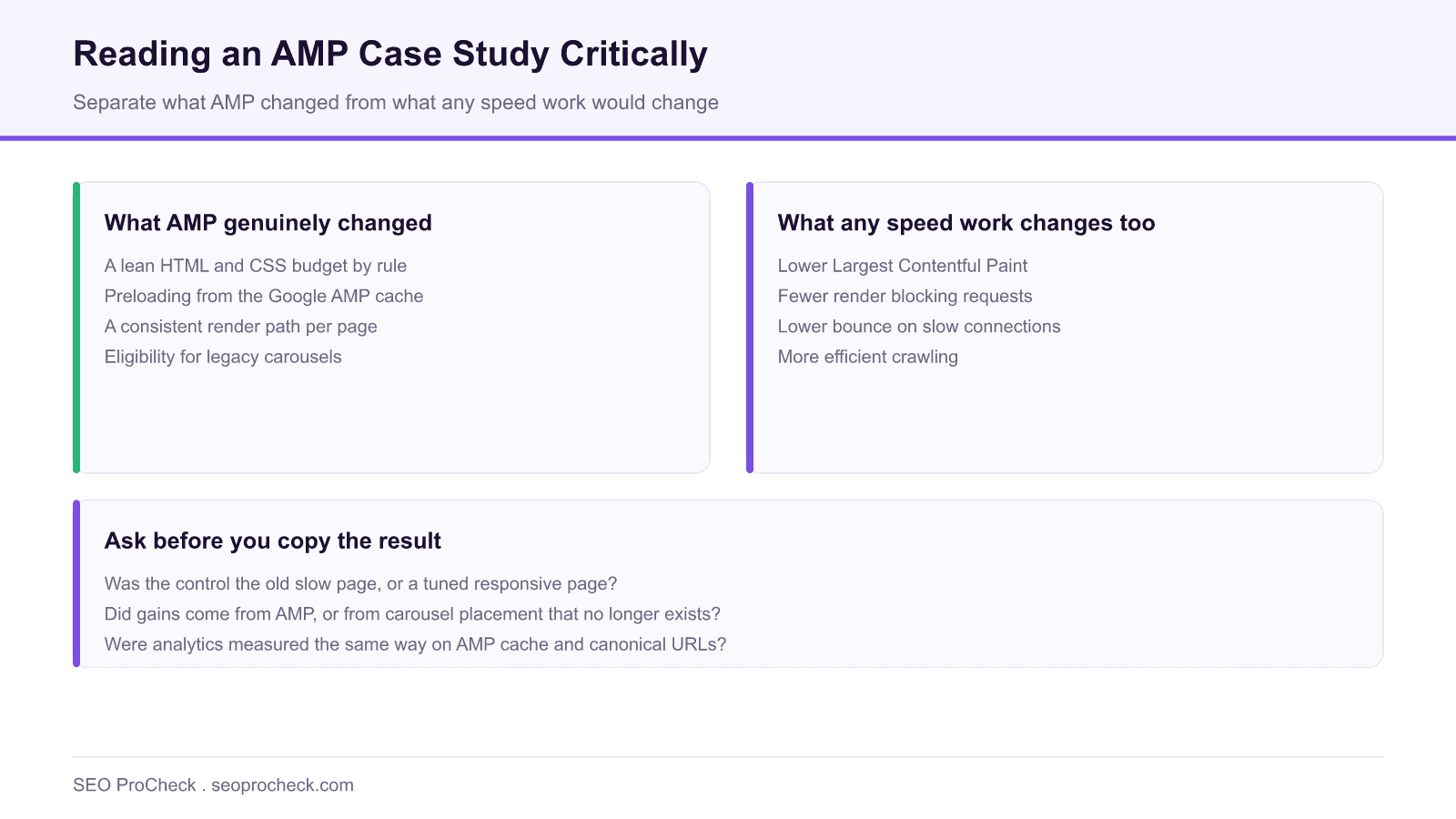
When you read an AMP case study, separate the gains that came from AMP itself from the gains that any speed work would have produced. Most reported wins, such as lower load time and lower bounce, come from being fast rather than from AMP specifically, and the carousel placement that once lifted AMP traffic no longer depends on AMP.
- Ask whether the control group was a slow page or an already tuned page.
- Traffic lifts often came from Top Stories placement, which AMP no longer gates.
- Analytics on cache URLs and canonical URLs are easy to measure inconsistently.
- The reproducible lesson is simply to make the canonical page fast.
This SEO case study documents a successful optimization initiative, providing actionable insights for practitioners. The documented approach demonstrates how strategic SEO implementation drives measurable results.
Initial Situation
Understanding the starting point is essential context for evaluating any case study. This documentation covers the initial challenges, competitive position, and business objectives that shaped the SEO strategy.
Strategy and Approach
The strategic approach combined multiple SEO disciplines to address identified opportunities. Key decisions around prioritization and resource allocation provide a template for similar initiatives.
Implementation
Moving from strategy to execution required specific technical implementations, content development, and process changes. This case study documents the practical steps that translated strategy into action.
Results and Learnings
The outcomes demonstrate effectiveness through measurable improvements in rankings, traffic, and business metrics. Analysis of successes and challenges provides learning value for practitioners.
Case studies like this contribute to the SEO knowledge base, helping practitioners learn from documented real-world experiences.
Source: https://www.seroundtable.com/google-amp-case-study-22410.html
Practitioner notes on reading the results
Case studies that announce a big win after adopting AMP are worth reading, but the interesting question is always the counterfactual: what would have happened if the same team had made their normal pages fast instead? AMP bundles several changes at once, a lean markup budget, cache preloading, and historically a carousel slot, so a headline number rarely tells you which lever did the work.
The first thing to check is the control. If the before state was a heavy page loaded with third party scripts and the after state was a stripped AMP page, then the study is really measuring the value of speed, not the value of AMP. A fair test compares AMP against a canonical page that has already been tuned to a similar budget. Very few public case studies set up that comparison, which is why their conclusions overstate AMP specifically.
The second thing to check is where the traffic came from. Before 2021 the Top Stories carousel was AMP only on mobile, so a large share of AMP traffic lifts came from that placement rather than from the format. That placement no longer requires AMP, so the gain is not reproducible today by adopting AMP. Understanding the difference between lab and field measurement helps here, and the field versus lab data guide explains why a lab score and real user data can disagree.
The third thing to check is measurement itself. AMP pages can be served from a Google cache on a different URL, and analytics setups often track cache traffic and canonical traffic differently. If sessions or bounce are counted inconsistently across the two, the comparison is contaminated before you even look at rankings.
What has changed since
The cache preloading edge that made AMP feel instant has narrowed as browsers and hosts improved, and the Top Stories carousel opened to non AMP pages with the 2021 page experience update. Many publishers who adopted AMP for the carousel have since moved back to a single responsive template. The durable lesson from any AMP case study is not to adopt AMP, it is to make the canonical page fast: lower Largest Contentful Paint, cut render blocking requests, and keep the page responsive to input. Responsiveness now has its own metric, explained in the INP explainer, and the WordPress specific tuning steps live in the speed up WordPress guide.
Claimed benefit versus likely cause
| Claimed AMP benefit | Likely real cause | How to verify |
|---|---|---|
| Lower load time | A leaner performance budget | Compare against a tuned canonical page |
| More organic traffic | Top Stories carousel placement | Segment traffic by SERP feature and date |
| Lower bounce rate | Faster first render | Check field data for both versions |
| Better crawl coverage | Lighter, faster pages | Read Crawl Stats before and after |
Run through the table before you copy anyone's result. In most cases you can capture the same benefit by tuning the page you already own.
Frequently asked questions
Why do AMP case studies often show big improvements?
Usually because the comparison is against a slow, script heavy original page. The improvement measures the value of speed, not the value of AMP. A fair test would compare AMP against an already tuned canonical page.
Did AMP traffic gains come from AMP or from placement?
Historically a large share came from the Top Stories carousel, which was AMP only on mobile before 2021. Since that placement no longer requires AMP, gains attributed to the format are not reproducible by adopting it today.
How should I set up a fair speed comparison?
Compare like for like: a tuned canonical page against the alternative, measured with the same analytics configuration and the same date ranges. Prefer a controlled holdout or split rather than a simple before and after, which confounds seasonality.
Does the AMP cache still give a speed edge?
The preloading advantage has narrowed as hosting, HTTP, and browser behaviour improved. A well tuned canonical page on fast hosting can match the perceived speed without the cache.
What is the reproducible takeaway from AMP case studies?
Make the canonical page fast. Lower Largest Contentful Paint, remove render blocking resources, and keep the page responsive to input. Those gains are portable to any page without a second template.
Should I trust bounce rate comparisons between AMP and canonical pages?
Only if both were tracked identically. AMP cache URLs and canonical URLs are often measured with different analytics setups, which can make bounce or session counts diverge for reasons unrelated to the format.
Claude Vincent is a technical SEO consultant focused on crawlability, rendering, and AI-search visibility. He writes the field guides and case studies at SEO ProCheck, with a bias toward the durable, unglamorous work that decides whether search engines and AI answer engines can actually read and cite a site.
About SEO ProCheck
Technical SEO consulting and GEO strategy with 20 years of enterprise experience. Case studies, resources, and tools for search and AI visibility.
Work With Me
Technical SEO audits, GEO strategy, site migrations, and international SEO. Hourly consulting for teams who need hands-on support, not just reports.
Subscribe to our newsletter!







Recent Posts
- Can AI Crawlers Actually Read Your Site? I Measured 400 of the Biggest September 5, 2026
- The Pre-Publish Quality Gate for AI-Assisted Content August 6, 2026
- AGENTS.md vs llms.txt vs llms-full.txt: Which Agent File Does What July 18, 2026