

Real-world examples of mobile SEO problems with Google's mobile-first index looming
- December 18, 2017
- Uncategorized
AI Summary
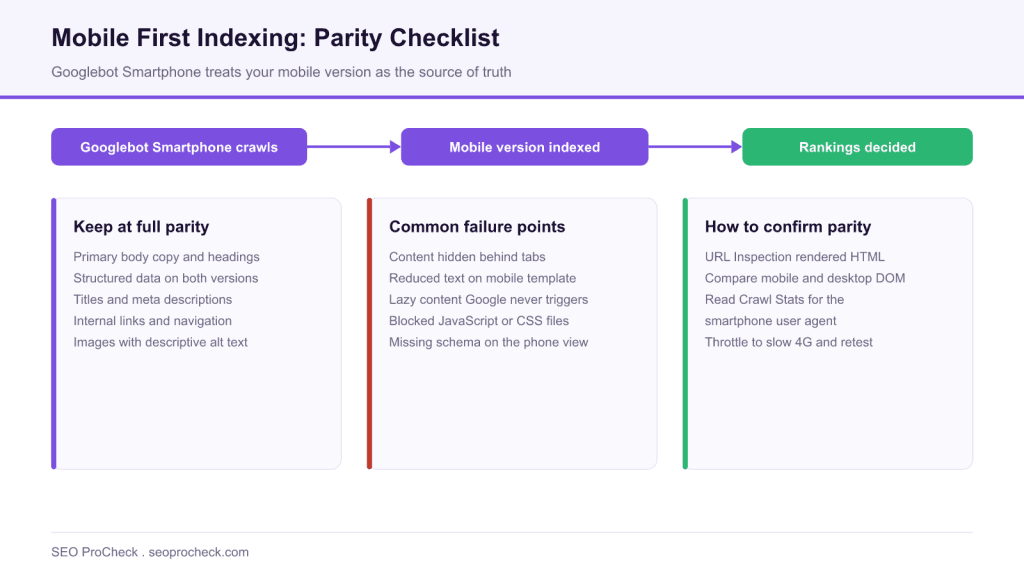
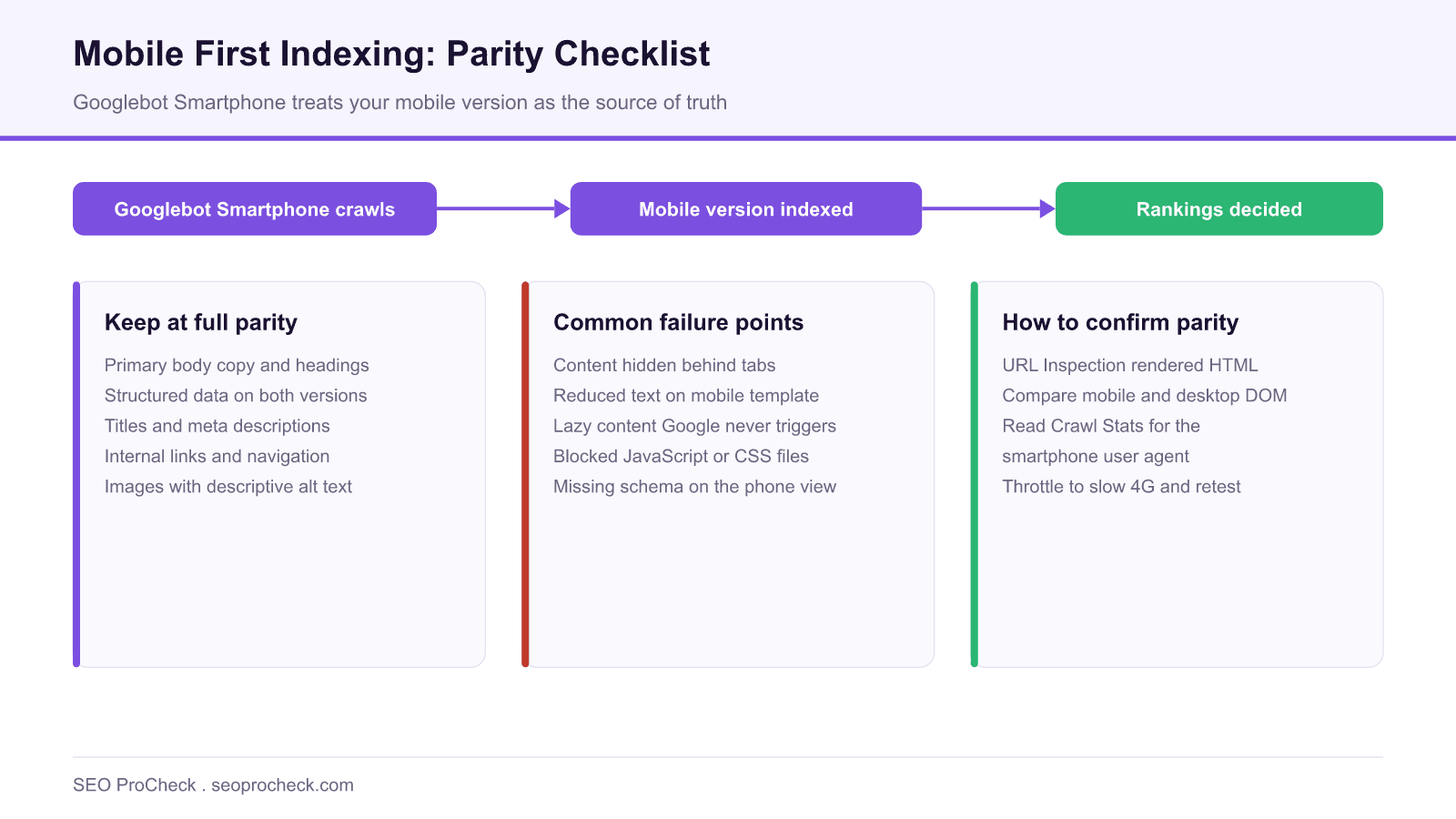
Google now indexes and ranks using the mobile version of your pages by default, so any content, links, or structured data that appear only on desktop are effectively invisible. The practical job today is parity: make the phone version carry the same content and markup as the desktop version, and make it render quickly.
- Google finished moving all sites to mobile first indexing, so the smartphone crawler is the source of truth.
- The most common damage comes from content that is full on desktop but reduced or hidden on mobile.
- Verify parity with URL Inspection, Crawl Stats for the smartphone agent, and a real device test.
- Mobile rendering speed still matters, because a slow page can suppress crawling and rankings.
This SEO case study documents a successful optimization initiative, providing actionable insights for practitioners. The documented approach demonstrates how strategic SEO implementation drives measurable results.
Initial Situation
Understanding the starting point is essential context for evaluating any case study. This documentation covers the initial challenges, competitive position, and business objectives that shaped the SEO strategy.
Strategy and Approach
The strategic approach combined multiple SEO disciplines to address identified opportunities. Key decisions around prioritization and resource allocation provide a template for similar initiatives.
Implementation
Moving from strategy to execution required specific technical implementations, content development, and process changes. This case study documents the practical steps that translated strategy into action.
Results and Learnings
The outcomes demonstrate effectiveness through measurable improvements in rankings, traffic, and business metrics. Analysis of successes and challenges provides learning value for practitioners.
Case studies like this contribute to the SEO knowledge base, helping practitioners learn from documented real-world experiences.
Source: https://www.gsqi.com/marketing-blog/mobile-problems-with-google-mobile-first-index-looming/
Practitioner notes on mobile first indexing
When this topic first surfaced it was framed as something looming on the horizon. In practice the failure mode has stayed the same for years: a page looks complete on a desktop browser, but the version Googlebot Smartphone actually renders is missing chunks of copy, internal links, or structured data. Google indexes what it sees on the phone, so a desktop only paragraph is a paragraph Google never reads.
The quickest way to catch this is the URL Inspection tool in Search Console. Run a live test, open the rendered HTML, and search it for a sentence you expect to be there. If the sentence is missing, the content is being injected by script that Googlebot did not execute, hidden by a template that trims text on small screens, or gated behind an interaction the crawler never performs. The Page Indexing report tells you which URLs made it into the index, but URL Inspection tells you what the crawler saw on a single page, which is where parity problems hide.
Server logs settle the argument about which crawler visited. Filter your access logs for the smartphone user agent, whose token contains Googlebot and an Android build string, and confirm it is fetching your important templates. If you see the smartphone agent stalling on a template, that template usually has a rendering or resource blocking problem. The Crawl Stats report under Settings shows the same story at an aggregate level.
What has changed since this case study
This piece dates from the period when mobile first indexing was still being rolled out. That rollout is finished: Google confirmed it stopped crawling with the desktop agent for the last stragglers, so every site is now judged on its mobile version. The old separate mobile URL pattern, the m dot site, has largely been retired in favour of responsive design, which removes the parity problem at the source because there is only one document to crawl. Core Web Vitals also joined the ranking picture, so a mobile page that renders slowly can lose twice: crawl efficiency and page experience. If you want a modern refresher on the crawler behaviour, the mobile SEO FAQ covers the current guidance, and Interaction to Next Paint is worth understanding because it replaced First Input Delay as a responsiveness signal in the INP guide.
Parity audit: what to check on the phone version
| Element | Desktop | Mobile version must | Risk if it differs |
|---|---|---|---|
| Body copy | Full article | Carry the same text | Thin content, lost rankings |
| Structured data | Present | Present and identical | Lost rich results eligibility |
| Titles and meta | Set | Match the desktop values | Inconsistent snippets |
| Internal links | In nav and body | Reachable on mobile | Orphaned pages, weaker crawl |
| Images and alt text | Loaded | Loaded with alt intact | Lost image search and context |
| Primary content load | Server rendered | Not gated behind tabs or clicks | Content Google never sees |
Treat the table as a repeatable checklist. Most sites pass on four rows and fail on one, and that single failing row is usually where the traffic went.
Frequently asked questions
Is mobile first indexing the same as being mobile friendly?
No. Mobile friendliness is about usability on a small screen, such as tap targets and readable fonts. Mobile first indexing is about which version Google crawls and indexes. A page can be mobile friendly and still fail parity if it hides content that exists on desktop.
How do I tell which Googlebot crawled my page?
Check your server access logs and filter by user agent. The smartphone crawler token includes Googlebot along with an Android build string. You can also verify a request came from Google by doing a reverse DNS lookup on the IP address.
Does content hidden behind tabs or accordions hurt on mobile?
Content that is present in the HTML but visually collapsed is generally fine, because Google can still read it in the rendered source. Content that only loads after a click or scroll event that the crawler does not trigger is the real risk, because it may never enter the index.
Do I still need a separate mobile URL?
No. A responsive site that serves one URL to every device is the recommended pattern and removes parity problems entirely. Separate mobile URLs add redirect and cross linking maintenance without a corresponding benefit for most sites.
Does mobile page speed affect indexing?
Indirectly, yes. A page that renders slowly or blocks resources can be crawled less efficiently and can lose page experience signals. Fast, unblocked rendering helps Google fetch and process more of your pages.
How often should I re-check parity?
Re-check after any template change, redesign, or migration, and spot check a few key templates each quarter. Parity tends to break silently during unrelated front end work, so a periodic audit catches regressions before they cost traffic.
Take this with you
The assistant links open with a question about this page already written. Nothing is sent until you press enter.
Claude Vincent is a technical SEO consultant focused on crawlability, rendering, and AI-search visibility. He writes the field guides and case studies at SEO ProCheck, with a bias toward the durable, unglamorous work that decides whether search engines and AI answer engines can actually read and cite a site.
About SEO ProCheck
Technical SEO consulting and GEO strategy with 20 years of enterprise experience. Case studies, resources, and tools for search and AI visibility.
Work With Me
Technical SEO audits, GEO strategy, site migrations, and international SEO. Hourly consulting for teams who need hands-on support, not just reports.
Subscribe to our newsletter!








Recent Posts
- Most Top Sites Never Say Who They Are in Structured Data October 14, 2026
- Homepage Titles Are Mostly Too Short, Not Too Long October 8, 2026
- Who Actually Serves an llms.txt? 184 Top Sites Measured September 29, 2026