

The September 2019 Google Core Update – Case studies, health and medical volatility, Discover impact, “baby algorithms”, and revisiting the “kitchen sink” approach to remediation
- October 12, 2019
- Uncategorized
AI Summary
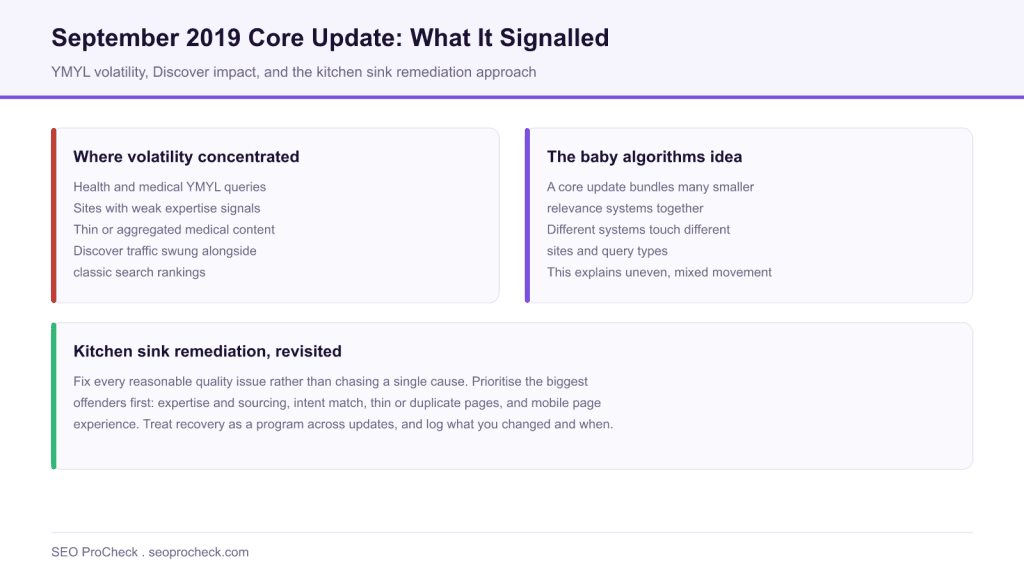
The September 2019 core update produced notable volatility in health and medical queries and moved Discover traffic alongside search rankings, reinforcing the idea that a broad core update bundles many smaller relevance systems, sometimes called baby algorithms. The durable takeaway is the kitchen sink approach: fix every reasonable quality issue, prioritised by impact, rather than chasing a single cause.
- Volatility concentrated in health and medical queries, which fall under your money or your life topics.
- Discover impressions moved in step with search rankings for some sites.
- The baby algorithms idea describes how one core update bundles many systems.
- Kitchen sink remediation means broad quality fixes prioritised by impact.

This SEO case study documents a successful optimization initiative, providing actionable insights for practitioners. The documented approach demonstrates how strategic SEO implementation drives measurable results.
Initial Situation
Understanding the starting point is essential context for evaluating any case study. This documentation covers the initial challenges, competitive position, and business objectives that shaped the SEO strategy.
Strategy and Approach
The strategic approach combined multiple SEO disciplines to address identified opportunities. Key decisions around prioritization and resource allocation provide a template for similar initiatives.
Implementation
Moving from strategy to execution required specific technical implementations, content development, and process changes. This case study documents the practical steps that translated strategy into action.
Results and Learnings
The outcomes demonstrate effectiveness through measurable improvements in rankings, traffic, and business metrics. Analysis of successes and challenges provides learning value for practitioners.
Case studies like this contribute to the SEO knowledge base, helping practitioners learn from documented real-world experiences.
Source: https://www.gsqi.com/marketing-blog/september-2019-google-core-algorithm-update/
Practitioner notes on the September 2019 update
Two things made this update instructive. First, the volatility clustered around health and medical queries, the kind of your money or your life topics where Google sets a high bar for expertise and trust. Sites with weak sourcing or thin, aggregated medical content tended to move the most, which is a recurring pattern across core updates rather than a one time event. Second, Discover traffic moved alongside classic search rankings for some sites, a reminder that the same underlying quality assessment feeds more than the ten blue links.
This update is also where the baby algorithms framing is useful. A broad core update is not a single dial. It bundles many smaller relevance systems, and different systems touch different sites and query types. That is why the movement looks uneven: two sites in the same niche can see opposite results because different bundled systems affected them. Understanding this stops you from looking for one magic fix, because there rarely is one.
The kitchen sink approach follows directly. Rather than betting everything on a single suspected cause, you fix every reasonable quality issue and let the aggregate improvement carry you. The discipline is in the prioritisation: start with the biggest offenders, which for YMYL sites usually means expertise and sourcing, then intent match, then thin or duplicate pages, then mobile page experience. Fix the site, not one URL, and keep a dated record of what you changed so the next update tells you whether it worked.
What has changed since September 2019
The expertise framework expanded from E-A-T to E-E-A-T in late 2022, adding Experience to reflect first hand knowledge, which matters most in exactly the health and product areas this update stressed. The separate helpful content system was later folded into the core ranking systems with the March 2024 core update, so quality signals that once sat outside a core update now live inside it. The playbook from 2019 still applies, only the systems it describes have been consolidated. For recent, dated updates to compare against, see the December 2025 core update and the March 2026 core update, and the historical Panda system shows how content quality first became a core ranking concern. A wider set of write ups sits under the 2026 core update coverage.
Kitchen sink remediation priorities
| Priority | Focus area | Why it matters for YMYL |
|---|---|---|
| 1 | Expertise and sourcing | Health claims need credible authorship and citations |
| 2 | Intent match | Each page must answer the query it targets |
| 3 | Thin and duplicate pages | Aggregated or shallow content drags quality down |
| 4 | Mobile page experience | Slow or unstable pages weaken user facing quality |
| 5 | Change logging | Attribution is only possible if you record changes and dates |
Work the list in order and resist the urge to stop after one fix. The whole point of the kitchen sink approach is that recovery comes from the sum of many improvements, revalued by Google's core updates, including the smaller ones it ships between major updates.
Frequently asked questions
Why did health and medical sites move the most in September 2019?
Health and medical queries are your money or your life topics, where Google applies a high bar for expertise and trust. Sites with weak sourcing or thin, aggregated content are more exposed when a core update reassesses quality on those topics.
What does the baby algorithms idea mean?
It describes how a single broad core update bundles many smaller relevance systems. Because different systems affect different sites and queries, the movement looks uneven, which is why two similar sites can see opposite results.
What is the kitchen sink approach to recovery?
It means fixing every reasonable quality issue rather than betting on a single suspected cause. You prioritise the biggest offenders first and let the aggregate improvement drive recovery over subsequent updates.
Did this update affect Google Discover?
For some sites Discover impressions moved alongside classic search rankings, which shows the same underlying quality assessment feeds Discover as well as search. Improving site quality therefore tends to help both surfaces.
How has the expertise framework changed since 2019?
It expanded from E-A-T to E-E-A-T in late 2022, adding Experience to reward first hand knowledge. That extra dimension is especially relevant to the health and product topics this update stressed.
How do I prioritise remediation across a large site?
Start with expertise and sourcing, then intent match, then thin or duplicate pages, then mobile page experience, and log every change with its date. Working by impact and recording changes lets you attribute recovery whenever Google revalues the site, which can happen between major core updates.
Take this with you
The assistant links open with a question about this page already written. Nothing is sent until you press enter.
Claude Vincent is a technical SEO consultant focused on crawlability, rendering, and AI-search visibility. He writes the field guides and case studies at SEO ProCheck, with a bias toward the durable, unglamorous work that decides whether search engines and AI answer engines can actually read and cite a site.
About SEO ProCheck
Technical SEO consulting and GEO strategy with 20 years of enterprise experience. Case studies, resources, and tools for search and AI visibility.
Work With Me
Technical SEO audits, GEO strategy, site migrations, and international SEO. Hourly consulting for teams who need hands-on support, not just reports.
Subscribe to our newsletter!








Recent Posts
- Most Top Sites Never Say Who They Are in Structured Data October 14, 2026
- Homepage Titles Are Mostly Too Short, Not Too Long October 8, 2026
- Who Actually Serves an llms.txt? 184 Top Sites Measured September 29, 2026