

AI Summary
Google News and Top Stories visibility comes from three layers working at once: a clean technical baseline (NewsArticle schema, a news sitemap holding only the last 48 hours, fast mobile pages), publisher authority earned through a sustained record of original reporting, and speed paired with depth. There is no application to submit: inclusion has been algorithmic since Google retired the manual review.
- A news sitemap should carry only URLs published in the last 48 hours, and no more than 1,000 of them.
- Keep a developing story on one URL: update it and bump
dateModifiedrather than shipping near duplicate follow ups. - Visible on-page timestamps must match the structured data exactly. Mismatches are a routine reason an eligible article never surfaces.
- New publishers break in through one narrow beat, not general news, where established brands hold the carousel.
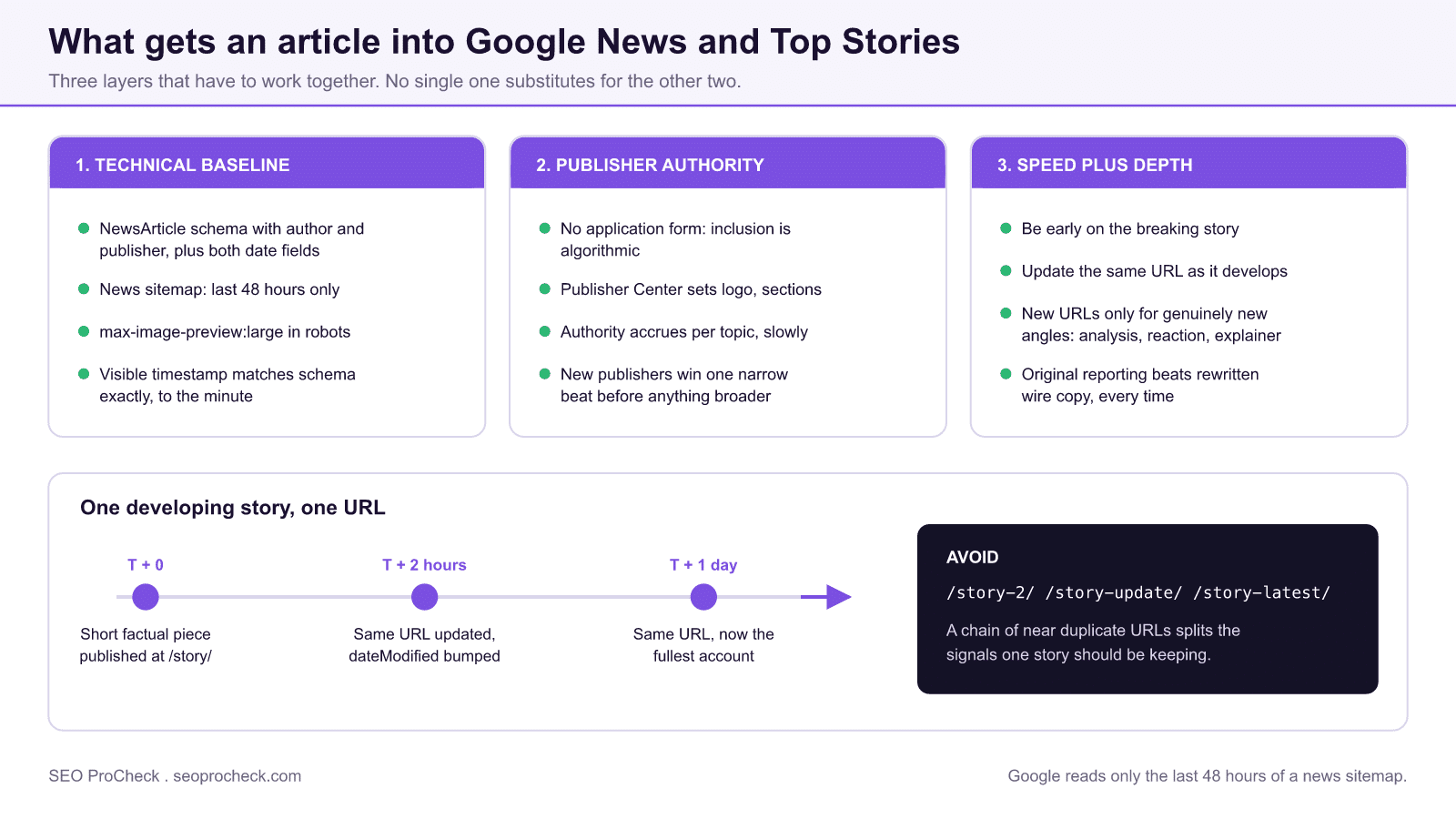
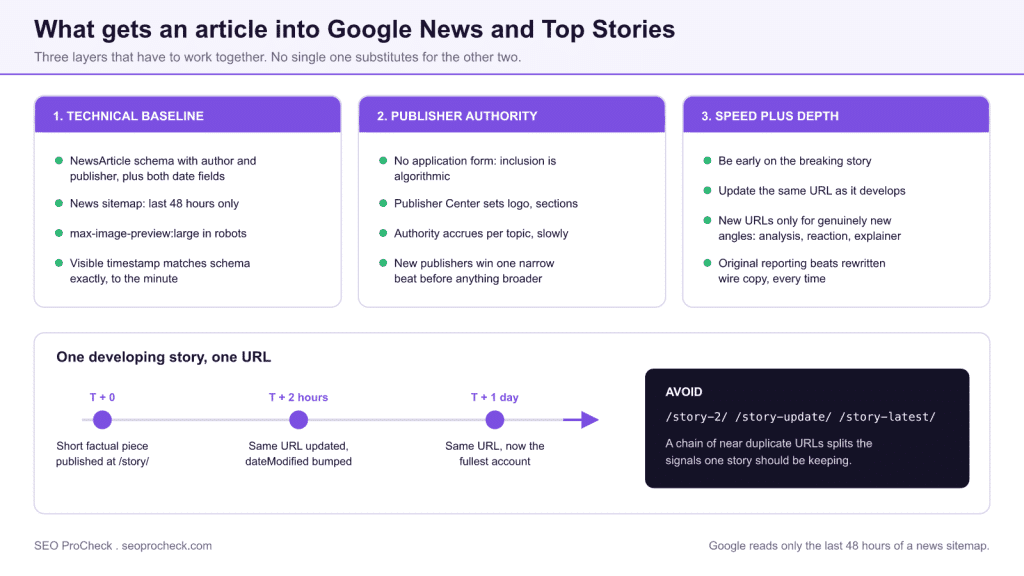
Quick answer: Getting into Google News and Top Stories requires three things working together: a clean technical baseline (valid NewsArticle schema, a news sitemap limited to articles from the last 48 hours, fast mobile pages), demonstrated publisher authority built through a sustained history of original reporting, and speed-plus-depth publishing: being early on breaking stories, then updating the same URL as the story develops. No single lever substitutes for the other two.
Research into news SEO examined the factors determining visibility in Google News, Top Stories carousels, and Discover. The study analyzed ranking patterns across major news publishers and emerging news sites.
Technical Requirements
Sites appearing in Google News consistently met technical baseline requirements: fast page loads, mobile optimization, proper article schema, and clean URL structures with publication dates. News sitemap implementation correlated with faster indexing and better visibility for breaking news.
In practice, the baseline checklist looks like this: NewsArticle structured data with headline, datePublished, dateModified, author (as a Person with its own page), and publisher properties; a dedicated news sitemap using the <news:news> namespace that contains only URLs published in the last 48 hours (Google ignores older entries, and bloated news sitemaps slow discovery); <meta name="robots" content="max-image-preview:large"> so Google can use full-width thumbnails in Top Stories and Discover; and visible timestamps on the page that match the structured data exactly. Mismatched on-page and schema dates are one of the most common reasons a technically eligible article never surfaces.
Publisher Authority
Established news brands dominated Top Stories positions. New publishers faced significant barriers to entry regardless of content quality. Building Google News presence typically required sustained publishing history and demonstrated editorial standards. Authority built over years, not months.
Since Google removed the manual Google News application process, inclusion is algorithmic, but Publisher Center still matters for claiming your publication, setting the logo that appears in news surfaces, and accessing the Google News performance filter in Search Console (Performance > News tab, which only appears once you have news traffic). For a new publisher, the realistic path is a tightly defined beat, the approach set out in more detail in the Top Stories optimization guide: consistent original coverage of one narrow topic gets picked up for that topic's Top Stories long before general-news visibility is achievable.
Freshness and Speed
For breaking news, publishing speed provided significant advantages. First-to-publish articles frequently captured initial Top Stories positions. However, comprehensive follow-up articles often displaced early thin coverage as stories developed. The optimal approach combined speed for breaking news with depth for ongoing coverage.
The working pattern for developing stories: publish a short factual article immediately, then update that same URL, bumping dateModified and the visible "Updated" timestamp, rather than publishing a chain of near-duplicate follow-ups that split ranking signals across URLs. Reserve new URLs for genuinely new angles (analysis, reaction, explainer), and interlink them to the developing story hub.
Content Differentiation
Original reporting, exclusive information, and unique perspectives improved news rankings compared to aggregated or rewritten content. Google's algorithms increasingly distinguished between original journalism and derivative coverage. Publishers adding unique value consistently outperformed those republishing wire content.
Where syndicated or wire content is unavoidable, canonicalize to the original source or keep it out of the news sitemap entirely; a site whose news sitemap is dominated by rewritten wire copy trains Google to treat the whole publication as derivative.
The news sitemap, exactly
The single most common technical gap is a news sitemap that is really just a second XML sitemap. Google reads only articles published in the last 48 hours from this file and recommends keeping it under 1,000 URLs, so it has to be generated dynamically and pruned automatically. The required shape is small:
<urlset xmlns="http://www.sitemaps.org/schemas/sitemap/0.9"
        xmlns:news="http://www.google.com/schemas/sitemap-news/0.9">
  <url>
    <loc>https://example.com/2026/07/story-slug/</loc>
    <news:news>
      <news:publication>
        <news:name>Example Times</news:name>
        <news:language>en</news:language>
      </news:publication>
      <news:publication_date>2026-07-19T08:14:00+00:00</news:publication_date>
      <news:title>Headline exactly as it appears on the page</news:title>
    </news:news>
  </url>
</urlset>
Three details decide whether it works. news:name has to match the publication name registered in Publisher Center, not your legal entity or your site title. news:publication_date needs a full timestamp with a timezone offset, because a date-only value costs you the ordering precision that matters when a story is minutes old. And news:title must match the headline on the page: a sitemap headline that has drifted from the rendered <h1> is a mismatch signal you never see reported anywhere.
Keep this file separate from your standard XML sitemap, which stays the long-term archive. Submit both in Search Console and expect the news sitemap to report a small, constantly changing URL count. A news sitemap whose URL count only ever grows is not being pruned, and everything past the 48 hour window in it is dead weight.
Diagnosing a story that never surfaced
When an article should have been eligible and was not picked up, the failure is almost always one of six things. Work the table in order rather than guessing, because several of these are invisible unless you go looking:
| Symptom | Most likely cause | Where to verify it |
|---|---|---|
| No news impressions at all, ever | The publication is not being treated as news yet, or the content is not news shaped | Search Console, Performance, search type News. The tab only appears once you have news impressions, so its absence is itself the finding |
| Indexed normally, never in Top Stories | Topic-level authority too low, or you published after the carousel had already settled | Compare your publish timestamp against the articles currently in the live carousel for that query |
| Missing from the Google News surface specifically | The URL never entered the news sitemap, or it entered after the 48 hour window closed | Fetch the news sitemap directly and search for the URL; check the Sitemaps report for read errors |
| No thumbnail in Top Stories or Discover | max-image-preview:large missing, or the lead image is below the size Google will use | View source for the robots meta tag; check the rendered image width, aiming well above 1200px |
| Wrong or missing date in the result | Visible timestamp and dateModified disagree, or the date sits only in schema | Rich Results Test on the live URL, then compare against the timestamp a reader actually sees |
| The wire version outranks your own | Your copy is derivative of the syndicated original, or the canonical points away | Check the canonical on your version and on every syndication partner republishing it |
Two of these deserve emphasis because they are cheap to fix and quietly expensive to leave. The timestamp mismatch is usually a caching artefact: the page is served from a cache with a stale rendered date while the schema updates live. And the thumbnail failure is often a theme that outputs a cropped social image rather than the full-size lead asset, which is the same discipline that governs Google Discover visibility.
News Ranking Surfaces at a Glance
| Surface | What Google primarily uses | Main optimization lever |
|---|---|---|
| Top Stories carousel | Freshness, NewsArticle schema, publisher authority on the story's topic, page experience | Publish fast, update the same URL, keep schema and visible timestamps in sync |
| Google News (news.google.com / app) | Algorithmic inclusion, publication-level signals, section structure, news sitemap | Claim the publication in Publisher Center; keep the news sitemap fresh (last 48h only) |
| News tab in web search | Standard ranking signals plus news eligibility; less carousel-dependent | Original headlines with the key entity early; clean crawlable article pages |
| Google Discover | Interest-based matching, image quality, entity clarity, E-E-A-T | max-image-preview:large, 1200px+ images, clear authorship and topical focus |
| "Full Coverage" clusters | Story clustering across publishers; original reporting flagged within the cluster | Add facts no one else has: originality is what earns a distinct slot in the cluster |
Frequently Asked Questions
Do I need to apply to Google News to appear in it?
No. Google removed the manual review process; inclusion in Google News and Top Stories is now algorithmic. Publisher Center is still worth setting up to claim your publication, control branding, and organize sections, but it is not an approval gate.
Why is my article eligible but never showing in Top Stories?
The usual culprits, in order: publication-level authority on that topic is too low, the article was published too late in the story cycle, on-page timestamps disagree with structured data, or the page fails mobile page-experience thresholds. Check Search Console's Performance report with the "News" search type filter to see whether you are getting any news impressions at all.
How fresh does a news sitemap need to be?
Google only reads articles published in the last 48 hours from a news sitemap, and recommends keeping it to no more than 1,000 URLs. Generate it dynamically, drop older entries automatically, and keep your regular XML sitemap as the long-term archive.
Should I publish updates as new articles or update the original?
Update the original URL for factual developments in the same story, with a visible "Updated" timestamp and refreshed dateModified. Publish new URLs only for distinct angles (analysis, reaction, background explainers) and link them together so the cluster reinforces itself.
Can a small or new site rank in Top Stories at all?
Yes, but almost always within a narrow beat first. Consistent original coverage of a specific niche builds topic-level authority faster than spreading a small newsroom across general news, where established brands dominate.
Does Discover work the same way as Top Stories?
No. Discover is interest-based rather than query-based: it rewards strong imagery (allow large previews via max-image-preview:large), clear entities in headlines, and publication-level trust. Discover traffic is also far more volatile: treat it as a bonus channel, not a plan.
Source: Multiple news SEO studies compiled
Claude Vincent is a technical SEO consultant focused on crawlability, rendering, and AI-search visibility. He writes the field guides and case studies at SEO ProCheck, with a bias toward the durable, unglamorous work that decides whether search engines and AI answer engines can actually read and cite a site.
About SEO ProCheck
Technical SEO consulting and GEO strategy with 20 years of enterprise experience. Case studies, resources, and tools for search and AI visibility.
Work With Me
Technical SEO audits, GEO strategy, site migrations, and international SEO. Hourly consulting for teams who need hands-on support, not just reports.
Subscribe to our newsletter!







Recent Posts
- Can AI Crawlers Actually Read Your Site? I Measured 400 of the Biggest September 5, 2026
- The Pre-Publish Quality Gate for AI-Assisted Content August 6, 2026
- AGENTS.md vs llms.txt vs llms-full.txt: Which Agent File Does What July 18, 2026