

AI Summary
Search intent is the goal behind a query, and matching it is the price of entry for ranking. The fastest way to read intent is to study the pages Google already ranks, because the live SERP is Google's own verdict on what searchers want.
- The four classic intent types are informational, navigational, commercial investigation and transactional.
- Content that fights the dominant SERP format rarely ranks, no matter how good it is.
- Some queries carry mixed intent, and intent can shift with seasons or news events.
- Diagnose intent by looking at result types, formats and SERP features before you write.
Research into search intent examined how well intent alignment correlates with ranking success. The study analyzed SERP patterns across different intent categories to identify optimization implications.
Intent Classification
The study categorized queries into informational, navigational, commercial, and transactional intents. SERPs showed strong consistency within intent categories. Content type mismatches with query intent showed poor rankings regardless of other optimization factors.
SERP as Intent Signal
Analyzing existing SERPs revealed Google's intent interpretation. Content formats dominating current rankings indicated required content types. Attempting to rank different content formats than SERP norms rarely succeeded.
Intent Shift and Mixed Intent
Some queries showed mixed intent with diverse content types ranking. Intent could shift based on news events or seasonal factors. Monitoring SERPs over time revealed intent stability or volatility for target queries.
Content Strategy Alignment
Successful content matched both the information need and expected format for the intent. Transaction-intent queries required product pages, not blog posts. Information-intent queries required comprehensive content, not sales pages. Proper intent alignment was foundational to ranking potential.
The four intent types and what each demands
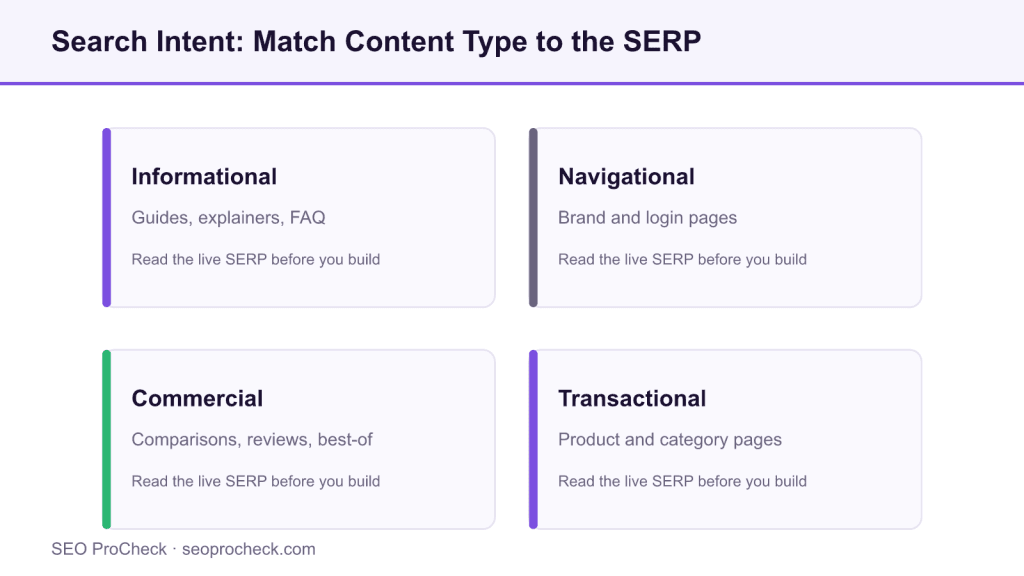
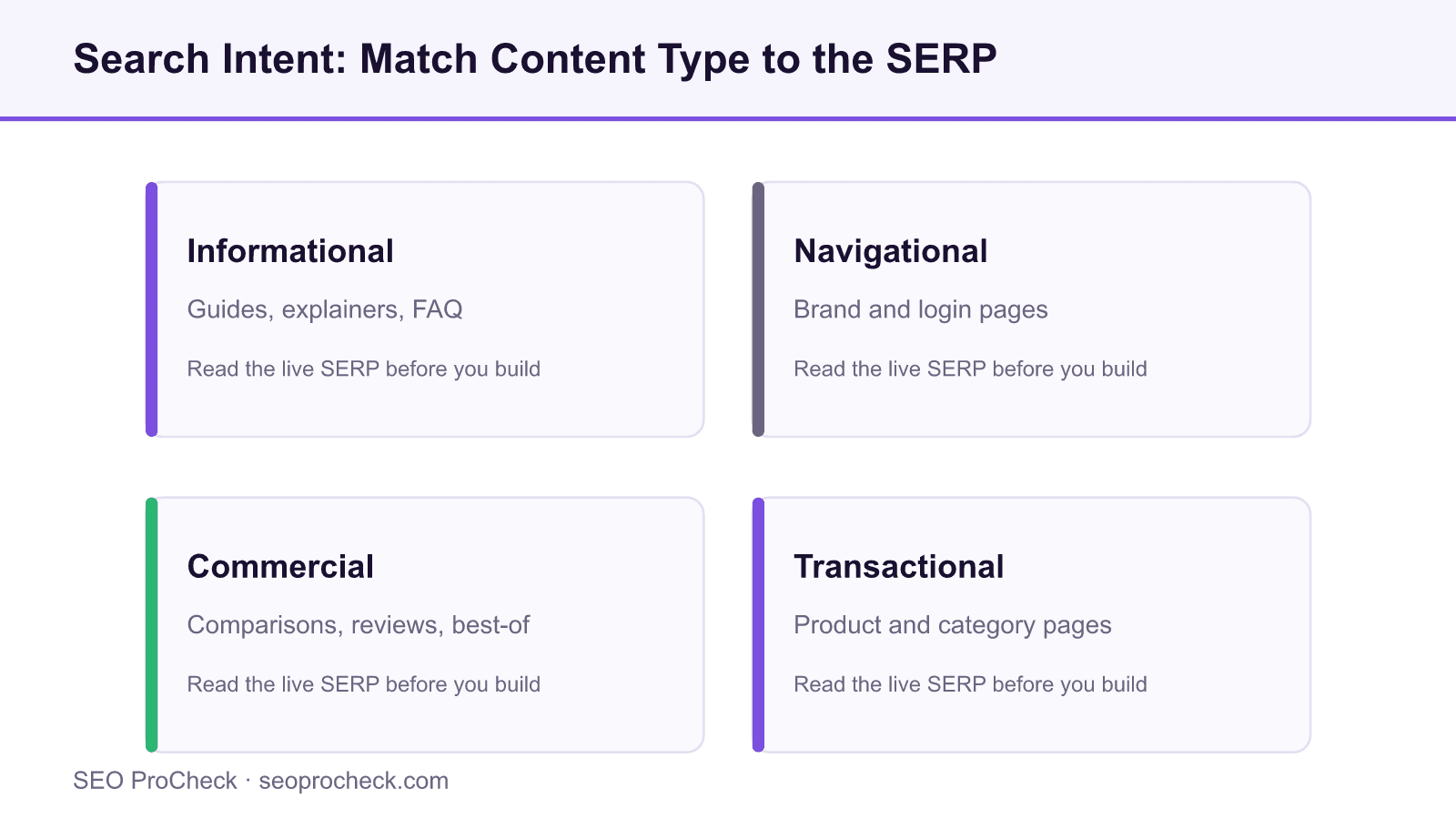
Every query sits on a spectrum from learning to buying. Informational queries want to understand something and reward guides, explainers and FAQ content. Navigational queries want a specific site or page and reward the official destination. Commercial investigation queries are comparing options and reward reviews, comparisons and best of lists. Transactional queries are ready to act and reward product, category and signup pages. The diagram above pairs each type with the format that tends to win, and our search intent types guide breaks down the query cues for each.
| Intent | Query cues | Winning format | Example query |
|---|---|---|---|
| Informational | how, what, why, guide, ideas | In depth article, explainer, FAQ | how does crawl budget work |
| Navigational | brand name, login, official | Brand home or landing page | search console login |
| Commercial | best, top, review, vs, compare | Comparison, review, best of list | best rank tracking tools |
| Transactional | buy, price, coupon, near me | Product or category page | buy standing desk |
Read the SERP as ground truth
You do not have to guess intent, because Google publishes its interpretation every time it ranks results. Search your target query and catalog what appears. Are the top ten results articles or product pages? Is there a shopping carousel, a video pack, a People Also Ask block, or an AI overview? Those SERP features are strong intent signals. If nine of the ten results are listicles and you publish a single product page, you are proposing a format Google has already decided searchers do not want for that query. Our search intent guide lays out a repeatable SERP audit you can run in a few minutes.
Diagnosing an intent mismatch
Intent mismatch is one of the most common reasons strong content underperforms. The tell is a page that attracts impressions but almost no clicks, or that ranks on page two and never climbs despite links and good technical health. Before rewriting, compare your page type against the ranking set. If the SERP wants a comparison and you published a how to, the fix is not more words, it is a different page built for the right job. The optimizing for search intent walkthrough shows how to restructure without starting over.
Mixed intent, intent shift and what has changed
Not every query is clean. Broad head terms often show mixed intent, where Google hedges by ranking a blend of guides, tools and product pages. For those, the safest play is to satisfy the dominant format while covering secondary needs on the same page. Intent also drifts: a query can lean informational most of the year and turn transactional in a buying season, or flip overnight on a news event. What has changed most recently is the rise of AI overviews and richer SERP features on informational queries, which push standalone content to add clear, extractable answers near the top. Monitoring the SERP over time, not just once, is how you catch these shifts before your rankings do.
Frequently Asked Questions
What are the four types of search intent?
Informational, navigational, commercial investigation and transactional. Informational wants to learn, navigational wants a specific site, commercial is comparing options, and transactional is ready to act.
How do I find the search intent of a keyword?
Search the keyword and study the top results. The page types that rank, plus SERP features like shopping carousels, video packs or People Also Ask, reveal the intent Google has assigned to that query.
Why does my content rank low despite being high quality?
A common cause is intent mismatch. If your page format does not match what the SERP rewards, for example a product page where Google ranks guides, quality alone will not lift it. Match the format first.
Can one keyword have more than one intent?
Yes. Broad queries often show mixed intent, where Google ranks a blend of formats. Target the dominant format and address secondary needs on the same page.
Does search intent change over time?
It can. Intent shifts with seasonality, news events and product cycles, and SERP features evolve. Recheck the live results periodically rather than assuming intent is fixed.
How does intent affect AI overviews?
Informational queries increasingly trigger AI overviews, so content should include clear, self contained answers near the top that are easy for an answer engine to extract and attribute.
Source: Search intent research compiled
Take this with you
The assistant links open with a question about this page already written. Nothing is sent until you press enter.
Claude Vincent is a technical SEO consultant focused on crawlability, rendering, and AI-search visibility. He writes the field guides and case studies at SEO ProCheck, with a bias toward the durable, unglamorous work that decides whether search engines and AI answer engines can actually read and cite a site.
About SEO ProCheck
Technical SEO consulting and GEO strategy with 20 years of enterprise experience. Case studies, resources, and tools for search and AI visibility.
Work With Me
Technical SEO audits, GEO strategy, site migrations, and international SEO. Hourly consulting for teams who need hands-on support, not just reports.
Subscribe to our newsletter!








Recent Posts
- Most Top Sites Never Say Who They Are in Structured Data October 14, 2026
- Homepage Titles Are Mostly Too Short, Not Too Long October 8, 2026
- Who Actually Serves an llms.txt? 184 Top Sites Measured September 29, 2026